
During the February bank holiday weekend, my children and I spent time rockpooling. The beauty of the shore is that there is never a bad time of year to visit. Granted, the water was icy cold, but only our hands felt the chill as we turned over and replaced stones and explored the rocky coastline in wellies and warm coats. All sorts of creatures were discovered, but, as a group, starfish are certainly one of our favourites. On our explorations, we spotted several different species. What starfish can be found along the West Cork coast? And are they all much the same? These questions prompted me to take a closer look.
Keeping things simple
ADVERTISEMENT
Echinoderms are sea animals that include starfish, brittlestars, sea urchins, sea cucumbers, and feather stars. Echinoderm means spiny skin and refers to the spines or bumps covering the outer surface of many of their bodies. True starfish belong to the Asteroidea class, a subdivision of echinoderms. This fits, as aster is Greek for star, and starfish are sometimes called asteroids. For ease, we tend to group star-shaped marine creatures with ‘star’ in their name as starfish. This usually includes not only true starfish, but also brittlestars and feather stars, which are different classes of echinoderm. Of course, none of them are actually fish. Fish are vertebrates, with a spine, while starfish are invertebrates, with none. Some have tried to move towards calling them sea stars, but we seem far too attached to their traditional collective name. All echinoderms have five-point radial symmetry. Many have five arms, but multiples of up to 200 are possible, especially in some feather stars
Scientific research
Starfish, brittlestars, and feather stars are all capable of autotomy, an adaptation that helps them survive attacks from predators. When disturbed or stressed, they may shed one or more legs, which later regrow. Starfish are often seen with three or four full sized legs and one or two smaller ones in the process of regeneration. Fish and other creatures often nip off pieces of the arms of brittlestars, a method known as sublethal predation, so that brittlestars are constantly regenerating a food source. Scientists continue to study the biological mechanisms behind this phenomenon. It is easy to think most discoveries have already been made, yet it was only in 2024 that the first neuropeptide was identified as a regulator of autotomy in starfish.
Ancient animals
True starfish are ancient creatures. Like all echinoderms, they began developing over 500 million years ago. They do not have blood and instead use filtered seawater to move nutrients around their bodies. Hundreds of tiny tube feet on the underside of their arms are used for movement and grip. Starfish eat by pushing their stomach out through their centrally located mouths, covering their prey, and digesting it externally before drawing the meal back in. They are carnivorous scavengers and predators, able to prise open shellfish with their tube feet. Despite lacking eyes that are obvious to us, starfish have basic vision that enables them to determine shapes and light from dark. They have simple compound eyes, known as ocelli, at the end of each arm.
Fabulous feather stars
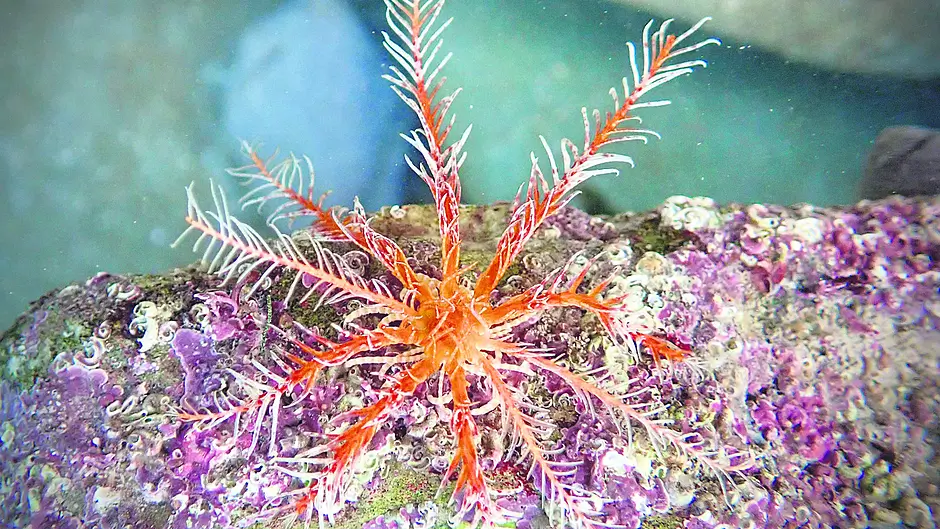
The highlight of our outing was spotting what looked like a small piece of walking seaweed, a feathery armed creature about six centimetres in diameter, moving across a rock on strange legs. This was the rosy feather star (Antedon bifida), not a true starfish but a fellow echinoderm. This delicate looking yet robust animal clings to rocks or seaweed with claw-like legs called cirri and waves five pairs of feathered arms in the water to catch food, drawing it down to their mouth on the upper surface at the base of their arms. This species is not rare, but it is an uncommon sight for rockpoolers, as it is most prevalent from the low water mark down to 450 metres. It was, therefore, an exciting sight for us.
Locals finds
Other species we have spotted include two types of cushion star. These are the cutest of all, looking like tiny five-point cushions, yet only reaching a maximum diameter of about five centimetres. We have also seen the common starfish and the larger spiny starfish. The spiny starfish is the one we find most often. It is impressive, reaching up to 70 centimetres in diameter. They are voracious predators that love mussels, making them unwelcome visitors to mussel farms. There are also several species of brittlestars along the West Cork coast. The one we see most often being the common brittlestar (Ophiothrix fragilis), a delicate, variably coloured animal with a rounded disc shaped body and five long, thin, flexible arms. Living up to their scientific name, they very easily shed their arms if handled, so we know to let them be.
Still more to see
Despite our many finds, there are still plenty of species along the coast that we have yet to spot. On our wish list are the aptly named, often bright red, bloody henry starfish and the seven-armed starfish. The seven-armed starfish is a super-predator and likes to eat other starfish, brittlestars, and urchins, which will appeal to my sons. Whether you are new to the seashore, or an experienced rockpooler, there is always something novel to see, and there is no time like the present to head out in search of those rockpool stars.
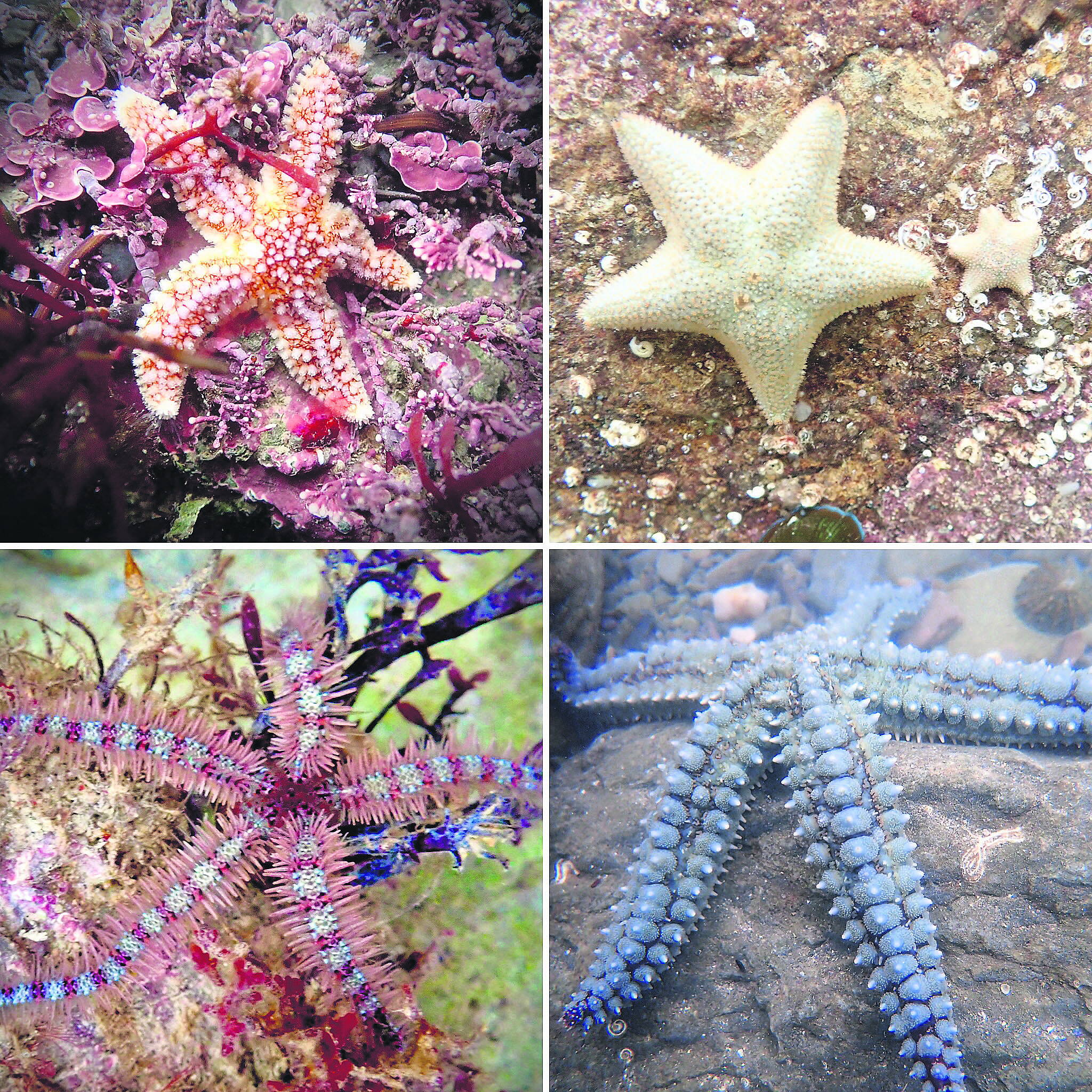 From top left clockwise- A common starfish, two cushion stars, a spiny starfish, and a common brittlestar, all seen while in rockpooling in West Cork.