
Last month, the International Union for Conservation of Nature (IUCN) officially confirmed that the slender-billed curlew is extinct. Although this was already unofficially accepted, the final declaration lands with a jolt. A species that once thrived no longer exists on Earth.
This was a different species to the curlew we have here in Ireland. Ours is the Eurasian curlew. The slender-billed curlew’s migratory range once spanned mainland Europe, North Africa and West Asia. The last credible sighting of a slender-billed curlew was in Morocco in 1995. The loss of this species, the only known global extinction of a bird with a range across several continents, was sadly driven by human activity. Draining the birds’ raised bog breeding grounds for agriculture, reclaiming coastal wetlands used for winter feeding, and even hunting pushed the slender-billed curlew to the brink and beyond. Much closer to home, it’s a call to action to focus on our native breeding curlew before it’s too late.
ADVERTISEMENT
Largest wading bird
The curlew species we see on our local wetlands has the Latin name Numenius arquata and is known as an crotach in Irish. It is the largest wading bird in Ireland, measuring 50–60 centimetres in length with a wingspan of 80–100 centimetres. Females are larger than males and can weigh up to one kilogram. Due to their size, they were once hunted for meat. They were only removed from the list of wild game bird species that could be hunted during the open season as recently as 2012. Thankfully, as they are now a critically endangered, protected red-listed species and breeding populations are alarmingly low.
Specialised bill
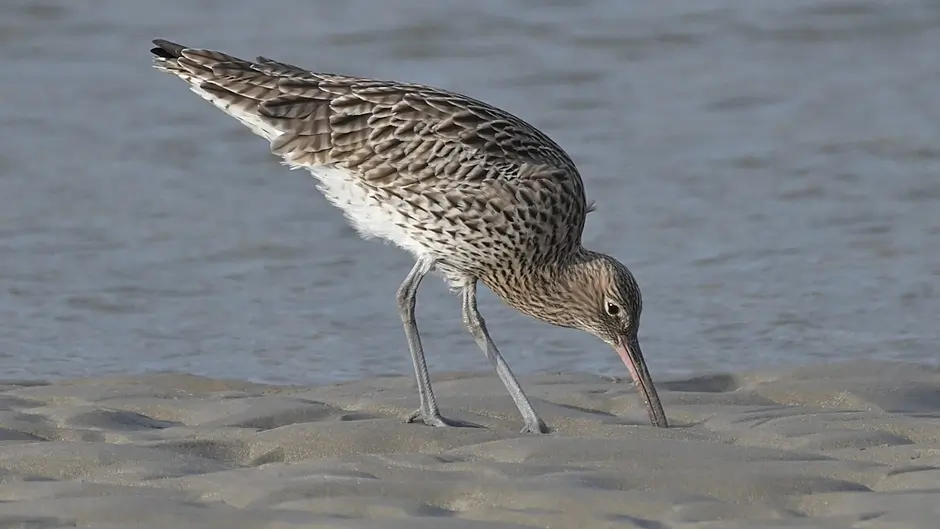
Curlew are elegant, mottled-brown birds with long necks and legs, readily identified by their distinctive long, down-curved bill. The only similar species is the smaller whimbrel, which has a shorter, less curved bill and a prominent dark eye stripe.
The unique bill of the curlew is the perfect instrument for probing mud in search of worms, molluscs and crustaceans. Curlew don’t rely on sight; their bill is adapted for probing through mud. The tip can flex upwards independently of the rest of the bill, allowing them to grasp prey even deep down in tightly packed mud or sand.
Coupled with this, they have masses of highly sensitive nerve bundles on the tips of their bills. When their bill is plunged into mud or wet sand, pressure waves bounce back from solid prey. As curlew move forwards, probing the mud, they can sense these pressure waves, and prey movement, to locate prey. It’s much like the way bats echolocate with sound, but using pressure instead. A curious quirk is that not only are female curlew larger than males, they also have a longer bill, about 2.5 centimetres longer and with a more pronounced curve. It’s presumed this reduces feeding competition between sexes, as they can forage in slightly different areas.
Haunting calls
Besides their long bill, another distinctive feature of the curlew is their evocative, bubbling song; a series of flute-like whistles and warbling notes that is emblematic of the tidal mudflats here in West Cork. Their song rises, haunting and utterly wonderful. Curlew also have a shorter call, which gives rise to their common name, with the phonetic description of this call being ‘coor-li’.
The thought that one day, not too far in the future, we might no longer hear this song, as has happened elsewhere with the slender-billed curlew, is alarming indeed.
Precious numbers
Ireland and the UK are home to around a quarter of the global Eurasian curlew population, yet their numbers have been plummeting. The Irish breeding range for curlew has contracted dramatically and is now restricted to a handful of sites in the middle and north of the country. Curlew breed on upland and lowland bogs, rough pasture, meadows and other areas of semi-natural vegetation.
Data from 2021 revealed that only 105 breeding pairs remained, representing a horrifying 98% loss in curlew populations in just thirty years.
During winter, curlew from more northerly regions such as Scandinavia and Scotland migrate to our wetlands and estuaries, somewhat disguising the low numbers of our breeding curlew. Even with these visitors, research shows that the number of curlew wintering in Ireland has decreased by 43% over the past 23 years.
Conservation efforts
Fortunately, co-ordinated national conservation efforts have been underway since 2016 to address the decline in breeding curlew. A Curlew Task Force was established, later superseded by the Breeding Waders EIP (European Innovation Partnership). This project supports the conservation of breeding waders, particularly curlew, through habitat restoration, predator control and work with landowners.
Headstarting is a new measure to attempt to reverse the curlew’s decline and involves captive hatching and rearing of curlew chicks until they are past their most vulnerable age. In 2024, the Breeding Waders EIP, in partnership with Fota Wildlife Park and the Hen Harrier Programme, successfully released 27 headstarted curlew fledglings into the wild. The 2025 headstarting programme began on World Curlew Day, April 21st, with teams collecting eggs from the wild. You can follow the progress of some of the released birds, seven of the 15 released this year were fitted with GPS tags. It is fascinating to watch their movements via this website breedingwaders.ie/headstarting-curlew.
Local action
You may have read recently about the purchase by the State of the 98.5-acre habitat at White’s Marsh, located within the Clonakilty Bay Special Area of Conservation, with the aim of conserving and enhancing it. The area includes grassland and a lagoon, providing vital habitat for migratory wintering birds such as the curlew.
Hopefully, with national and local efforts combined, support can be given to both Irish breeding and migratory curlew to help this charismatic species avoid a fate similar to that of the slender-billed curlew.