
Previous Christmas wildlife-themed articles I have written have explored the many gifts that nature gives us. This year I am taking a different approach and looking instead at the gifts wild animals give to each other. Do only humans give gifts to show how much they value one another? The answer is ‘no’. In the animal kingdom, gift-giving usually supports the evolution and fitness of a species and contributes to its survival. Some might argue this is not hugely different to the human experience!
Dolphin deliveries
ADVERTISEMENT
Much of what we know about gifting in dolphins comes from Australia, where calm, clear seas may provide preferable conditions for research. Off Australia’s west coast, a ten-year study of humpback dolphins showed males diving to collect sea sponges and presenting them to females as a display of their potential as mates. Sponges are not typical food, which makes this behaviour even more striking. Dolphins were seen carrying the sponges on their heads and beaks and tossing them towards females, the dolphin equivalent of a bunch of flowers.
Scientists studying a different population of bottlenose dolphins in Australia were surprised when the animals began bringing them fish, octopus, and squid they had caught; highly valued food items not given lightly.
Along our own coast and in the Shannon Estuary, pods of bottlenose dolphins are well known for their social behaviour, and like their international counterparts they may also engage in playful passing of objects to each other. Confirming this is challenging, as the water is often too cloudy for observation.
Gifting gannets
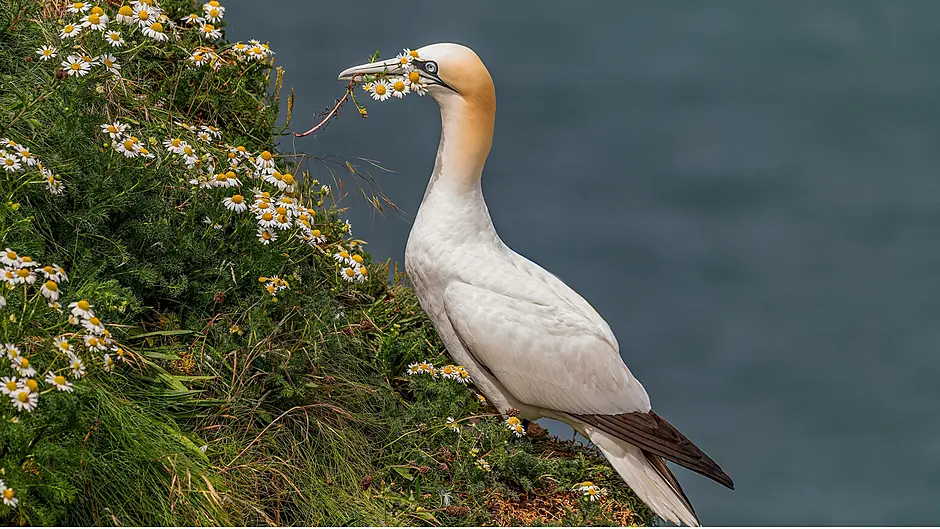
Gannets are elegant seabirds best known for their spectacular diving and elaborate courtship behaviour. Monogamous pairs mate for life and share a strong bond. When reunited, they perform a special greeting ritual: standing breast-to-breast, spreading their wings and entwining their necks while calling loudly. The male shakes and bows his head and the female offers her neck for him to nibble. Males also bring gifts of seaweed, vegetation, or flotsam, which are incorporated into the nest. On dry land at the start of the nesting season, male wrens invest considerable effort in building multiple nests, often five or six, to present to a female. She inspects each and once she chooses, lines the nest and breeding can begin.
Generous crows
Corvids, collectively known as crows and including magpies, rooks, ravens, jays, and hooded crows, are renowned for their intelligence and enthusiasm for gift-giving, often used to attract females. Male magpies offer shiny objects or food to potential mates, and hooded crows give nest materials, such as sticks and moss, at the beginning of the nesting season.
These birds also show generosity within their social groups. They share food, trade sticks, stones, and feathers during play, and even pass on information about good feeding areas when resources are plentiful. Male Eurasian Jays can work out what food their partner prefers and share it with her, suggesting an understanding of what the other is thinking or feeling.
If you find yourself watching Happy Feet over Christmas, you can think of how Adélie and Gentoo penguins offer pebbles to females as part of their courtship. In the Antarctic, suitable nesting materials are limited, and a good pebble is a valuable resource. Males present them to encourage a female to start a family. You could try gifting a pebble to your partner this Christmas and see how it goes!
Sign the pre-nup
Gift giving is also widespread among invertebrates. Items provided by a male to a female before mating are known as nuptial gifts. Their purpose is to impress, to demonstrate hunting ability and good genes, and to offer calories the female can use to produce her eggs.
Spiders are particularly interesting. The male nursery web spider, widespread across Ireland, presents the female with a neatly wrapped parcel of prey bound in spun silk. Males, however, are not always honest. Some wrap poor quality prey or even the remains of something they have already eaten. While the female is occupied with unwrapping what she assumes is a generous gift, the male grasps the moment to mate and then makes a swift exit before she discovers the ruse. Research has shown that nearly seventy per cent of the gifts produced by male Nursery Web spiders are in fact deceptive. You might dare to try that on Christmas morning, although it is unlikely to end well.
Not wild about it
Beyond the Australian dolphins that offered food to humans, examples of gifting between species are far less common than those within species. One familiar case is the unsavoury gifts brought home by pet cats. There are several theories about why cats bring dead animals home. Cats are natural predators, with the urge to hunt stronger in some than in others. Bringing prey home may reflect a preference for eating in a safe place or a desire to share their catch. Another explanation is the instinct to play, as they may be presenting a toy to play with you.
Unfortunately, studies increasingly warn about the impact of free roaming pet cats on already threatened wildlife. Keeping cats indoors, if they are comfortable inside, especially at dawn and dusk when vulnerable prey such as amphibians are active, can help reduce this impact. Encouraging play with toys, rather than prey, and considering anti-predation collars and other innovations can also make a difference.
Happy Christmas
In animals, the term used for behaviour that benefits others without offering an immediate gain for the giver is prosocial behaviour. While giving your gifts on Christmas morning, you might pause to remember that this trait is not unique to humans. Wishing you all a very Happy Christmas!