
Growing up in West Cork in the eighties and nineties, the cuckoo (Cuculus canorus) was a prominent feature of the early summer soundscape. Their distinctive call heralded sunburnt shoulders and the school holidays just around the corner. Those were the days. Sadly, that soundscape is now very different for my own two sons, although they do use more sunscreen. When we are out in nature, it is now a genuine moment of excitement and surprise to hear a cuckoo, and the depressing truth is that we rarely do.
This lovely bird is now very seldom heard in our part of West Cork, and the boys haven’t heard them calling at all this year. Fortunately, there are still areas in the region where that charismatic sound echoes, particularly further west and around Glengarriff, where I was fortunate to hear one last week. Even so, the cuckoo’s decline in Ireland, and their absence from places where they were once common, is deeply poignant.
ADVERTISEMENT
Classic calls
The cuckoo migrates to Ireland each year from Africa, where they spend the winter. As the old rhyme goes, ‘The cuckoo comes in April, sings his song in May, in the middle of June he changes his tune, and in July he flies away.’
Cuckoos are medium-sized birds, roughly the size of a collared dove, with a grey back, head, and chest, and a barred black and white underside. It is far more common to hear one than to see one. If you catch their onomatopoeic ‘coo-koo’ call, you can be sure the caller is male, as only males produce this instantly recognisable sound. Females have a bubbling call, sometimes described as bathwater gurgling down a plughole, which is markedly different.
Brood parasites
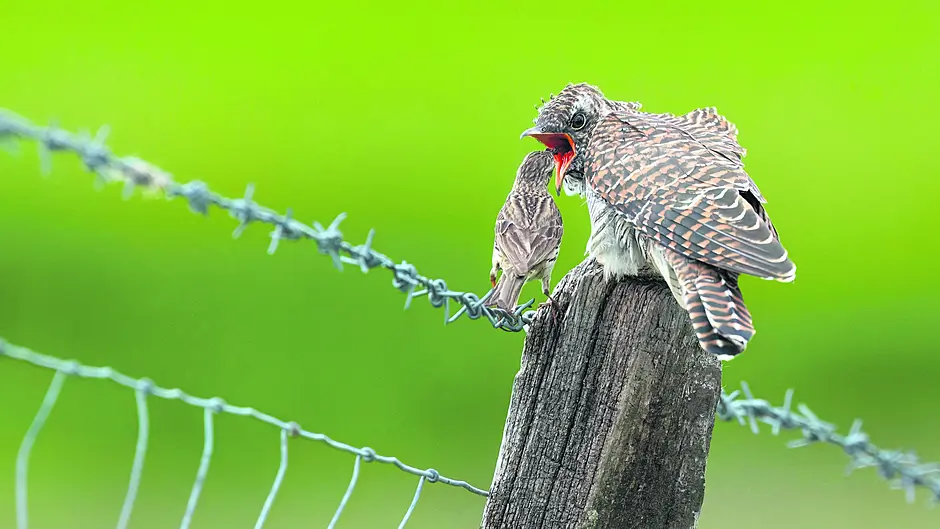
Cuckoos are, of course, best known for not building their own nests. Instead, they lay their eggs in the nests of other unsuspecting birds, which then incubate and raise the chick as their own. This behaviour is known as brood parasitism. In Ireland, the cuckoo most often targets the nest of the meadow pipit, a small and widespread songbird.
Across their wider range, which stretches from Europe to Japan, cuckoos have been recorded parasitising more than one hundred different species. A particularly curious detail is that female cuckoos will only lay their eggs in the nests of the same species that raised them.
Each female typically lays around ten eggs, distributing them across different nests. These eggs closely mimic the colour and patterning of the host’s clutch. Once hatched, the young cuckoo instinctively ejects any remaining eggs or chicks from the nest, maximising their chances of survival.
Little and large
The Irish for meadow pipit is ‘riabhóg mhóna’, though it is also known as ‘banaltra na cuaiche’, meaning the cuckoo’s nurse, or ‘giolla na cuaiche’, meaning the cuckoo’s servant. Both names vividly capture the image of a small bird rearing a cuckoo chick far larger than themselves.
Cuckoos are sometimes mistaken for sparrowhawks due to their similar barring, long tails and pointed wings, which give them a hawk-like silhouette in flight. Sparrowhawks prey on many of the same small birds that cuckoos exploit, and it is believed that this resemblance helps cuckoos to intimidate and flush out potential hosts to gain access to their nests.
Money matters
The cuckoo holds a firm place in our heritage and folklore. Last week, I was with a group in Glengarriff when I heard my first cuckoo of the year. I was slightly taken aback as people immediately began asking whether I had money in my pocket. This comes from an old belief that if you have money with you when you first hear the cuckoo, you will have money all year. I did not, so I had to hope that Apple Pay on my iPhone might count as a modern equivalent.
Lost calls
The cuckoo has declined by 27% between the first national Bird Atlas survey from 1968 to 1972 and the most recent survey from 2007 to 2011. Despite this, relatively little is known about the precise causes.
One likely factor is the decline of meadow pipits, which are now on the red list in Ireland. Without sufficient host nests, cuckoos simply cannot reproduce.
There is also evidence of a possible mismatch in timing. Cuckoos may still be arriving at roughly the same point each spring, while meadow pipits are breeding earlier in response to climate change. Food availability may also play a role. Cuckoos feed largely on caterpillars and other insects, which are themselves in decline due to habitat loss, hedgerow removal, and pesticide use.
In England, the situation is even more severe, with a decline of around 70% since 1995. In contrast, Scotland has seen an increase of about 30%, particularly in the Highlands. This suggests that cuckoos fare better in upland heath and less intensively managed landscapes than in lowland farmland. Since my own childhood, the landscape in my home parish has changed dramatically, with scrub and wet ground drained or reclaimed. It seems likely that this has contributed to the cuckoo’s local disappearance.
Tracking tags
Cuckoos spend much of the year outside Ireland, notably in the Congo Basin and along their migration routes, where they face similar pressures, as well as the added threat of hunting in some regions. To better understand their movements and behaviour, the National Parks and Wildlife Service has been tagging a small number of cuckoos since 2023. Each bird carries a lightweight, solar-powered tag that allows researchers to track their journeys over time. Last month, one tagged individual returned to Killarney National Park from Africa, having travelled an extraordinary 9,000 kilometres from Ghana.
As this research continues, it will be fascinating to see what emerges. With greater understanding may come practical measures to stabilise, or even restore, the cuckoo’s population. At the very least, let’s hope it will help to prevent further loss of a bird whose call announces the beginning of the Irish summer.