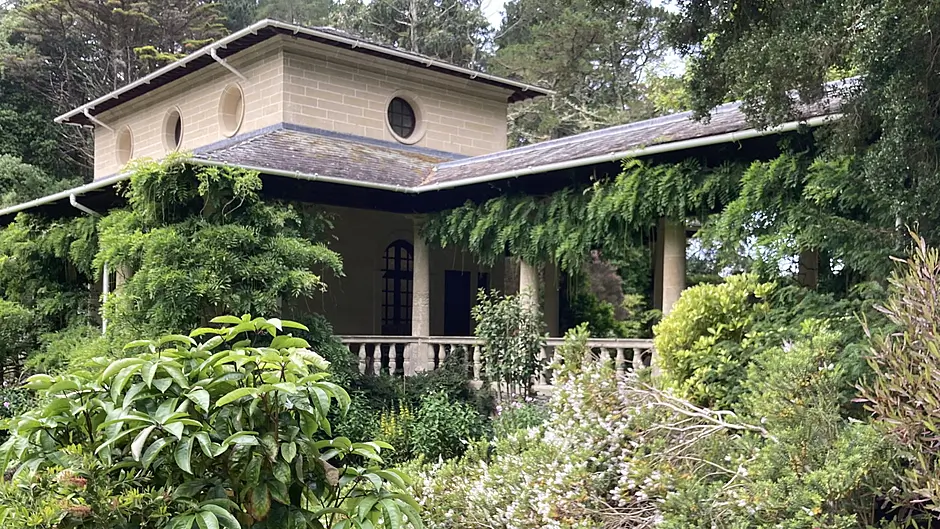

FEW would deny that the gardens on Garinish Island are magnificent; yet the original plan was for something hugely more ambitious.
On March 18th 1911, The Southern Star announced that £2,500 had been earmarked by the new owners of Garinish (or Ilnacullin) to build themselves a home on the island.
ADVERTISEMENT
Some 50 or 60 men would initially be employed in the work which would last ‘for some considerable time’, seeing as the island was merely a barren rock.
Their first task was to enrich the soil, then plant shelterbelts of pine, birch and cypress. Once complete, ‘there won’t be a prettier structure in Ireland’, the report concluded.
Nestled in Bantry Bay among tiny islets inhabited by seals, 37-acre Garinish Island is accessed from Glengarriff by a 15-minute ferry crossing.
Today it is home to one of the finest gardens in Ireland, thanks largely to its award-winning head gardener Murdo Mackenzie (1896-1983), who devoted 55 years to create the wonderful sights tourists have enjoyed since it opened to the public in 1925.
Recent visitors have left glowing comments on TripAdvisor, describing it as a ‘stunning place’, and noting how the ‘beautiful plants, trees, ponds and ornamentation’ make it feel like ‘a different continent’.
The presence of a ‘casita’ teahouse, swathed in wisteria, an Italian garden with lily pond and statue of Mercury, and a Grecian temple overlooking the sea and Caha mountains, all add to this sense of being somewhere special. 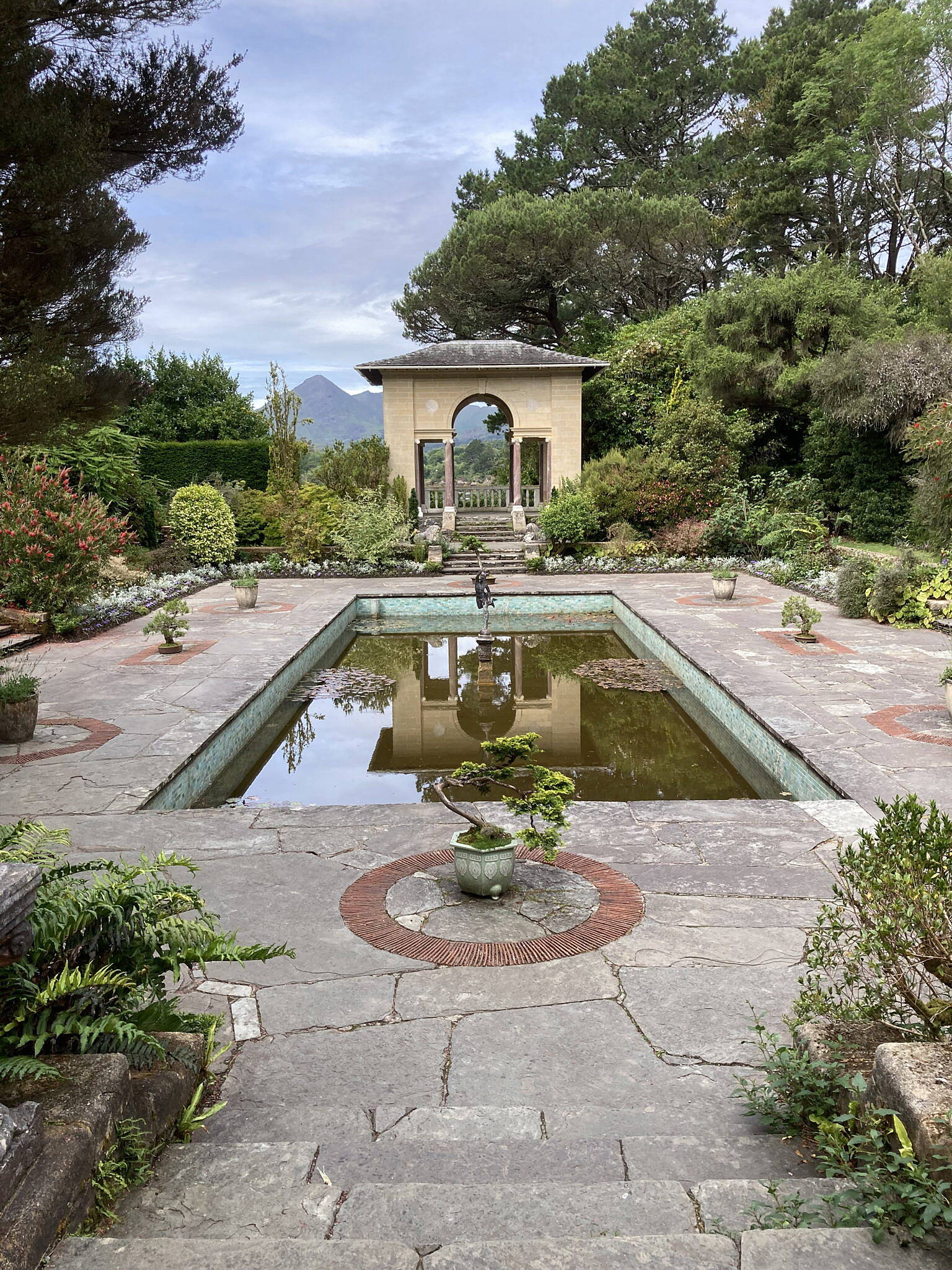
Garinish is now managed by the Office of Public Works. However, it was once in private hands, having been bought from the British War Office in 1910 by Mr John Annan Bryce. Born in Belfast in 1841, Bryce’s main home was at 35 Bryanston Square, Westminster, London, where he lived with his wife, Violet.
Formerly a teak merchant in Manchester and Mumbai, the Liberal MP for Inverness Burghs helped direct and chair numerous international companies, including the Ivory Coast Corporation. He had explored unmapped regions of Burma and Upper Siam, and taken part in plant-hunting expeditions for the Royal Geographical Society.
Violet, 20 years his junior, was the cousin of the trailblazing Irish revolutionary Countess Markievicz, and ran a small hospital for convalescent army officers in Glengarriff during the First World War. After her husband died in 1923, Violet lived on the island with their son Roland, head gardener Mackenzie, and housekeeper Margaret O’Sullivan from Bocarnagh. Roland inherited Garinish island when his mother died in 1939, and bequeathed it to the nation on his death in 1953.
English garden designer Harold Peto (1844-1933) was a longstanding friend of the Bryces. He had planned the gardens at Ilford Manor, Wiltshire, and at West Dean House, West Sussex; and was also responsible for the first-class accommodation on the Mauritania, sister ship of the Titanic.
Having travelled extensively world-wide, in 1905 Peto was in East Cork, exploring Fota Gardens with John Bryce. After that, their attention turned to West Cork. Since nothing had come of a scheme to build two railway viaducts across Garinish Island linking Berehaven to Cork, ‘the peace of Garinish remained largely undisturbed’, writes Nigel Everett (Irish Arts Review, 2013).
The dream
On top of the island’s rocky summit, Belfast architects Young and Mackenzie were contracted to build an incredible seven-storey mansion, which mixed elements of Romanesque, Italian Renaissance, and Celtic Baronial. Such a lofty palace would dwarf three-floor Bantry House, even the imposing Dunboy Castle with its four storeys.
The design would incorporate the existing Martello Tower, built by the British War Office in 1805 when Garinish was a military base, ready to defend the country against the threat of Napoleon. Derelict for over a century, it could at last be converted to house a garden room, a music room, and a private room for Mrs Bryce.
The grounds would mirror those of Medici villas around Florence, and boast cloisters and galleries exhibiting exotic statues and vases, balconies and balustrades made from Carrara marble, all linked by grand staircases. Formal gardens would be constructed, including a stunning rose garden with a magnificent pergola, and a rectangular ‘privy garden’, enclosed on three sides by yew hedges, with an octagonal pool and a splendid central fountain.
Still more was planned: two orchid houses, a kitchen garden, houses for ‘early’ and ‘late’ peaches, an apple orchard, and three vineyards growing ‘early’, ‘late’, and ‘muscat’ grapes.
Peto was against what he called the ‘too catholic desire’ among western countries towards nondescript bedding plants, herbaceous borders and shrubberies. After visiting Japan in 1898, continues Everett, he had become captivated by the ‘solemn gloom’ of cryptomerias, the ‘exquisite tints’ of maples, and picturesque ‘wind-blown pines’.
The Japanese-favoured magnolias, azaleas, pink, white and red roses, and white-flowered ‘sacred bamboo’. Peto was particularly taken by their enthusiasm for ‘exquisite’ pieris, with its thousands of ‘pearly white tassels of bloom’ and ‘young shoots a tender copper red’. All would be introduced into this little spot in West Cork, where they would thrive in its almost sub-tropical micro-climate. Garinish Island would become one of the wonders of the world.
Some of these grand designs were fulfilled, but many – most obviously the seven-storey mansion – remained on the drawing board. Bryce had over-invested in Russia, and after the First World War experienced financial difficulties. Further disruption caused by Irish independence meant him having to scale back his plans. So, the dream was only partially realised. Nevertheless, Garinish Island still remains a national treasure.