It is hard to believe, but that spooky season of Halloween has crept up again. I love this time of year, as it gives me a chance to share some of my favourite seasonally appropriate wildlife wonders. These accounts often include gruesome or macabre details, but to me they perfectly showcase the enchanting and intricately beguiling side of nature.
Some species may seem horrifying, while others display behaviours we humans find unsettling. Fortunately for me, there’s no shortage of such material, all drawn from the biodiversity we have right here on our doorsteps.
What lies beneath
ADVERTISEMENT
Beneath the surface of our seemingly peaceful inland waterways lives a thriving community of creatures locked in a constant struggle for survival. Not everyone realises that Ireland has 13 species of freshwater leech. They’re not human-blood suckers, but leeches nonetheless.
The horse leech is our largest species, reaching up to 15 centimetres when extended. Despite the name, it doesn’t feed on horses or humans. In this case, ‘horse’ probably derives from the Anglo-Saxon word for ‘false’, referring to its inability to suck blood. Instead, horse leeches prey on insects, slugs, snails, tadpoles, and small fish, and may even venture out of the water to hunt earthworms. Keep an eye out for them at the muddy bottoms of shallow ponds and ditches; they’re certainly reminiscent, at least visually, of leeches from old horror films.
I always think of leeches when passing a barber’s, because of the red and white pole outside. That pole originates from an additional service barbers once offered up until the late eighteenth century, bloodletting with leeches. The bloody bandages were wrapped around a pole outside to dry, creating what later became the traditional barber’s symbol. Today, leeches, while off-putting to some, play an important part in the food web, both as predators and as prey for larger animals such as fish and birds.
Bogged down
Bogs have a wonderful mystique and are home to 11 species of insect and invertebrate-eating plants. When I visited Abbeyleix Bog back in April, I had the pleasure of spotting one of the most common species, the round-leaved sundew (Drosera rotundifolia). This small bog plant has red, hair-covered leaves that produce glistening droplets of sticky liquid (dew) to attract and ensnare insects. Once an insect is caught in the plants glue-traop, the leaves fold inward. Digestive enzymes then break down the prey so the plant can absorb the nutrients.
Other carnivorous plants in Ireland include two further sundew species, three butterworts, four bladderworts, and two introduced non-native species. Because bogs are nutrient-poor environments, these specialist plants have evolved ingenious ways to supplement their diets to survive and thrive.
Bladderworts are fully aquatic, rootless and free-floating plants, often found in bog pools. Along their stems are tiny bladder-like traps that comprise of vacuums triggered by fine hair-like sensors. When an unsuspecting insect brushes against them, it is instantly sucked inside. This action takes place in just a fraction of a millisecond. Digestive enzymes then break down the prey, absorbing nutrients before the plant expels any indigestible remains and resets the trap in a remarkable display of natural engineering. It’s truly mind-blowing given how small and inconspicuous these plants are, the ‘bladder’ traps are less than five millimetres in diameter.
Magic Mushrooms
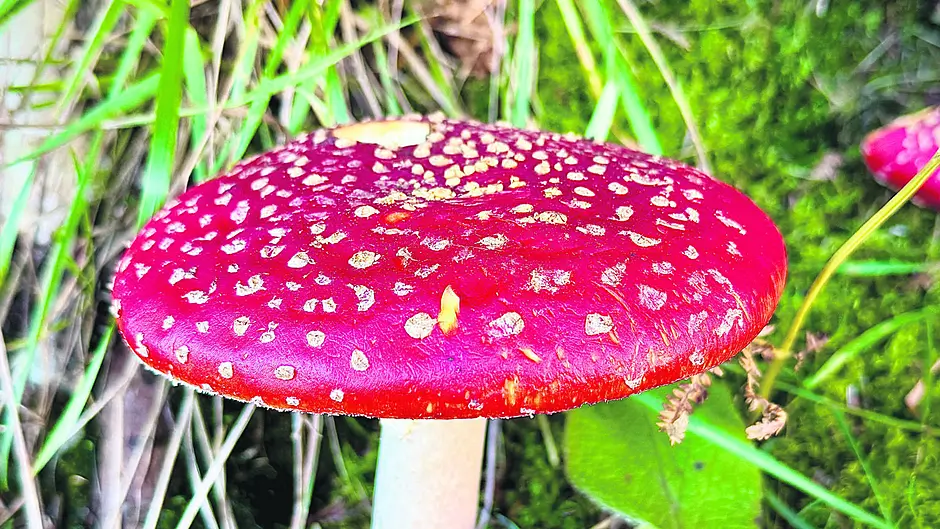
October is a fungi-lover’s favourite month. The countryside, especially woodlands, teems with mushrooms of every colour, shape, and size. Few sights evoke fairy magic quite like the fly agaric (Amanita muscaria), the classic red-capped, white-spotted mushroom, which seems to have been particularly abundant this year.
Not all mushrooms are quite so enchanting. The horn stalkball (Onygena equina) is a small species that grows in large numbers on the decaying remains of horns and hooves from deceased animals such as sheep and horses. Remarkably, it can break down keratin, the tough protein that forms these structures. Though the sight of a horn or hoof covered in small mushrooms might seem gruesome, the fungus performs a vital recycling role; another clever example of nature’s clean-up service.
Few fungi seem more fitting for Halloween than the stinkhorns. These begin as a partially buried ‘egg’ in the ground before rapidly growing into an unmistakably phallic structure. The most common, Phallus impudicus, has a tip coated in a sticky spore-loaded substance called gleba, which emits a strong odour irresistible to flies. As the flies feed, they pick up spores and carry them elsewhere, helping the fungus to reproduce and spread.
Scarier without them
The truth is there’s nothing to fear from any of our native Irish wildlife. It would be far scarier to lose these species, each of which plays a vital role in the environment. At this time of year, it’s fun to reflect on the diverse and sometimes gruesome ways species adapt to survive. So why not embrace the weird and wonderful this Halloween, head outdoors, and relish a gory natural sight or two?