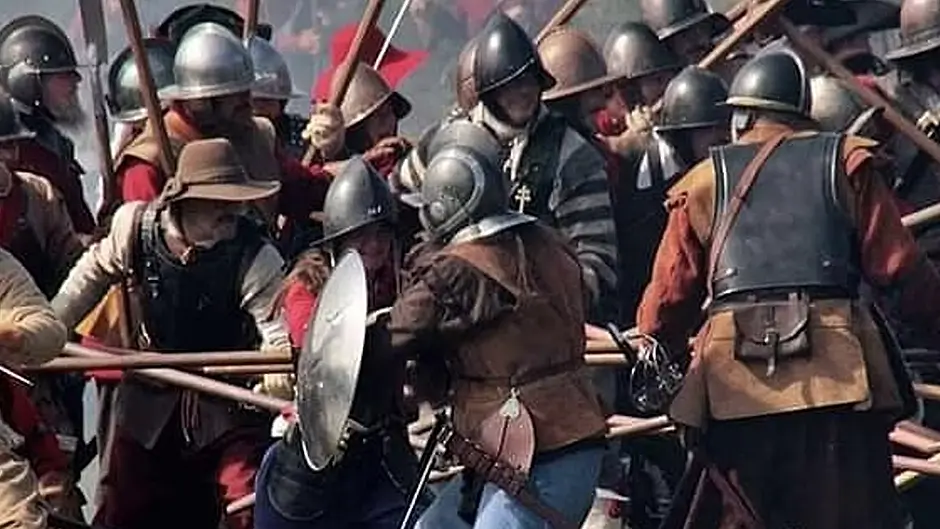

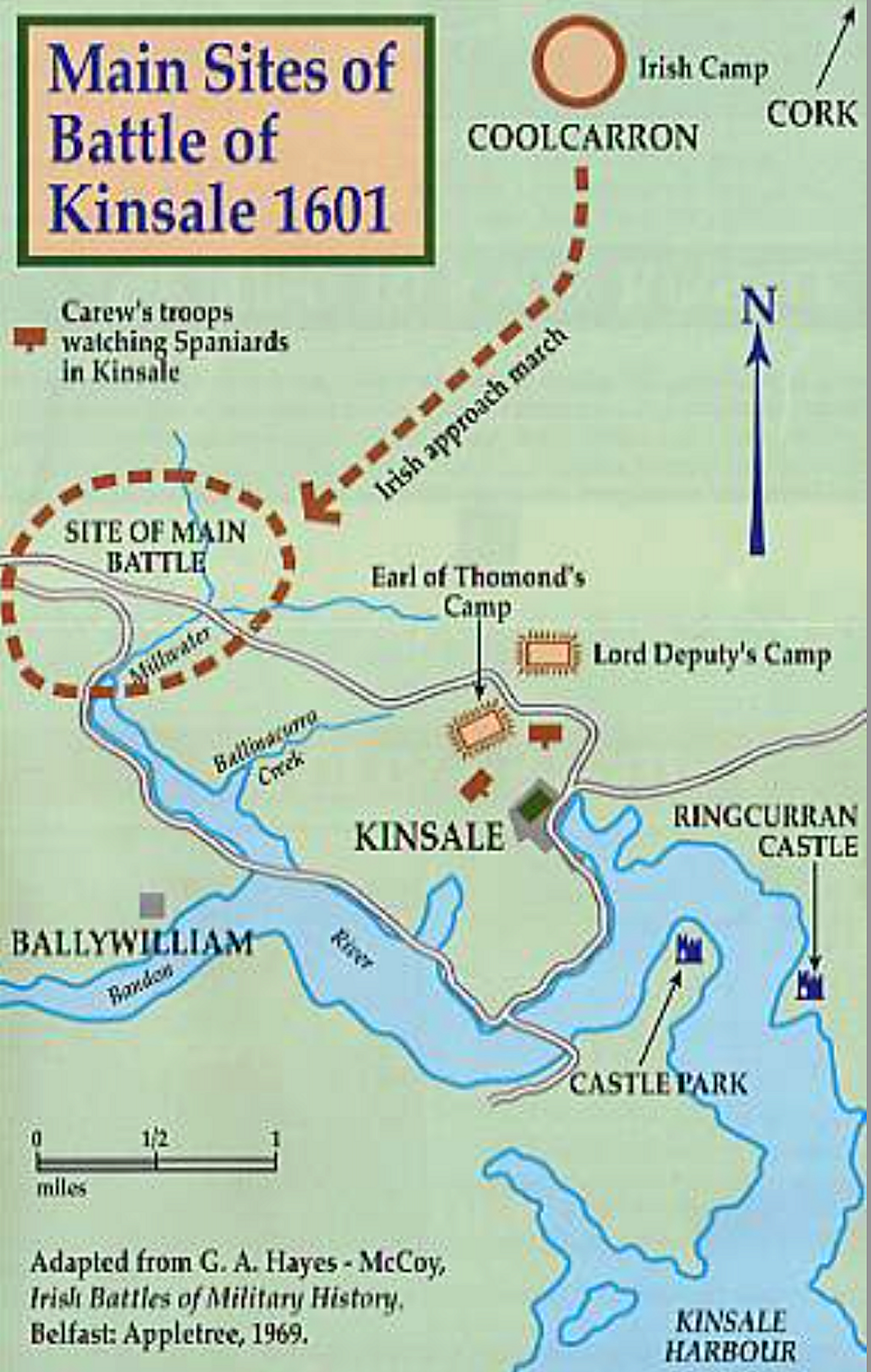
On Christmas Eve 1601, Irish, English and Spanish soldiers met in battle outside Kinsale. By the end of the day the Irish, under Hugh O’Donnell and Hugh O’Neill, Earl of Tyrone, were fleeing back northwards, and the Spaniards were also preparing to surrender. The ‘Nine Years War’ had ended with a thumping success for the English.
Until recently, English accounts of the battle – which apparently lasted from anything between five minutes and two hours – have remained the staple diet of virtually all the descriptions. They portray the fight as an English triumph, a complete rout of the enemy, who looked on, or ran away.
But is that what really happened?
ADVERTISEMENT
An English Version
‘A letter from a soldier to his friend in London’ (13 Jan. 1602) praises the English captains, officers and soldiers, who fought ‘most valiantly’ against 2,000 experienced Spanish fighters and a ‘great store of ordnance and munition’, to achieve a ‘notable victory’. About 1,200 Irish rebels were killed, 800 injured, whereas ‘only one man was slain’ among the English. Lord Deputy Mountjoy is lauded as a ‘wise diligent Conductor’, who directed the building of forts and barricades, and kept ‘strong and watchful guards’; while the Earl of Clanricarde ‘never ceased urging to fight’.
Despite the English having to ‘answer two forces at once’ – from within and without the town – they ‘utterly broke’ the ‘chaotic, base, weak, barbarous, perfidious’, Irish, who were consumed with ‘pride, malice and powerful disdain’
When it mattered, O’Neill showed reluctance to fight, ‘thinking it was no day for him’, and began a ‘disorderly retreat’, which proved decisive in the enemy’s collapse.
Success for the ‘courageous’ English was all the sweeter since the Irish had assembled ‘the greatest and choicest force ever amassed in Ireland’, whereas the English, ‘in numbers scant equal to them’, were weary with the ‘misery of a long winter’s siege’, and their horses ‘decayed, lean and very weak’.
The ‘marvellous’ and ‘just’ victory was put down to ‘the goodness of God’, Queen Elizabeth’s ‘great care’, and the ‘diligence’ of her ministers.
An Irish Version
In his Annals of the Kingdom of Ireland (up to 1616), monk Michael O’Clery gives a different perspective: When O’Donnell heard the Spanish fleet had entered Kinsale harbour to aid them against their enemies, he was ‘full of satisfaction and joy’, left the siege in which he was then engaged, and immediately set off south with the greatest force he could muster.
His troops included ‘the most illustrious of the race of Brian’, were ‘full of spirit, blameless in discipline and repute’. Showing ‘neither fear, nor dread, nor death-shiver’, they marched on ‘day and night, without stop or halt’. By contrast, the English were ‘greatly afraid and anxious’, and ordered people not to give them food or lodging. Yet ‘a very considerable number’ came over to the Irish camp.
Meanwhile, O’Neill had assembled an ‘active, joyful crowd of heroes’ in Ulster and began his 300-mile journey south. Although delayed by ‘extraordinary ice’, and ‘heavy, slippery snow’, they managed to reach Kinsale, where they hemmed the English inside the town, placing them in such ‘intolerable straits and difficulties’ that of their 15,000 troops, 8,000 died of cold, starvation and disease.
The Spaniards were also ‘in great straits and helplessness’, and as soon as night fell, O’Donnell’s men stealthily brought them weapons. But they had ‘not the desire of battle’, they’d been ‘timid, languid, slow, cowardly’ ever since they arrived from Spain.
Only when the English forces poured on them a ‘strong shower of globular balls’ were O’Neill’s forces eventually defeated – ‘an unusual thing with them’. It was ‘not the will of God to give victory to them then’. Nevertheless, there fell ‘so small a number of the Irish in that battle of Kinsale’.
A Spanish Version
In the ‘True Report of what happened’ (1602), Bustamente, a Spanish ensign who acted as messenger between commander Don Juan del Aguila and Hugh O’Neill, also refers to God overseeing events, how ‘All Christianity was watching’, as the Spanish tried to help their fellow Catholics expel the English
Back on October 1st, Spanish soldiers had taken the port of Kinsale and two castles without resistance, and on the following day the inhabitants of the town surrendered without a fight. Earl Mountjoy was ‘extremely reluctant’ to fight – unlike the Spanish, who launched sallies ‘by day and by night… We did not give the enemy any respite, killing many of their troops, though we lost very few.’
When it became clear they could not possibly win – that King Philip III’s decision to land in the south had been a huge mistake – Bustamente was full of excuses. He exaggerated the strength of the English forces by alleging they had 10,000 men and 400 horses, and that most of the Spanish troops – far from being experienced – were ‘raw recruits’. As for the Irish they’d come to help, they were ‘somewhat lukewarm and fearful’, with several soldiers going over to the enemy. Their infantry failed to march in one group, making them easy for the English to pick off; O’Donnell clumsily sounded a ‘false call to arms’; and O’Neill made ‘bad choices’.
Meanwhile, the Spanish troops were starving, since the enemy cavalry had ‘swept the countryside and carried away all the livestock’.
After six days they ran out of bread, and ‘the cats and dogs in the town were quickly consumed’. Without a doctor or surgeon, many died. By claiming the Spanish captains and the Archbishop of Dublin had agreed to ‘honourable terms’, Bustamente justified their surrender to Mountjoy. But according to the Archbishop’s correspondence, this was completely untrue. Aguila had acted unilaterally, and had probably got Bustamente to write his report to justify the defeat to his King.
Three different reports, three different versions: food for thought now that an exhibition on the Battle of Kinsale is about to open at Desmond Castle.