From cursed castles, to haunted hotels and lurking lighthouse-keepers, our region has been touched by them all
BY ROBERT HUME
ADVERTISEMENT
‘Ghosts and dreams’ ran the title of a lecture given by the great poet WB Yeats to the ‘Society for Psychical Research’ on Saturday October 31st 1925 at the Eccles Hotel, Glengarriff, itself reputedly haunted by the spirit of its original owner, the ‘White Man’, who walked the corridors checking guests were happy. Now, ladies and gentlemen packed the dining room, eager to exchange sixpence for more of the ‘creepy stories’ about ‘messengers of death’ and ‘haunted houses’ they’d been devouring for years in the Skibbereen Eagle and Southern Star.
West Cork abounds with spooky nooks and crannies. When merciless Colonel Warrender, a widower, took command of Charles Fort, Kinsale, in the 1700s he brought with him his beautiful daughter, Wilful, who fell in love with and married an officer, Captain Sir Trevor Ashurst. On their wedding night, as the couple walked along the ramparts, Wilful spotted beautiful flowers on the rocks below. A guard offered to climb down and pick her one, provided Trevor took his place on duty. Wilful returned inside. However, the guard took longer than expected to retrieve the flower, and her husband fell asleep.
Later, while showing dignitaries around, Warrender spotted a guard slumped inside his sentry box, and demanded he stand up. When he took no notice, he flew into a rage and shot him through the heart. Discovering his tragic mistake, he summoned a doctor, but too late.
Hearing what had happened, Wilful threw herself from the highest bastion, and died instantly. From that moment, soldiers began saying they’d seen the figure of a young woman in white, her face colourless like a corpse, walking through walls and locked doors, ascending stairs, and disappearing into thin air. Was she looking for sleeping sentries to awake? Recently, one local who was running near Charles Fort placed his hand on a wall while re-tying his shoe, and felt another hand reach out from the wall to help him. At other times, Wilful can appear as a malevolent spirit: in 1922, when the fort surgeon stooped to retrieve a key, he was dragged across the hall and flung down a staircase.
Some 50 kilometres down the coast lies Coppinger’s Court, Ballyvireen, a crumbling four-storey gabled house built around 1616. It was once the site of weekly hangings with its owner, Sir Walter Coppinger, tending to execute anyone who irritated him.
According to one story, he offered a widow help with her ‘problem’ son. Next thing she knew, the boy was swinging from his gallows, Coppinger gloating that he’d solved her problem. Before leaving home one Saturday in 1639 to settle a money dispute with a neighbour, Coppinger ordered a servant to set fire to the house if he didn’t return by a certain hour. Coppinger won the argument, started celebrating, and lost track of time. Arriving home late, he found his house in flames. The servant deserved to be executed but it was now Sunday and Sir Walter was refused permission. He flew into a rage, suffered a stroke, and died. Some claim they still hear screams from Coppinger’s Court today.
Nearby, the Drombeg Stone Circle is said to be haunted by the ghost of a pregnant woman who drowned herself shortly before she was due to give birth. Human sacrifices may once have taken place at winter solstice on the rock known as the Druid’s Altar. When archaeologist Boyle Somerville visited the Circle in 1935, he unearthed cremated bones and detected on the rock two cup-marks, and a human foot. Psychic medium Geraldine Cummings, who accompanied him, felt deeply uncomfortable, sensing it was a place where animals and small children had been destroyed. She claimed to see a priest, dressed in blue and saffron robes, standing at the altar, about to kill his human offering.
A very different site, that of the former Eldon Hotel, Skibbereen, is famous today as the place where Michael Collins ate his last meal on August 22nd 1922. But it was also once well known for things going ‘bump in the night’. Over the years, staff have reported crying coming from Room 28, where a young woman apparently once burnt to death during a fire. In November 2014, when Jackie Clarke from the Cork Supernatural Society stayed overnight in that room, she captured the sounds of the wardrobe door ‘blowing open’ with a ‘loud bang’, a ‘disembodied voice’ saying: ‘Go away!’, and ‘dragging noises in the corridor’ as though someone was ‘pulling suitcases along’.
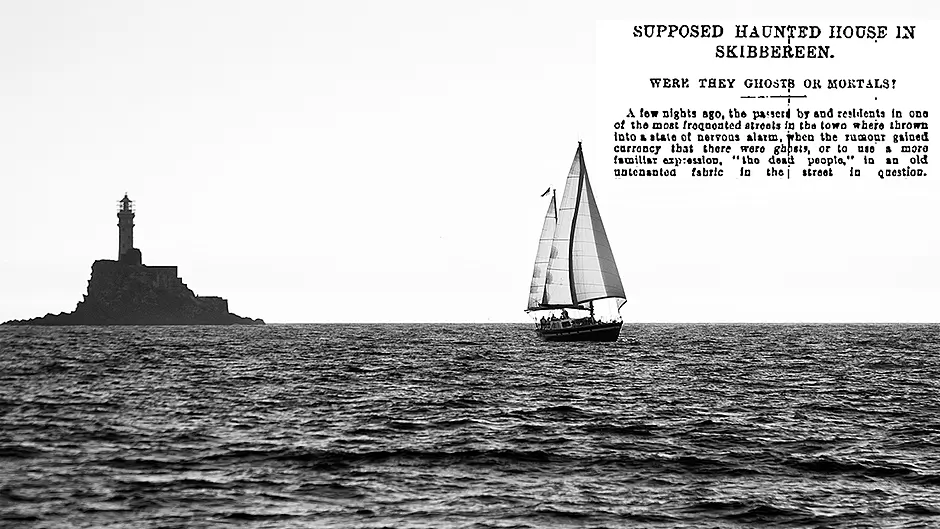
However, it’s less West Cork’s hotels, and more their beacons of light, especially the lighthouses at Mizen Head, Bull Rock and Fastnet Rock, that share the darkest secrets. When a relief crew arrived one foggy morning in 1904 at Fastnet, they claimed to have found head keeper Patrick Daly talking to three fellow keepers who were supposed to be dead: Robert Reading, the lighthouse’s first head keeper had succumbed to pneumonia in 1856; Thomas Breathnach had fallen from the gallery during a storm in 1897; and Michael Sheehan had vanished one winter night in 1901, leaving behind his oilskin and a log entry ending mid-sentence. Some claim that these ‘phantom keepers’ had chosen to remain at their posts in order to help the living. Back at the Eccles Hotel, Yeats would have told his audience that such ghosts were ‘harmless and well-meaning, and it was perfectly possible to talk to them: he and his wife did – regularly.
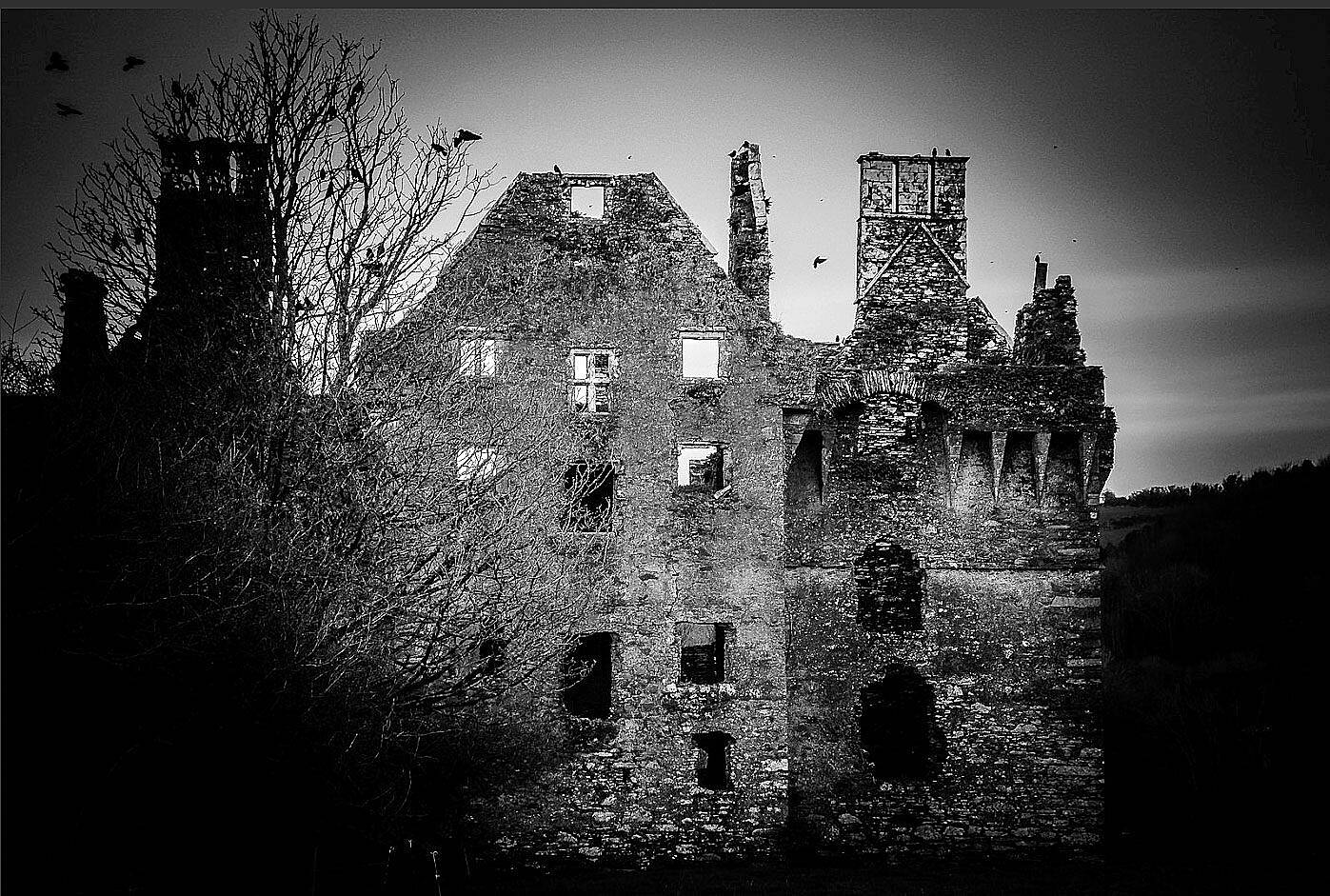 Something out of a horror movie: Coppinger’s Court, Rosscarbery (The Cinematic Country, Facebook, 2024)
HAUNTED HOUSES
By Henry Wadsworth Longfellow
All houses wherein men have lived and died
Are haunted houses. Through the open doors
The harmless phantoms on their errands glide,
With feet that make no sound upon the floors.
We meet them at the doorway, on the stair,
Along the passages they come and go,
Impalpable impressions on the air,
A sense of something moving to and fro.