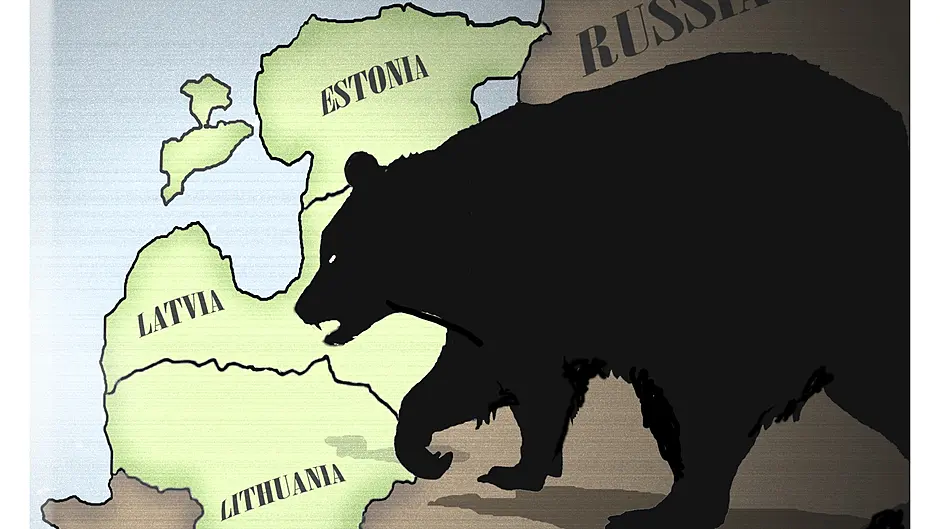

Lads, it’s absolutely Baltic. And I don’t mean that in the way we usually mean it when we’re complaining about the weather in Ireland. I mean it literally. I’m somehow in Latvia, for the Riga International Film Festival. While everyone back home is still processing the fact that we’ve just elected Catherine Connolly as President of Ireland, I missed my opportunity to make a preference and have ended up over here learning about a country that had to fight tooth and nail just to exist.
It’s another one of those sentences that makes me wonder how Past Colm keeps landing Future Colm in these situations without consulting him first. But here I am, in a city that’s buzzing with creative energy, meeting filmmakers and artists from across the region, all while Russia lurks on the border like an unwelcome presence at a family event. Riga is a beautiful city, all Art Nouveau buildings and cobbled streets, but underneath the surface there’s a weight to the place that you can’t ignore. This is a country that’s been rolled over by history again and again, and yet somehow it’s still standing, still making films, still determinedly being Latvian.
ADVERTISEMENT
Outside of work commitments, I spent an afternoon at the brilliant Museum of the Occupation of Latvia, although as the name suggests, it’s not exactly a laugh-a-minute. Between 1940 and 1991, Latvia was occupied by the Soviets, then the Nazis, then the Soviets again, like a game of totalitarian pass the parcel.
In June 1941, over 15,000 people, including 2,400 children under the age of ten, were shoved into cattle trucks and deported to Siberia. Their crime was being successful farmers, intellectuals, and politicians; basically anyone Stalin decided was a bit too Latvian and independent-minded for his liking.
Then in March 1949, another 42,000 people got the same treatment. Families were separated as men were sent to the Gulags in the back end of Russia while women and children were dumped in ‘administrative settlements’ in the middle of nowhere. The conditions were medieval and people died of cold, starvation, disease, and despair. And I thought we had it bad with the Brits.
I also visited The Corner House, the former headquarters of the Soviet secret police in Riga, known to you and me as the KGB but known in Latvia as Cheka. My tour guide was a young history student whose grandmother had been sent to the camps after her land was seized for collectivisation. She showed us around with the kind of matter-of-fact precision that comes from having these horrors baked into your family history.
The building hasn’t changed much since the Soviets legged it in 1991. There’s a lift with a partition down the middle, one side for the prisoner, one for the guard, which you can step into and it gives you a real chill to think of all the people who had been carried in it over the years.
Upstairs were the interrogation rooms. Downstairs in the basement were the cells, kept at over 30 degrees Celsius at all times, with lights blazing 24/7. They’d stuff 20 people into cells meant for four. Little sleep or comfort, just heat and light and the smell of overflowing chamber pots until you’d confess to anything. At the end of the tour, we stood in the execution room. It’s basically just a small garage, with a wall. Yellow markers show where the bullet holes were found after independence, traces of at least 188 confirmed executions, though nobody knows the real number. They used to run a truck engine outside to mask the sound of the shots. Then they’d wrap the bodies and bury them in the forest.
James Joyce famously wrote that ‘history is a nightmare from which I am trying to awake’. You can feel it here in Riga.
Throughout all this, the Latvians never gave up. While the KGB was disappearing people, more than 20,000 Latvians took to the forests as partisans. They lived in bunkers, fought a guerrilla war against impossible odds, and kept the dream of independence alive from 1944 until 1956. The last Forest Brother didn’t come out of hiding until 1995. I was in secondary school in Clonakilty at the time and had gone on a school tour to Moscow in 1993, but that’s a story for another day.
By the late 1980s, a gentler form of resistance exploded into the Singing Revolution. Hundreds of thousands of people gathered to sing patriotic songs that had been banned for decades. On August 23rd, 1989, two million people formed a human chain 600 kilometers long, from Tallinn through Riga to Vilnius, holding hands in a peaceful protest that was noticed the world over.
Latvia declared independence in May 1990 and the Baltic States have enjoyed a short but very meaningful period of independence and growth ever since. They are inside the EU and Nato, but the looming presence of Putin and the war in Ukraine are ever-present. One the last day of the festival, I was driven to the airport by a festival volunteer accompanied by two filmmakers from Ukraine. I was slightly dreading the flight home on Ryanair, to be honest, but I soon had a reality check. The two Ukrainian women had a twenty-four hour train journey to Kyiv ahead of them, and they seemed remarkably chilled out about it. The night before, two people had been killed and 12 injured in a Russian ballistic missile attack.
Climbing out of Riga above the clouds on the packed Ryanair plane, I have never felt so happy to be Veering West.