ON Tuesday February 24th, Olena Baranova sat down to write about her experience, four years ago, when she woke to hear the sound of her beloved Odessa being bombed.
‘I remember it was early morning, still dark, maybe around 4am, when I walked out onto my balcony on the 15th floor and saw war in the air.
‘It was practically tangible. For the briefest time, I hoped what I was witnessing was just fireworks. I went back to bed, only to wake up ten minutes later to the sound of bombing. The realisation struck: ‘These are explosions. War has begun.’
ADVERTISEMENT
Many people thought war with Russia was impossible. But Olena had an emergency go-bag ready.
‘I had gathered the necessary documents, bought the essential medications, and had withdrawn cash from an ATM,’ said Olena.
The streets at 5am were filled with panic. There were many people and lines of cars and the five-minute drive to the petrol station took an hour and a half.
‘The roads were chaotic. Police cars sped by with their lights flashing. We managed to fill the car up. Thank God, I had cash, because cards weren’t being accepted.
‘I was shaking, unable to calm down. A childhood friend of mine, who had been living in the US for many years, called to say Russian troops had landed at an airfield near Kyiv. She said we needed to leave immediately.
‘We left Odessa on the evening of March 1st. We stood at the border all evening and all night, and we crossed into Moldova in the morning.
‘Even now, as I write about this, I recall that sunny morning and the extraordinary support that we honestly didn’t expect to receive.
‘Many governments made unprecedented decisions by abolishing visas for Ukrainians, as Ireland did on the second day of the war.
‘As a result, countless people were able to save themselves. Freed from bureaucratic delays, people were given the chance to survive.’
Olena and her family lived in Moldova for a year, where she worked as a psychologist at a humanitarian aid centre for Ukrainian refugees.
‘It took me a whole year to realise that the war wasn’t ending any time soon. That we needed to start our lives in another country.
‘Ireland, for me, was love at first sight,’ said Olena, who works part-time at the Uillinn West Cork Arts Centre in Skibbereen.
‘On our first day in Ireland, we met incredible people. People with open hearts and open souls. Now, I understand how incredibly fortunate we were to be settled in West Cork.
‘People came to introduce themselves and to get to know us. They brought clothes and things for the house, fruits and vegetables. They even organised English classes for us.
‘I would love to name them all. Because I remember everyone. But I won’t. I am simply grateful to each and every one of them for the welcome, and the help, they have given us.
‘We are very grateful to the Irish government too for its initial support and assistance, and we are happy to be self-sufficient and independent of government support.
‘We are,’ she concluded, ‘happy to be of service to this country and perhaps one day we will be able to repay our debt through our actions.’
Four Devastating Years: A message from Fiona Corcoran of the Cork- based Greater Chernobyl Cause
Four devastating years. Four years of unrelenting cruelty. Four years of a war that has torn apart a nation, shattered families, and left innocent civilians to suffer indescribable horrors.
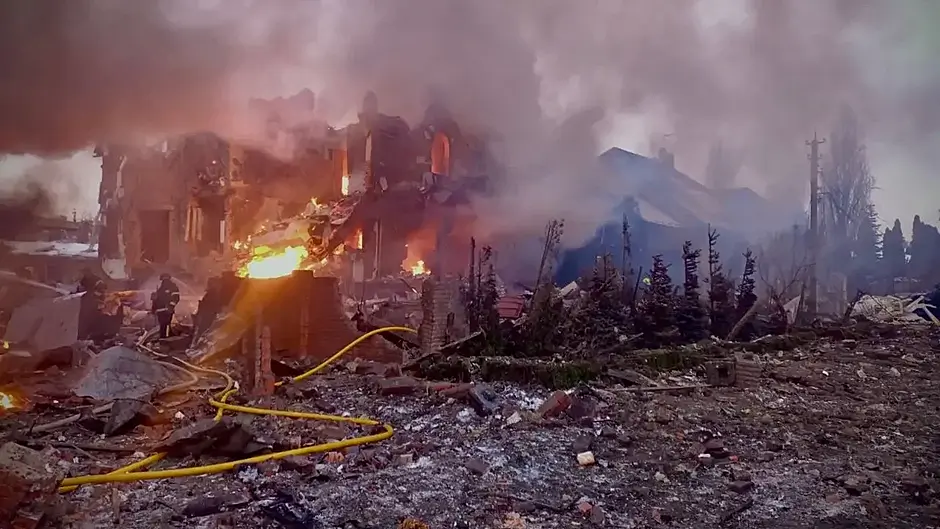
As the world marks the fourth anniversary of Russia’s brutal invasion of Ukraine, I write to you from the heart of Kyiv—a city still battered by missile strikes, where the sounds of explosions and the wails of the innocent echo ceaselessly day and night.
Just last night and into the early hours of this morning, terror gripped all areas of Ukraine as relentless strikes tore through homes, schools, and hospitals alike. I bore witness once again, listening to the horror of explosions ripping through the darkness—a terrifying reminder that this nightmare is far from over. This is no distant conflict. It is a living nightmare. It is a crime against humanity that must NOT be ignored or forgotten.
I am here on the ground, as part of an aid mission with The Greater Chernobyl Cause, bearing witness to the unspeakable suffering inflicted on the people of Ukraine.
I have seen families ripped apart, children trembling with terror in cramped shelters, and elderly survivors enduring freezing cold without food, without heat, without hope. Their pain is unbearable. Their courage is extraordinary—but how much longer must they endure this hell?
Our home in Prybisk shelters 37 elderly residents, many forced to live four to a room, their minds and bodies crushed by the brutal realities of this war.
The demand for safe shelter grows every day. One critical project we are committed to support is the installation of an elevator to bring children safely to sanctuary during air raids. Today, these children must be carried down dark stairwells by carers to the basement bomb shelter.
With deepest sorrow, fierce determination, and unyielding hope—from the front lines of a relentless and air-intensive conflict, we face challenges that no one can overcome alone. I beg you, please, do not turn away.
The people of Ukraine need your support now more than ever. Stand with Ukraine. Stand with us.
Please donate what you can: