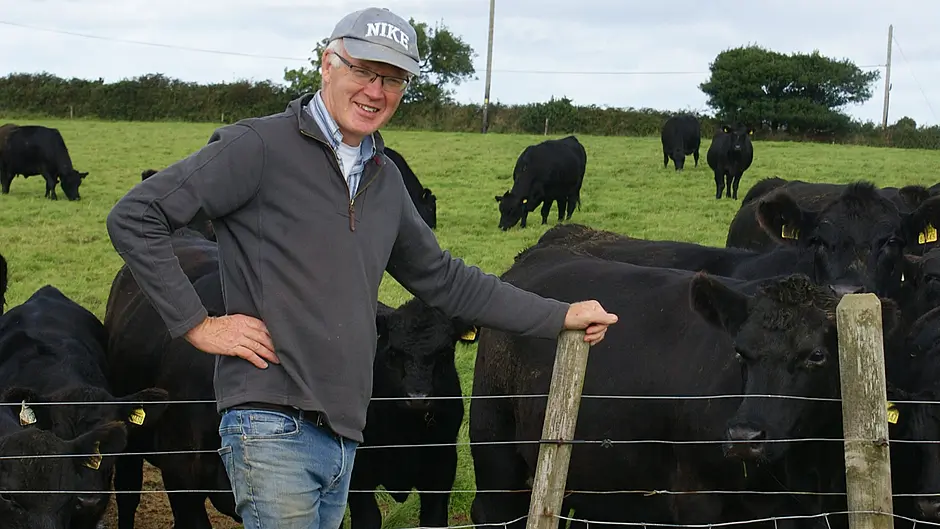
Innishannon man Cornelius ‘Neilie’ Hurley is one of the latest farmers to be profiled by the CAP Network Ireland, demonstrating his commitment to cut the carbon footprint of the 23-acre farm at Dunderrow.
Neilie, a suckler beef breeder, is taking part in a number of programmes including the Suckler Carbon Efficiency Programme (SCEP), and his actions today represent a big change in how farming is conducted on the farm, which has been in the family since the 1960s.
Back then, they were involved in fattening cattle and sheep and over time, transitioned to a weanling to beef system.
ADVERTISEMENT
Neilie took over the family farm in the 1990s and, as the second-generation farmer, he started on a part-time basis until 2022 when he retired from his pharmaceutical career.
In the early 2000s, Neilie bought some suckler cows and quickly saw the benefits.
‘With the suckler cows, whatever we were producing in the year, it was paying our bills, and we didn’t have to go back and buy store cattle again. We evolved from that then and bought a couple of Aberdeen Angus heifers. Now we are all Aberdeen Angus because we found a ready market for the bulls.’
The sheep are now gone, and today, Neilie manages 25 suckler cattle. Prior to his involvement in the SCEP, Neilie had taken part in the Beef Data and Genomics Programme (BDGP) and the Beef Environmental Efficiency Programme (BEEP).
Aside from the financial incentives, Neilie found the programme to be both beneficial and in alignment with his own farming practices. His herd is becoming more efficient by reaching their target weights earlier, with less greenhouse gases being produced.
The emphasis on carbon efficiency has also led him to be more environmentally conscious.
‘It pushes you in the direction of improving your carbon footprint, especially for the beef.
‘Once we’re thinking of carbon, we’re thinking of what’s around the field as well. Our grassland is much more focused on carbon efficiency.’
GREEN SCHEMES
Neilie’s decision to introduce clover into his pastures is another step towards sustainability.
Clover, a nitrogen-fixing plant, not only enriches the soil but also means less expensive chemical nitrogen inputs are needed to grow grass.
Apart from the obvious financial benefit, the environmental upshot of this is there is less nitrous oxide being lost to the air and less danger of nutrients running off into nearby waterways.
Under the ACRES scheme, Neilie is aiming to increase the percentage of habitat of the farm from roughly 8% to over 12%.
So far, he has planted an extra 350m of hedgerow and half a hectare of woodland, which is strategically situated to act as a shelter belt. He also chose the hedge laying option in ACRES and has finished laying 250m of established hedgerow.
Doing his ‘bit for the environment’, another benefit of hedgerows is that carbon is now being captured as the hedgerows grow, and it also means a significant increase in habitat for wildlife on his farm.
Payments from such schemes allow for more investment in farm infrastructure such as sheds.
There are practical benefits too: on one wet, windy night, Neilie went to check on his cattle and found them lined up uniformly against a previously-planted hedgerow, as it provided protection from the wind as if it was a solid brick wall.
Neilie, a firm believer in programmes like SCEP and ACRES, believes these will play a vital role in sustaining family farms across Ireland.
‘These schemes are going to keep people on the land, rather than lose interest in it’.