THOMAS McCarthy, a young Timoleague man, is working as a forage scientist in New Zealand where he’s addressing some of the major challenges facing pasture-based systems under climate change.
These findings in the Southern Hemisphere, says Thomas, will help West Cork dairy farmers whose grass-based systems are just as vulnerable to weather extremes.
‘I’m currently working as a forage scientist with DairyNZ in the North Island near Hamilton. Forages can refer to anything grown for animals to eat, and in New Zealand, much like Ireland, the predominant feed largely refers to grazed grassland, and all the science that goes with that,’ said the 28-year-old Ag Science graduate.
ADVERTISEMENT
‘I’m involved in a recently launched research programme called Resilient Pastures, which is focused on addressing some of the issues facing pasture-based systems under climate change.
Over the past two decades, pasture growth and utilisation in parts of New Zealand has stagnated or even declined, largely due to climatic factors such as hotter, drier summers and more intense rainfall events,’ he said.
Farmers, Thomas explained, are increasingly having to reseed pastures more frequently, as traditional perennial ryegrass swards come under stress during prolonged heat and drought.
‘Once temperatures move into the high 30s, ryegrass can struggle or die off altogether. Our research is exploring alternative species such as tall fescue and cocksfoot mixed into the sward, as well as multispecies swards that include plants like chicory and plantain to test how they persist under grazing in these regions. Alongside this, we’re also looking at pasture management practices, such as grazing intensity and timing, and how these affect pasture persistence.’
Many of the challenges being faced in New Zealand are highly relevant to Ireland.
‘Events like the 2018 drought highlighted how vulnerable Irish grass-based systems can be to weather extremes. Climate projections suggest hotter, drier summers and more concentrated rainfall events will become more common in Ireland too. Given how similar Ireland and New Zealand are in terms of grass-based dairy systems in temperate regions, a lot of the findings from this work should be directly transferable back home.’
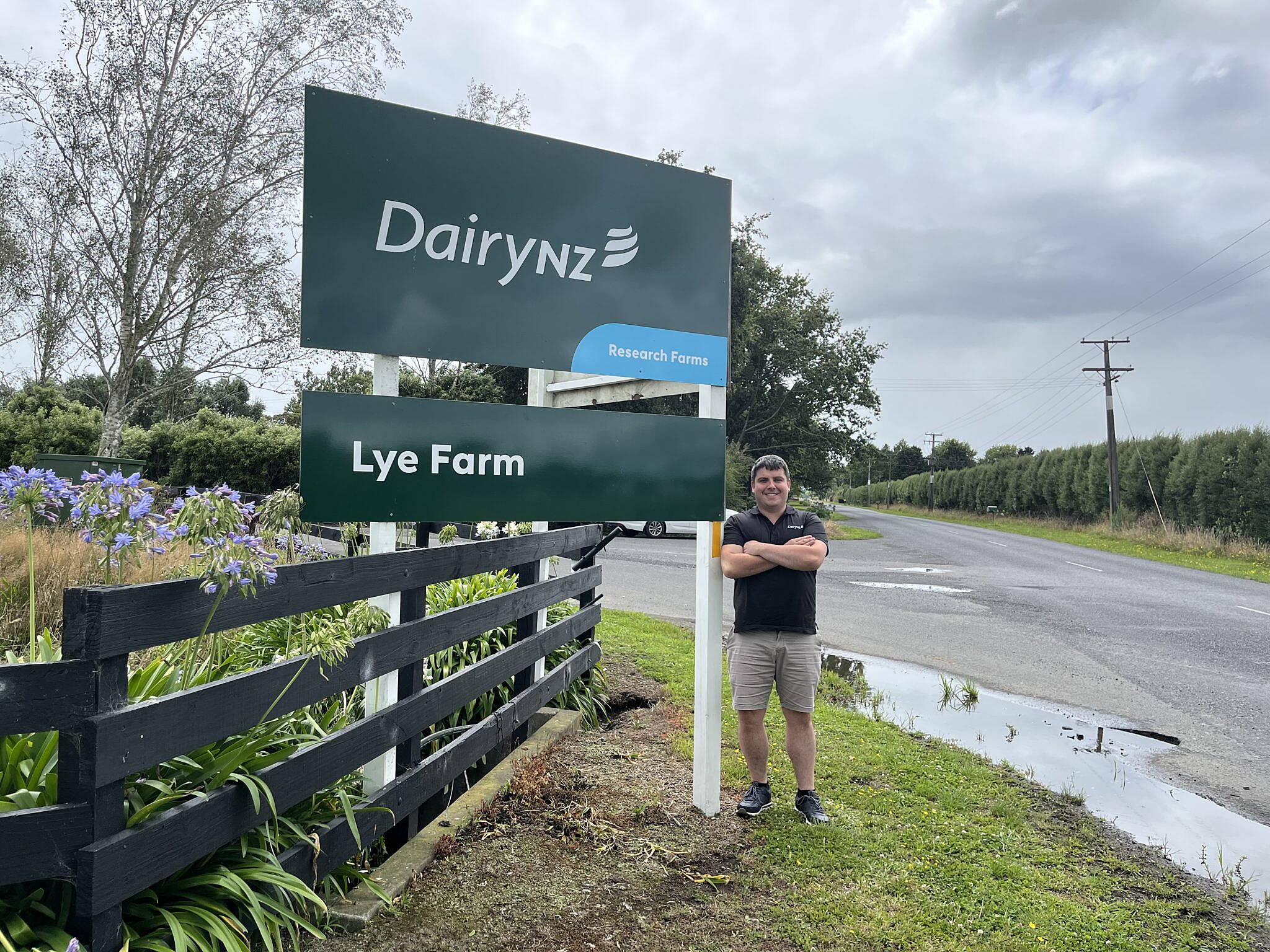 At Lye Farm, a DairyNZ research farm near Hamilton.
Another area he’s currently working on is the use of technology such as satellites and drones and other sensors to measure grass growth and yields.
‘Accurate and timely measurement of grass covers on farm is critical for optimising grazing management and increasing grass utilisation. DairyNZ research has drawn a clear relationship between the amount of feed grown on NZ farms and overall farm profitability. The same can be said in Ireland, where the more grass and feed grown on the farm can reduce the need for importing concentrate feed supplements in large amounts, along with the associated environmental considerations that come with it. However, walking the entire farm weekly to measure grass is time-consuming and labour-intensive, and often limits farmers to adopt this practice.
‘Technology has huge potential to reduce this workload while still providing reliable grass measurements. Ultimately, this can lead to more grass grown and utilised on farm, improving overall profitability. That’s just as relevant for farmers in West Cork as it is for those in New Zealand.’ Thomas, who also has a PhD in Soil, Agronomy and Crop Science from South East Technological University, feels the future of Irish agriculture depends on more research like this.
‘We saw the recent challenges in securing another round of nitrates derogation for Ireland, and my understanding is that with this latest round, a close eye is going to be kept on the trends in water quality in the key intensive dairy production areas in order to retain it.’
‘Teagasc, and the various universities and research bodies in Ireland are doing some fantastic research into strategies that can be implemented on-farm to maintain productivity while mitigating environmental pressures associated with intensive agriculture. We can see this in practice on a daily basis around Timoleague where the Agricultural Catchments Programme work collaboratively with the farmers in the area to maintain and improve water quality in the Timoleague catchment.’
‘From my own experiences, advances in soil science research, strategies to reduce nitrogen fertiliser use, and technologies to mitigate fertiliser N loss to the environment, along with the many technologies and mitigation strategies being both trialled and implemented on farms have never been more important. I would say they are key to making the sector more resilient, and to future-proof it against climate challenges, social and political pressures.’