Through decades of farming in Macroom, 99-year-old Cornelius O’Mahony has seen seismic changes in Irish rural life
99-year-old Cornelius O’Mahony has seen a lot of changes in farming life since 1953, when he earned his Diploma in Rural and Social Science from University College Cork. The Crookstown man was interviewed by The Southern Star back in October, when he cast his vote in the local hall, which he also helped to build.
Back in 1953, he was attending classes every week in the local vocational school in Macroom, run by Liam O’Brien, and sometimes he said the students would go into UCC for lectures.
ADVERTISEMENT
‘Professor Alfred O’Rahilly was president of the university at the time,’ recalled Cornelius, whose certificate still hangs proudly on the wall of his home.
Being a member of the Young Farmers’ Club in Toames gave him, and others, a great sense of community and pride in the land.
‘I have always been a member of the IFA and I’ve always believed it’s important for people to attend meetings, not just for business, but for the social aspect too which has always been a great part of the experience.’
Family has always been at the mainstay of Cornelius’s life: ‘I have five children; two daughters, Kathleen and Joan, and three sons, Pat, John, and Niall, 11 grandchildren, and two great-grandchildren, with two more on the way!
‘Most of my children have retired from their jobs, but I like to think I’ve passed them out, as I wouldn’t consider myself retired from farming just yet!’ said Cornelius.
His late wife, Margaret, was a national school teacher. The couple married in 1957 and because of the marriage ban, Margaret was forced to give up her teaching job.
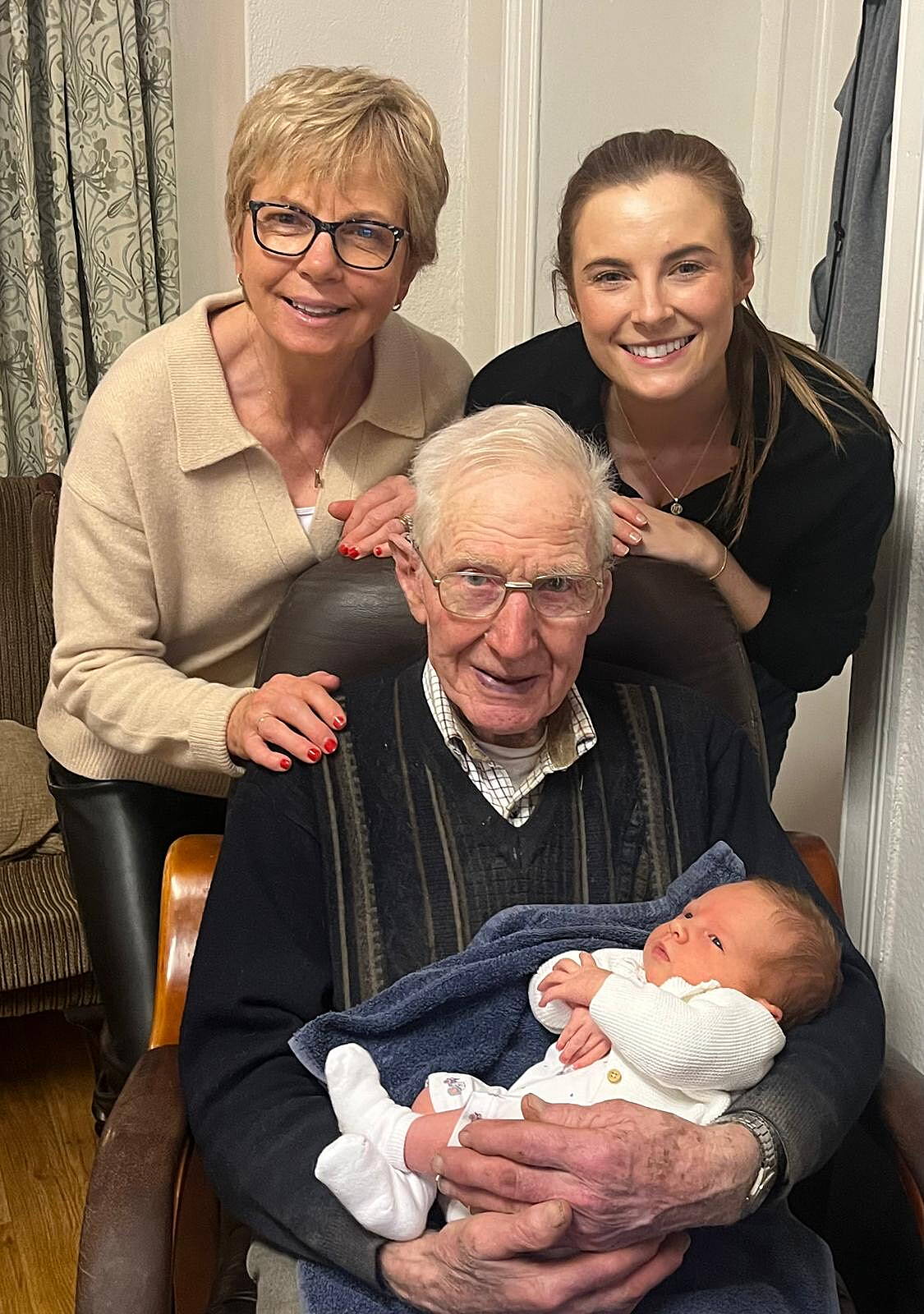 Cornelius with his daughter Kathleen, her daughter Mairéad, and Mairéad's son Rory.
‘When that ban was finally lifted, Margaret was one of the first women to return to the classroom,’ said Cornelius.
‘Teaching has remained a proud tradition in our family: our daughter Kathleen followed in her mother’s footsteps, teaching in Macroom, while our granddaughter Aoife teaches in Newcestown and our grandson Andrew in Dublin.’
‘I always took part in community work. I helped to build Crookstown Hall, when I was about 12 or 13, and it was built entirely by local labour.
‘I remember I used to go with my uncle Dan to lend a hand. Over the years, I’ve helped with whatever needs to be done in the local community. That’s what community means to me, everyone working together.’
Commenting on the changes he has seen down through the years, Cornelius said that the changes ‘have been immense. Today, I can sit by the fire with my iPad and FaceTime my granddaughter Mairéad in Canada and even see my great-grandchild Rory grow up in Toronto. When I was young, the journey to America took six weeks, and many who went were never heard from again. Now, the world fits in your hand.’
‘The farming life has changed just as much. I remember walking cattle from Crookstown to beyond Coppeen. The last few miles were always the hardest, as the cattle would tire. Now, I can sit by the fire and buy cattle online on my iPad.’
‘The fairs were the big events of the year: Coachford, Kilmurry, Ballineen, Inchigeelagh, Macroom, Millstreet. I even once travelled from Toames to Kenmare by pony and trap.’
‘And I’ll never forget the time my uncle Dan bought sheep in Kenmare and told me to mind them. I was only about fourteen. The sheep broke loose, burst through the door of the Protestant church, and ran wild inside. I was leaping over the pews trying to catch them; it was a sight to behold!’
Cornelius also remembers the first time he went on the train to Cork City: ‘I was an eager and happy young boy, thrilled to join my father on his fortnightly trip to the city. We walked into Macroom and boarded the train. It was a great service that connected the local people to the wider world.’
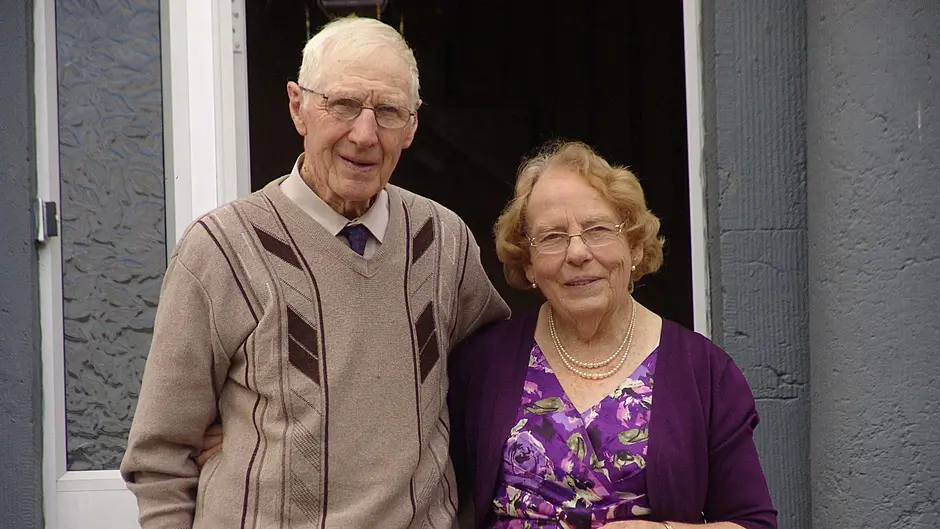
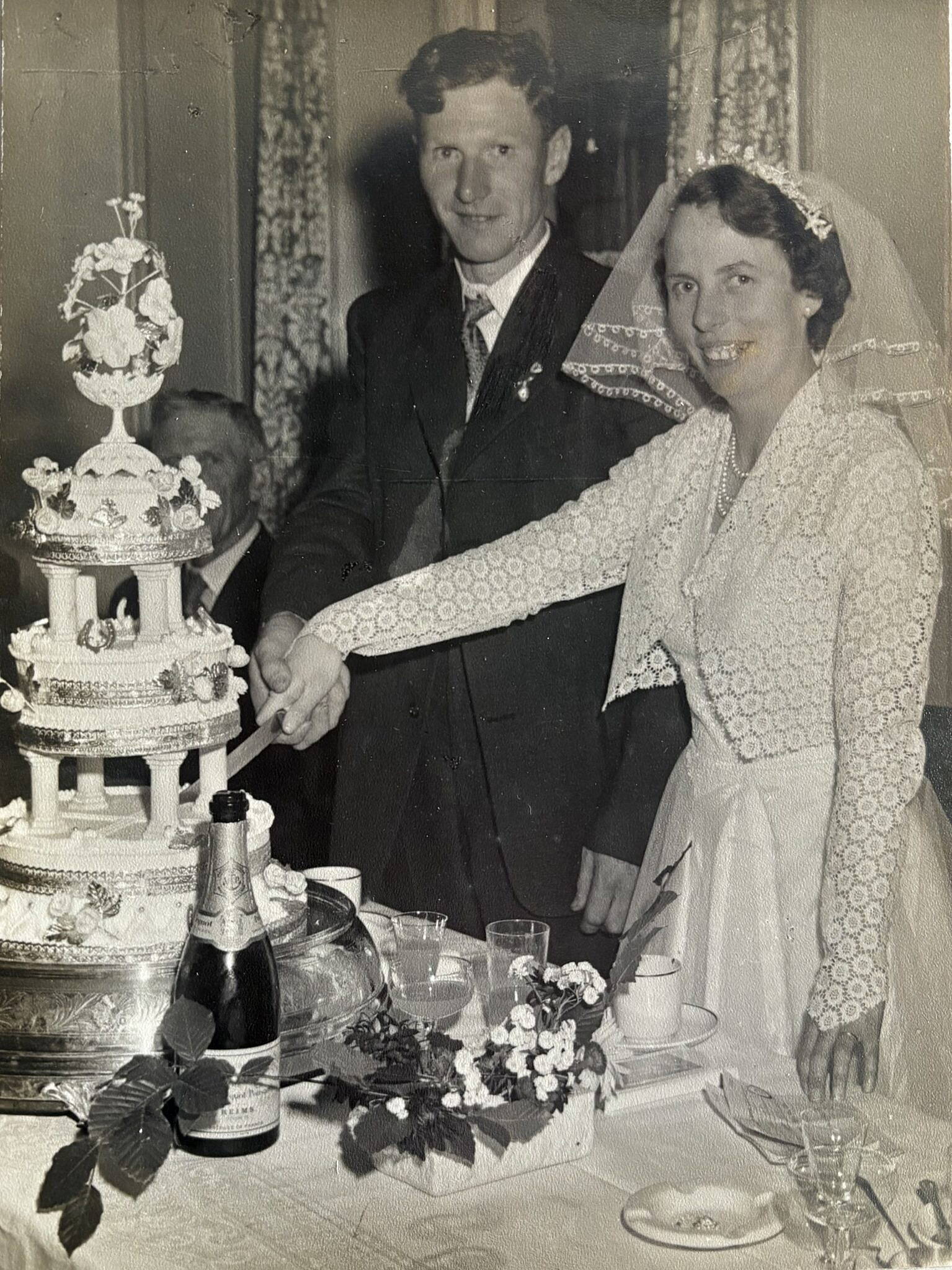 Cornelius and Margaret’s Wedding Day back on the July 18th, 1957.
‘The return fare from Macroom was two and six, and it was money well spent. The train even brought tourism to the area: I remember city folk coming out on Sunday afternoons to visit Castlemore Castle and Belmount House, where they would hold what seemed to me at the time to be the most elegant garden parties.’
‘My own love of travel began with summer holidays spent at my grandparents’ house in Raheen, Newcestown. These are days I still remember fondly. It gives me great pride that my granddaughter Aoife now teaches in Newcestown, keeping that family connection alive.’
‘Over the years, I’ve been lucky to travel far and wide to New Zealand, Hong Kong, America, Canada, and across Europe. My first flight was to England to attend the Royal Show.’
Cornelius remembers the rural electrification programme too. ‘It changed everything. It made life easier and took a lot of hardship out of daily living.’
‘During the war, things were tough, coupons were used and everything was rationed. Tea and sugar were scarce, and we grew most of what we needed ourselves. The closing of the sugar beet factories years later was a big blow. It took a long time for Irish agriculture to recover.’
‘Joining the European Union was a major turning point. It brought new opportunities such as fertiliser, better breeds of cattle, and access to new markets beyond England. It transformed farming and brought prosperity to rural Ireland.
‘Thinking back on my nearly 100 years, one of the hardest times that I can remember was the TB outbreak,’ said Cornelius. ‘It swept through communities quietly but cruelly and people lived in constant fear of it. Families built little huts or makeshift houses away from their homes so that anyone who became infected could stay there, often to die there, alone. It was a very isolating and sorrowful time. When COVID came along, it brought those memories flooding back, but I still think TB was far worse. I’ve lived through hardship and prosperity, through war and modernisation, through Ireland’s rebirth as a confident, independent nation. And through it all, I’ve remained proud to call this place home.’
Cornelius has lived through the election of 10 presidents, including the first president of Ireland Douglas Hyde in 1938, and he said it was a privilege to cast his vote this year too. He was just 12 when Douglas Hyde was elected, but he still remembers the controversy surrounding his appointment.
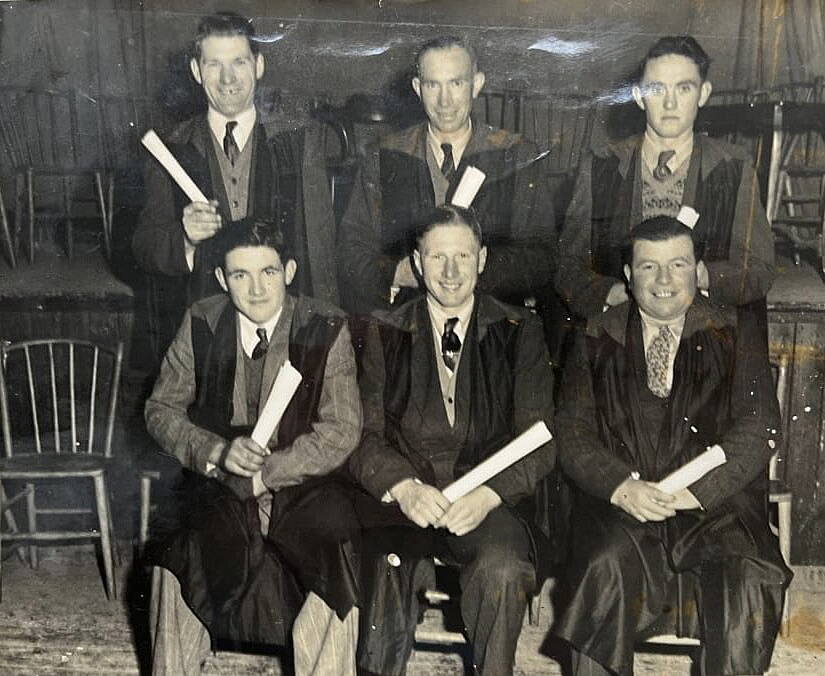 Cornelius (front row centre) receiving his diploma of Social and Rural Science from UCC in 1953.
‘Many of the old, traditional supporters of Éamon de Valera weren’t happy with Douglas Hyde’s appointment, and it took quite a while for feelings to settle and for people to accept the decision,’ he said.
‘The first time I voted in a presidential election was in 1959. In those days, you had to be 21 to vote, so I was too young when Seán T O’Kelly was elected in 1945,’ said Cornelius, who believes voting is one of the most important rights we have.
‘It’s your chance to express your opinion and help shape the direction of the country. Not everyone had that right once,’ he added, citing a time when only registered property owners could vote. ‘That didn’t last long, but it left its mark.’
Cornelius doesn’t agree with people spoiling their votes as many did in October’s election. ‘To me, that’s abusing the right to vote. It’s something hard won, and every citizen should value their say in how Ireland is run,’ he stated.
Looking back on his life, Cornelius said he is amazed at how much has changed in politics, in farming, and in how we live and communicate.
‘The pace of change over the years has been extraordinary and yet, the memories of those earlier times remain as clear as ever.’
‘When I walked into Crookstown Hall to cast my vote in the presidential election, I was reminded of my younger days helping to build that very hall. I can’t say that, as a young fella, I ever thought I’d still be here in my hundredth year, voting for the next President of Ireland.’