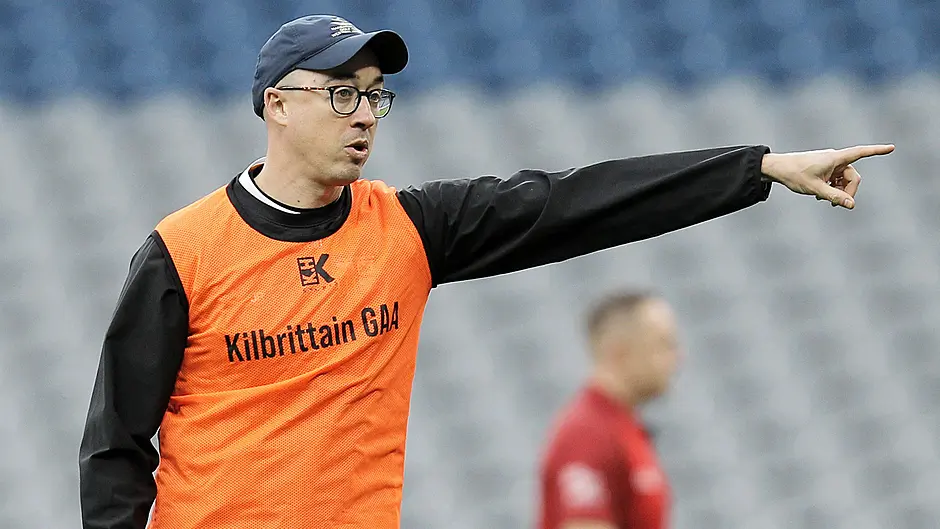
KIERAN McCARTHY caught up with Kilbrittain boss Joe Ryan this week to chat about key moments in the All-Ireland final
AWAY from the cauldron and chaos that Croke Park can be on All-Ireland final day, earlier this week Joe Ryan took the chance to rewatch Kilbrittain’s greatest day.
‘You get a different perspective watching it back,’ the Kilbrittain boss explains.
ADVERTISEMENT
‘It can be hard to judge the quality of a game while it’s happening because you are worrying about one thing or another, and they are so tense too.
‘Watching it back, it was a really high intensity game, with some great scores in it. At the time I might have felt there were things we were struggling with, and then that you are not playing as well as you can, but that was down to Easkey’s pressure as well.’
So, a few days on, Ryan shared his thoughts on key match-ups, reacting to Easkey’s first red card, and Ronan Crowley’s man-of-the-match showing.
***
How Kilbrittain set out to negate the influence of Easkey star attacker Andrew Kilcullen.
‘Anyone who has watched Easkey will know that Andrew Kilcullen is their main man,’ Ryan says.
‘In previous games they had isolated him one-on-one inside, so we had to have a plan for that. In other games they had Kilcullen and Thomas Cawley inside, so it became about match-ups – when Thomas Cawley goes out, who is with him? When he’s in, who is with him?
‘I like to back who we have, so James Hurley was going to go on Andrew Kilcullen. There was evidence there for James, in terms of how he dealt with Padraig Fitzgerald of Kilrossanty and James Doyle of Davidstown.’
Ryan also pointed to the influence of Fionn Connolly in Easkey’s system.
‘We knew Fionn Connolly goes out. In some games he roams around midfield, but in the Connacht final he went much deeper and was effectively acting as a sweeper.
‘When Connolly went back deep, we were hoping to engage him. So Philip (Wall), who was on Rory McHugh – a very good player – and Bertie (Butler) had to engage Connolly when he was on the ball.
‘Sometimes that works and sometimes it doesn’t. It’s a lot of work for Bertie and Philip, and a lot of ground to cover. There were times when it worked, and times when maybe it didn’t.
‘Easkey were really good at finding the man in the better position and working the ball up. Ironically, in the second half that’s something we lacked a little bit. The hope was to work it up more, draw their half-back line out, and deliver it over them – but that’s not an easy thing to do.’
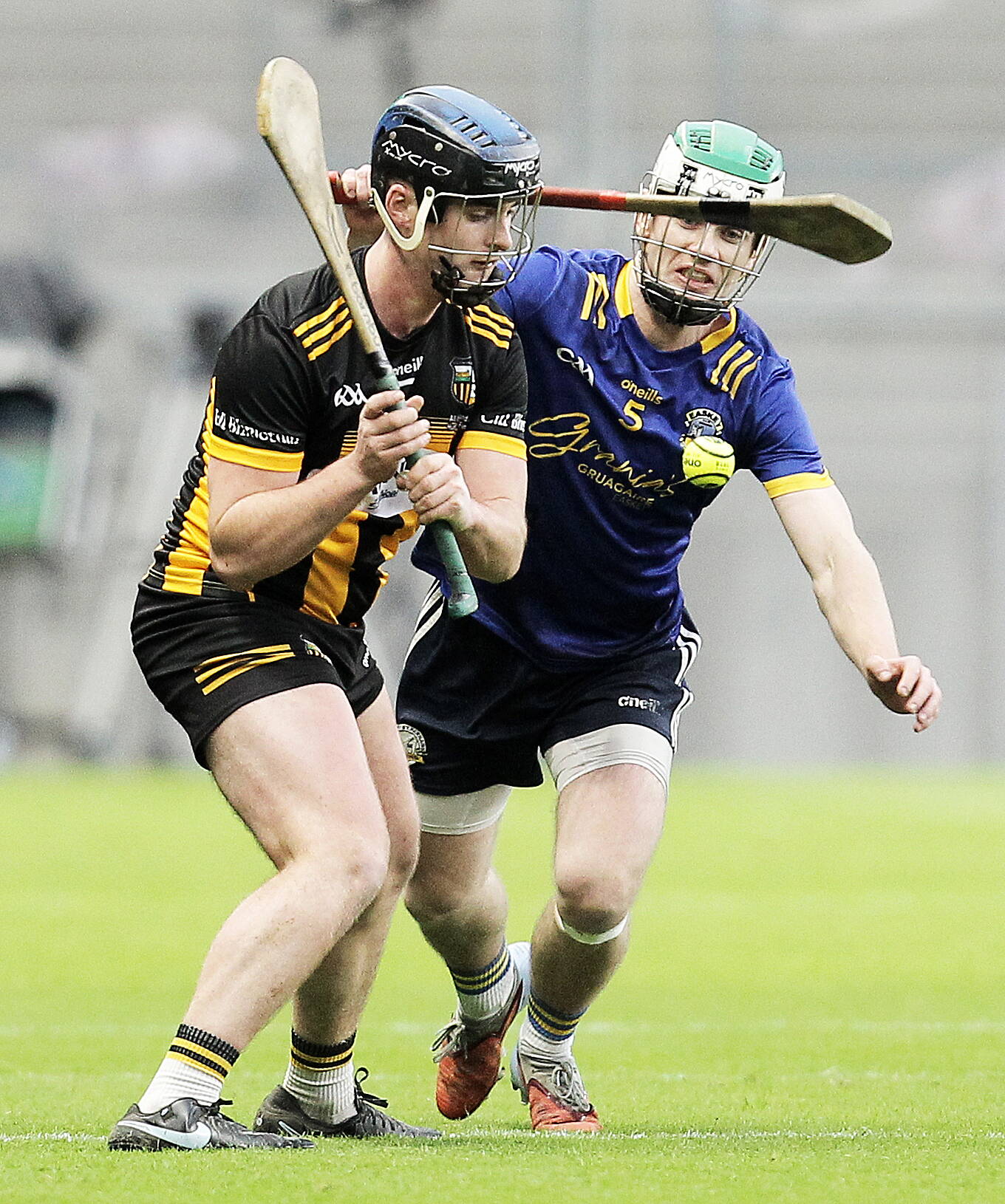 Kilbrittain's Colm Sheehan is challenged by Easkey's Dónall Hanley during the All-Ireland final. (Photo: Paddy Feen)
***
When Kilcullen was red carded in the 40th minute, Easkey hit back impressively, going from two points down to one up. Kilbrittain responded to the swing in momentum by introducing the experienced Tomás Harrington.
‘I wasn’t surprised they rallied when they went down to 14 players – you see that happen a lot,’ Ryan says.
‘From a structure point of view, we had two players behind and there was a lot of space. We were overplaying it a little bit, moving the ball around the half-back line and delivering it from there, which is our normal game.
‘The problem was Easkey had dropped really deep, so we needed to draw them out. You do that either by taking long-range shots – which we did against Kilrossanty in the Munster final and it worked – or by carrying the ball further, with Colm Sheehan, Tomás Sheehan or Aaron Holland from the half-back line soloing up, engaging them, and delivering over them.’
Harrington’s introduction brought composure.
‘When Tom came on, he did what he’s very good at. He’s a very intelligent player. From a communication point of view, in that cauldron where everything seems chaotic, Tom will come on and say: “Okay, this is your job, stand over there. This is my job here,” and just move lads around.
‘The other lads have massive respect for Tom because of the experience he has – it settles them as well. And it worked. Easkey had their chances, but we came out on the right side of it.’
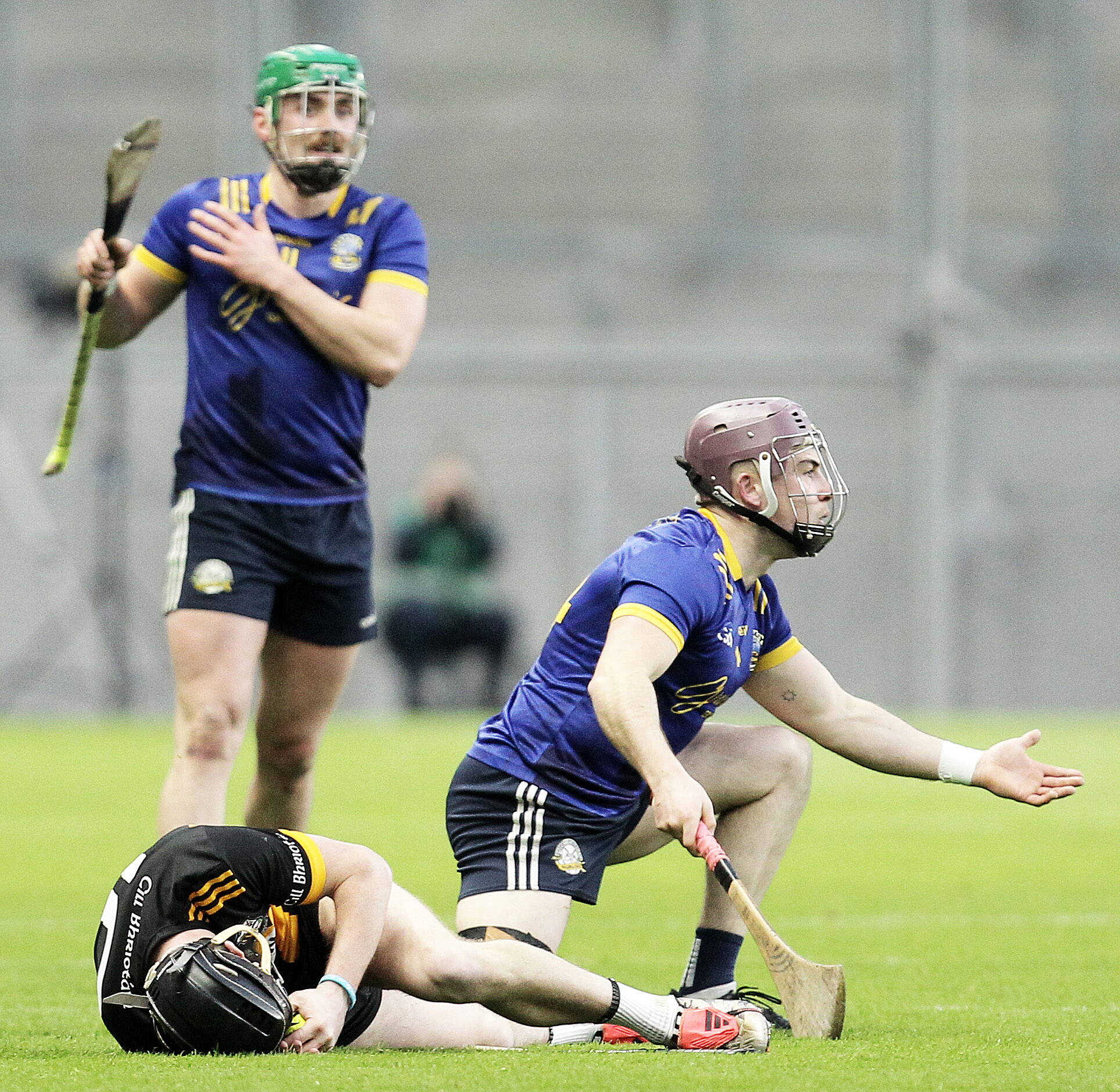 Andrew Kilcullen's red card in the 40th minute was a turning point. (Photo: Paddy Feen)
***
Ronan Crowley emerged as the All-Ireland final man of the match, scoring four points from play. This was his day to shine. One to remember.
Ronan Crowley emerged as man of the match, scoring four points from play on the biggest stage of all.
‘We have real calibre in our forward line – six forwards who are all a threat,’ Ryan explains.
‘If you look back over the run to the final, Conor Hogan had big games, Mark Hickey did too, as did Luke Griffin, Philip Wall, Bertie Butler and Ronan. Different players were delivering in different games.’
Ryan wasn’t surprised that Crowley stepped up.
‘Ronan’s big game earlier in the championship was against Davidstown in the All-Ireland semi-final. After the county final against Glen Rovers he hurt his shoulder, so he hadn’t done any training going into the Knockaderry game in the Munster semi-final.
‘From a fitness point of view, we knew he’d struggle a little. He was caught somewhat in the Kilrossanty game because the intensity was higher again.
‘After that, Ronan took it upon himself and said he would work as hard as he possibly could. He did that against Davidstown, and he had the evidence then to say: “If I work really hard, good things will happen.”
‘A few balls didn’t fall for him in the first half last Saturday, but he kept going. He’s excellent at offering himself as an outball, tracking back, and using his position well.
‘He’s an outstanding striker of the ball. In our first league game against Midleton last March he played centre forward and scored eight points from play. Nobody here was surprised that Ronan scored four points from play in an All-Ireland final – we know how good he is. This was his moment to show it.’