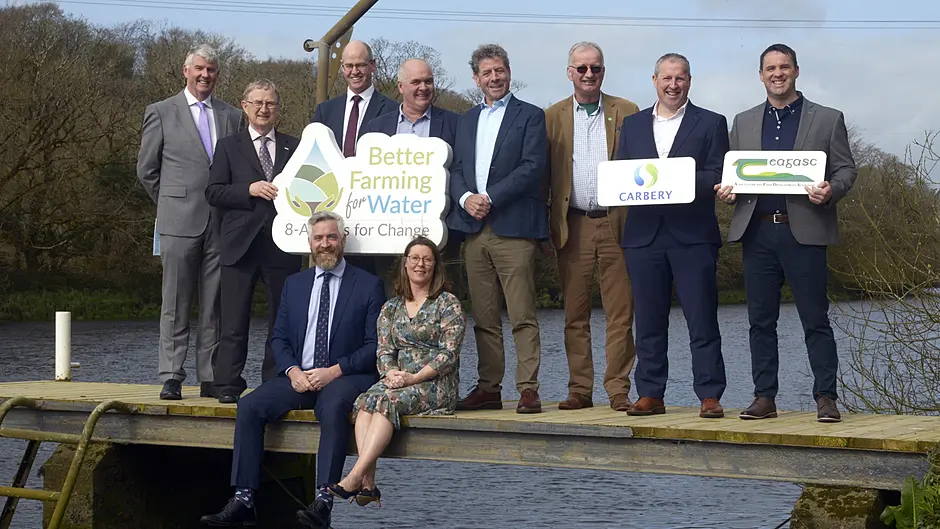
Farmers across the Bandon-Ilen catchment area are being encouraged to adopt a number of measures that have been identified as key to improving water quality where agriculture is a significant pressure.
The measures are part of the Lee and Bandon-Ilen Catchment Action Plan (CAP), which was recently launched as part of Teagasc’s ‘Better Farming for Water’ campaign.
Eight ‘Actions for Change’ in three categories were identified as crucial. In nutrient management, farmers are encouraged to reduce the purchased nitrogen surplus; optimise soil fertility (especially lime/pH); and apply fertiliser at appropriate rates, times, and conditions. In farmyard management: ensure sufficient slurry storage; minimise point source nutrient loss from yards and roadways. In land management: fence off watercourses; use riparian margins and buffer strips; maintain over-winter green cover on
tillage land.
ADVERTISEMENT
The Bandon-Ilen catchment was named as one of eight priorities, along with the Barrow, Blackwater, Boyne, Lee, Nore, Slaney and Suir, identified by the EPA as ‘catchments of concern’ which require tailored, locally driven programmes to reduce nutrient and sediment losses and restore water quality. The latest EPA water‑quality assessments highlight the need for coordinated on‑farm actions, which is a core aim of the campaign.
Minister of State for Nature, Heritage and Biodiversity, Christopher O’Sullivan TD was at the launch in the Innishannon House Hotel last week and said that the issue of water quality was central to the future of Cork’s communities.
‘This government is deeply committed to supporting the work being done on the ground by farmers, advisers, industry and local authorities to reverse the declines in our freshwater ecosystems, restore them to better health and ensure that they are more resilient,’ he said. ‘The Lee and Bandon–Ilen action plan is a clear example of a collaborative, practical and science‑led approach. Implementation really is key, and this is where my focus is as Minister for Nature. I want to acknowledge the commitment of the farmers across county Cork who are already making changes and who will play a vital role in delivering lasting improvements for our rivers, lakes, estuaries, and coastal waters.’
A dedicated Lee and Bandon-Ilen Catchment Implementation Group (CIG) has been established to oversee delivery of the Action Plan. Carbery Group, based in Ballineen, have undertaken the role of ‘industry lead’ to foster collaboration among stakeholders. The group brings together farmers, local authorities, catchment‑based industry representatives, regulators, catchment scientists, and specialists from LAWPRO and the ACP programme, Teagasc, and independent farm advisers.
Local Bandon farmer Roy Kingston has been named as the chair of the new Lee and Bandon-Ilen CIG, and says that ensuring a healthy, living countryside is key to the future. ‘Our farm has operated on the River Bandon for four generations,’ he said. ‘I grew up appreciating the peace and tranquillity of those pleasant, flowing waters, full of life and vitality. It is our responsibility to pass our countryside to the next generation in that same
good heart.’
In total, there are 229 surface waterbodies included in the Lee and Bandon-Ilen plan: 20 High status, 117 Good, 71 Moderate, 10 Poor, two Bad, and eight unassigned. Of these, 179 are river waterbodies – 17 High status, 106 Good, 49 Moderate and 7 Poor. All 179 are spread across 35 sub‑catchments. While many waters remain in good condition, High‑status rivers have declined, as highlighted by the EPA’s annual report released late last year.
Kingston said: ‘Reversing this trend will take time and collective effort. Yet with approximately 8,000 farmers across these catchments, we have a powerful opportunity to make a difference.’
At the launch, a comprehensive booklet was presented outlining the six pillars of the Lee and Bandon-Ilen Catchment Action Plan. Professor Frank O’Mara, director of Teagasc, said: ‘Farmers have a crucial role to play in restoring and protecting water quality. Across the country we are already seeing evidence of positive change, but further progress is needed.