
Volvo CE (construction equipment) can trace its origins back to humble beginnings in an engineering workshop in Eskilstuna, Sweden in 1832 founded by Johan Munktell.
Munktell built Sweden’s first steam train in 1853, his first steam-powered roller in 1906, and Sweden’s first tractor in 1913.
ADVERTISEMENT
In 1932, Johan formed an alliance with the Bolinder brothers, whose company manufactured Sweden’s first combustion engine in 1893. Their company went from strength to strength until ultimately purchased by Volvo in 1950.
Volvo were the pioneers of the articulated dump truck (ADT) in 1966, with the release of the 631 in 1966. The 631 was joined by the three-axle 831 in 1968, and Volvo had a winning formula with over 10 generations released so far.
While Volvo excavators became popular in the Irish earthmoving industry in the 2000’s, the Volvo ADT has been instrumental in shaping the Irish landscape since the 1980’s as a no-nonsense earth-carrying dumper, employed in a huge number of construction projects across the country. The Volvo 861 of the 1980’s was a true workhorse in the Irish construction scene.
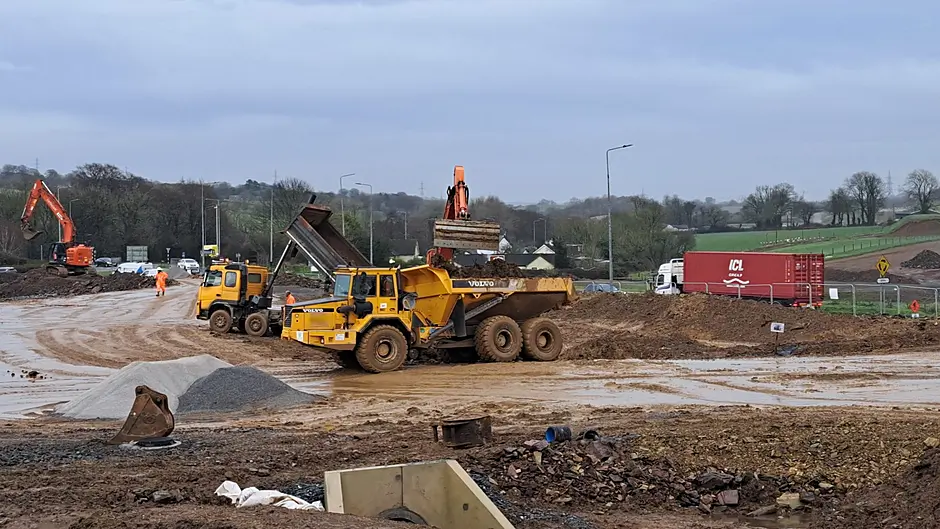
A testament to their longevity and purpose, a 20-year Volvo A30C (pictured) is still diligently at work at the Shannon Park roundabout section, despite more than ten of the latest Volvo G series ADT being involved in the Cork-Ringaskiddy M28 motorway construction project.
Manufactured in Volvo’s dedicated ADT factory in Braas, Sweden, the Volvo A30C was released in 1997, the third instalment of the world renowned ‘A’ series. Powered by a Volvo 6 cylinder 9.6 litre turbocharged, intercooled engine, the A30C produces 289hp.
The fully automatic power shift transmission has six forward gears and two reverse, operated by a round-handled lever to the operator’s right. The ADT has front axle suspension, 100% differential locks for each driven axle, is equipped with air over hydraulic brakes and has a top speed of 52kph.
Apart from the articulated steering, another key design feature is the twin A-frame bogey axles under the body which can move independently of each other. The rotating cylinder at the pivot of the machine keeps the front tractor unit upright in the event of the dumper body capsizing.
Weighing in at 21.5 tons, the standard body of the dumper can add an additional 30 tons which has a 14mm of steel thickness in the floor. Twin double-stage ramps are capable of tipping the load to a 70-degree angle for fast ejection in with a load cycle time of 27s. This is thanks to four engine-driven hydraulic pumps with a 109/min capacity, driven directly from the engine on the right hand side.
Contact Peter at [email protected] or see Instagram @flashphotoscork