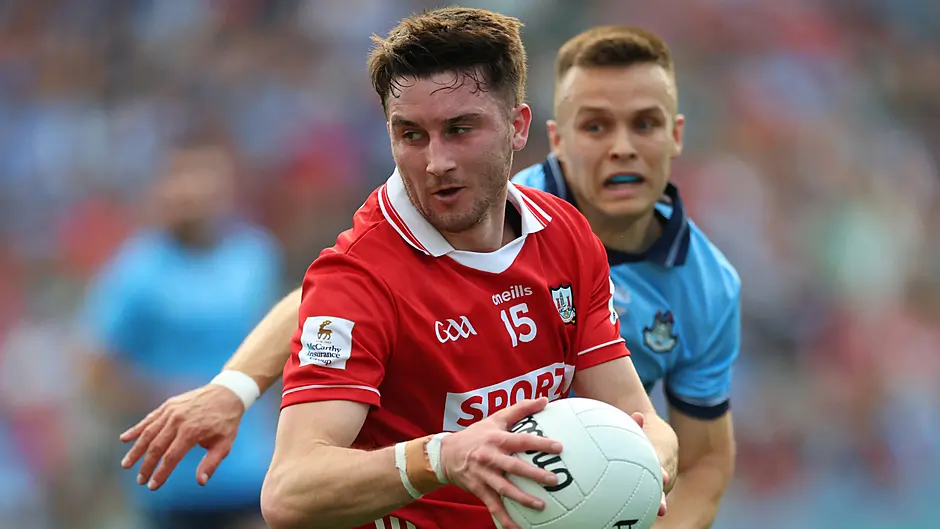
AS we grow more used to Gaelic Football 2.0 and the new rules, there’s more attention than ever on two-pointers, the three-up rule and much more. But one element of the game that isn’t being talked about as much is goalscoring. Or, in Cork’s case, the lack of goals.
Since round four of Division 2 in 2025 – against Monaghan on February 22nd – Cork have hit the net just four times from play in 12 competitive games. If you include penalties, that total nudges up to five, but that’s not much of an improvement.
It equates to an average of just 0.33 goals from play per game.
ADVERTISEMENT
Only Chris Óg Jones (against Kerry in Munster, Dublin and Louth), Colm O’Callaghan (against Louth in 2025) and Mark Cronin (penalty against Monaghan) have scored goals for the Rebels in this period.
Worryingly, only one forward has scored a goal from play in that timeframe, despite Cork having the likes of Brian Hurley and Seán McDonnell in attack.
John Cleary’s goal-shy side have drawn blanks against Roscommon (twice), Cavan (twice), Limerick, Meath and Kerry (All-Ireland series).
Compare Cork’s average goals-per-game with other Division 2 sides over the same stretch. The closest to the Leesiders is Cavan with a 0.73 average, followed by Tyrone on 0.77, and they operated in Division 1 for four of those games. Meath and Louth have higher rates again (1.0 each), while Kildare and Derry have been most productive at 1.13 and 1.2 goals per game respectively.
Cork have created 40 goal-scoring opportunities in those 12 games but converted just five. That’s a success rate of only 12.5 percent.
There are several contributing factors. One is the speed of delivery into the forwards. Too often, Cork work the ball into the space between the opposition’s 45 and 65 and then go sideways or backwards rather than spotting a runner breaking through for a quick kick-pass.
Cork players have the ability to move the ball quickly into dangerous areas. In the Sigerson Cup quarter-final, Clonakilty’s Conor Daly (who has been training with Cork too) delivered a pinpoint kick-pass that set up Ciarán Santry (Carbery Rangers) for a UCC goal against DCU, finished low to the corner. That’s an example of what can happen when the attack is sharp and accurate.
Even when Cork do create openings, however, composure in front of goal has been lacking. Too often, shots are hit high rather than low. This was evident in their 2025 All-Ireland group game at home to Kerry when Matty Taylor and Mark Cronin both had chances.
A shot at head or chest height is far easier for a goalkeeper to stop. A low effort at ground level is much more difficult to deal with. Look at the three goals Cork did score from play – O’Callaghan’s and Jones’ finishes were all low and well placed. That’s the way to make a goalkeeper work.
The best forwards in the game keep it low. Look at David Clifford and Con O’Callaghan, they get their rewards through composure, bravery and ruthlessness. For the Rebels to reach the next level, they must start converting their goal chances. They must find their goal-scoring touch. It’s a crucial piece of the jigsaw, and one that could bring Cleary’s side closer to where they want to be.