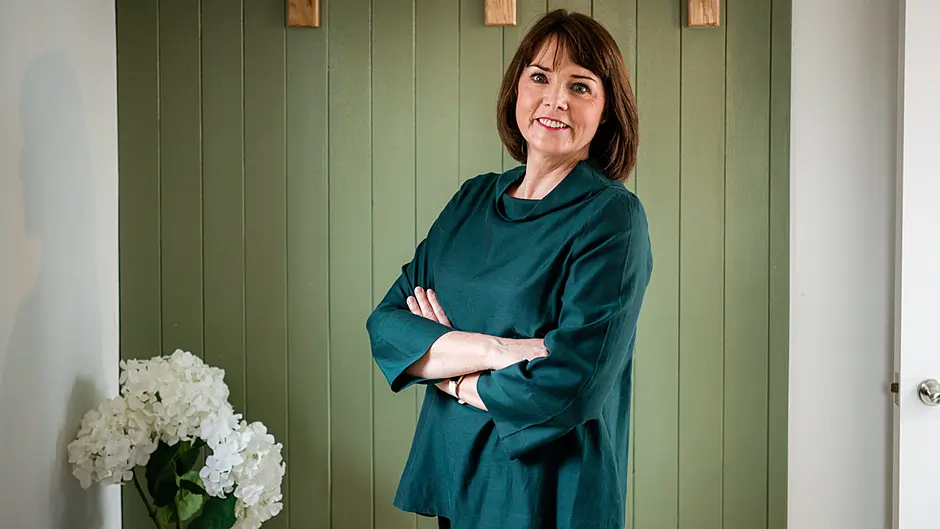
KINSALE-based professional organiser Vera Keohane was forced to practice what she teaches when she and her husband downsized and she had to say goodbye to many treasured possessions.
Vera, the first Irish woman to receive formal training from the Japanese decluttering guru Marie Kondo, moved from their five-bed family home to a smaller custom built property, with a short stint in a rental in between.
She enjoyed a near 30-year career as a nurse, and said it was her time working in the community that prompted their decision to move.
ADVERTISEMENT
‘My experience as a nurse in the community really shook me,’ said Vera.
‘Often I would be aghast at how elderly people were living – perhaps confined to one or two rooms, because the rest of the house had been taken over with clutter, or because the space wasn’t suitable for them. It was very sad.
‘We wanted to prepare for our future selves. Our five children have all flown the nest, some rooms in the house weren’t in use and we had a garden that needed lots of maintenance. We didn’t want to be making decisions in ten years’ time, it was about making a move now when we were still in control, and getting ahead of things as no one knows what’s coming down the line.’
Despite her vast experience and passion for organising, there were still aspects to the move she found challenging – all emotional.
‘Framed family photos were hard to let go. They were hanging on the walls in the old house, but we’ve a lot of glass in the new house so they don’t work.
‘It was hard to let go of the dining table as well – there were so many memories associated with it dancing around my head. I couldn’t get rid of it initially and put it in storage when we were renting and then gradually I was ready to let it go.’
Vera was also ready to relinquish her wedding dress, veil and shoes – 30 years on – which she donated to charity.
‘Some things you have to do in your own time,’ she said, and it’s this gentle approach to organisation that has put her services in high demand. ‘All my memories were in that house, but after six months every feeling of loss was replaced by the joy of being able to create new memories.’
The couple’s move was never in their original plan, but Vera feels she paved the way for it, and her radical career pivot, when she began the process of decluttering her home in 2018.
‘I saw Marie Kondo’s book, The magic of Tidying Up, online, bought it and put her principles into practice. It was like I was getting the permission to rid of things without any of the guilt,’ she recalls.
Half-way through that process, she celebrated a significant birthday, and having read that Mari Kondo would be giving a seminar in New York, Vera flew to the Big Apple.
As a result she completed her training with the Japanese organising consultant, and in 2019 gave up nursing to embark on her new career.
‘The timing was right – the Marie Kondo documentary came out on Netflix that year, and my name was on her website as the Irish trained expert so that really helped,’ said Vera.
 Marie Kondo
Our homes are our biggest investments, she says, and should be a source of enjoyment. But for many it’s the opposite.
‘Our surroundings directly impact how we feel and clutter is rarely recognised as a source of stress, but there’s been extensive research done into this. There can be some feelings of embarrassment when it comes to asking for help, but getting on top of this, something that’s controllable, can be the gateway to better mental health.’
Vera point out, for example, how lots of people will have received gifts for Christmas that they don’t need or want.
‘The purpose of the gift was to express gratitude, not to be a burden so there’s no need to feel bad about passing them on to a charity, or taking unopened toiletries to a hygiene hub,’ Vera says.
Her approach isn’t ‘if in doubt, throw it out,’ rather ‘if in doubt, have a think,’ but the focus is on keeping things you really cherish.
‘The emphasis isn’t on losing something, but creating joy from what you’re keeping. Expressing gratitude for something helps you let them go. We can be cerebrally attached to things, but if you thank them for their services, it helps the process.’
Vera has been vocal on the notion of Swedish Death Cleaning, a mindful process where people sort through their belongings to reduce clutter for loved ones after they die, preventing future burdens.
And far from being morbid, she thinks it’s an empowering process that people could start to think about from their mid 40s.
‘At different stages of life, we’ll be at a different readiness to let things go. It’s not morbid, in fact it’s about allowing us to live before we die – by organising your home you’re clearing the path for retirement, or the next stage of life, perhaps for a time you won’t be able to care for yourself, or make decisions for yourself.
‘And you’re giving your children a gift as well as they won’t have to do it,’ said Vera who suggests giving a gift with a warm hand, can be nicer than leaving something in will.
One common pitfall she sees is people rushing out to buy containers and baskets for their decluttering project.
‘I advise not to buy anything until the process is done – otherwise all you have is organised clutter!’
Ultimately, Vera says, if you want more joy in life, you need to create space for it – one organised drawer at a time.
VERA’S TOP TIPS
Declutter by category not by room: this is a game changer says Vera. Rather than taking on your entire bedroom, decide instead to deal with the category of coats and blazers. Round them up, from where ever they are around the house, so you can clearly see, and hang them all together.
Pause before you pay. ‘We’re living in a consumer driven society that’s led us to think that happiness is in having things. Buying less is where organisation start – invest in experiences instead, a day out with someone, a hike, meeting for a coffee. Take home a memory, not more stuff,’ says Vera.
If someone doesn’t live with your, neither should their stuff. For various reasons people store things, including large items of furniture, for family – at the expense of their own comfort. If someone has to take responsibility for their possessions, and possibly pay for storage, it will help them decide what to keep, she says.
Digital clutter is a thing, says Vera. Our phones are clogged with so much that we usually can’t find what we need, when we need it. She advises taking time when waiting at appointments or in airports to delete unnecessary files and images. ‘We hold on to so much on our phones and it causes us stress. There’s also a cost to it – the next time you get a reminder to get more storage, take the opportunity to create more space instead.’