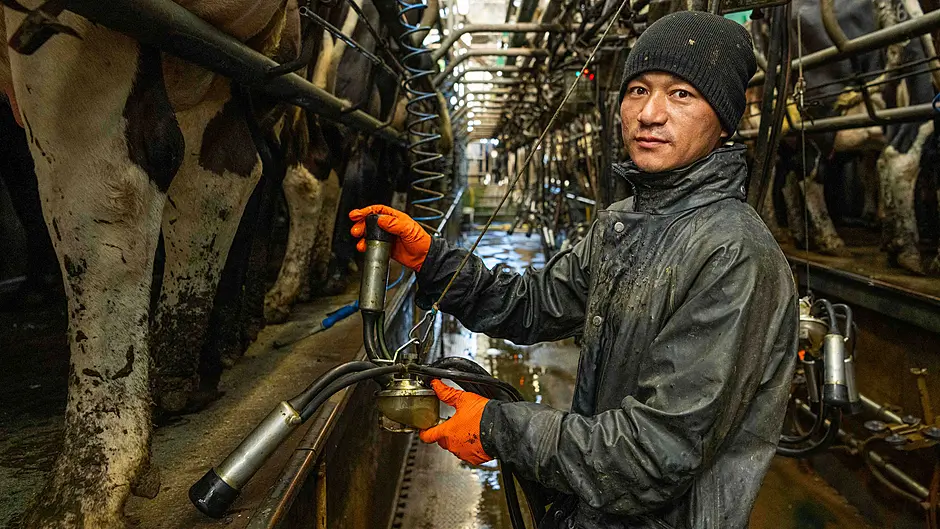
A NEPALESE rice grower is milking cows in West Cork, as local dairy farmers rely increasingly on foreign workers for vital labour.
Krishna Bunchhen moved to Ireland in 2024, after spending five years working for the Almarai farm group in Saudi Arabia.
A friend of his was already working in Cork and Krishna initially came to a farm in East Cork, before moving to Timoleague last September, where he works with dairy farmer David Deasy.
ADVERTISEMENT
The 33-year-old’s motivation for coming here was to support his family in Nepal; he’s a married father of two, and for David Deasy, who operates a 220 dairy farm with a 130 acre milking platform, Krishna is absolutely crucial to the day-to-day running of the operation.
Krishna says Ireland and Nepal aren’t as different as you might imagine.
‘The countryside is quite similar and I don’t mind the weather here. It’s really only cold for one season at home, so it didn’t take any getting used to. People are also very friendly, the food is great, and there are other Nepalese farm workers working near Ballincollig that I’m in touch with,’ he said.
Technology means Krishna, who lives in a mobile home on the farm, has daily contact with his wife and his children, who are aged 10 and two, and his mother mother who run a rice, corn and tomato growing farm at home.
‘We video call every day so I don’t feel like I’m missing out on too much,’ he said.
David points out that in Nepal, cows are sacred: ‘Krishna is very respectful of the animals, and has a brilliant work ethos.’
This isn’t the first time David has employed foreign workers and has had labourers from Germany, Italy and New Zealand.
‘I worked with a brilliant stockman, Stephen O’Brien from Ballinascarthy, for over 10 years, and who is retired now. He was an outstanding stockman but there’s not the likes of him available anymore,’ he said.
David has three sons, aged 17, 15 and 13, who all help out on the farm, but given the scale of his operation, full-time labour is essential.
‘There’s very few of the younger generation now who are prepared to work seven days a week, and get their hands dirty unless they are well paid for it.
There are much more attractive options out there for them. Put simply, the sector is experiencing a labour crisis’.
‘As a result I think that in the next two to three years co-ops and processors won’t know what will hit them as there will be so many farmers who will get out of cows.’ As well as a problem with a lack of labour, he pointed to the ‘over-regulation’ of the sector that’s deterring the next generation.
‘On any given day there’ll be a letter or a visit from what I call the “food police”. I also feel there’s a lack of respect and appreciation for the work that we do. What other industry has no idea what’s going to happen to it in six months’ time, for example, in the case of derogation? It feels like figures will be plucked out of the air and we’ll be told to get on with it.’
He added: ‘I feel that only a very small percentage of our policymakers have any idea what happens day-to-day on a farm. Few people have any idea of the mental load farmers carry, that you’re never off. I’ve been farming since I was 18 and I had my first Christmas Day off in 2011. Money, even if we were getting a price we deserved, doesn’t replace lost time.’
David is conscious of treating Krishna well, and to prevent burnout he has every second weekend off.
‘For the farmer who doesn’t have access to labour it means that on those weekends they are doing the work of two men; for me that means milking and the associated jobs could take anything up to three hours, morning and evening.’ He predicts that in the future, the government will be in a position where they will be throwing money at people to stay or get involved in dairy farming.
‘Dairy farming will be ran into the ground, like what has happened to beef farmers, and what’s in the process of happening to tillage farmers.’
Having said that, he still has a huge passion for farming and does see a future for the next generation.
‘However, the landscape will look very different; when someone retires, their land might be farmed by someone else, but it won’t be feasible to milk in more than one place. Farmers will be scarcer but hopefully reality will have hit policymakers by then, and we’ll get the respect, appreciation and income we deserve.’