AT AROUND 1am on Monday January 8th 1979, a dinner dance at Bantry’s West Lodge Hotel came to a sudden halt when the floor began to tremble and chandeliers dropped to the ground.
BY ROBERT HUME
In Glengarriff, the walls became ‘distinctly hot’ at the Eccles Hotel; while, in the Mealagh Valley, small pieces of shrapnel rained down.
ADVERTISEMENT
‘It was terrifying,’ recalls John O’Shea from Bantry.
‘You could feel vibration all around the place.’
An orange fireball lit up the sky, ‘brighter than any sun we’d had on the finest day of summer’.
Two miles offshore, Whiddy Island had been identified by Gulf Oil in 1966 as a suitable site for a new terminal because it offered a long, sheltered, deep-water anchorage – and no harbour fees.
The idea was enthusiastically accepted by locals as it meant jobs, and its opening in May 1969 was celebrated in the Clancy Brothers song Bringin’ Home the Oil.
The onshore facility consisted of 12 huge 70ft high tanks, capable of holding 1.3 million tonnes of oil, while the offshore ‘jetty’ comprised 22 platforms (‘dolphins’), a power-house, pump-house, fire-station and control office.
On 24 November 1978, tanker MV Betelgeuse, owned by French oil giant Total, and measuring the length of three football pitches, left Ras Tanura in Saudi Arabia bound for Portugal with 115,000 tonnes of crude oil.
The weather was too bad for her to enter Sine on 26 December, and docking at Leixões was impossible because another ship had run aground across the harbour entrance.
On December 30th Total HQ in Paris redirected her to Whiddy Island: a fateful change of course.
Tanker
On January 4th 1979 the tanker berthed at the offshore jetty where there had already been a number of spillages.
It was cold but calm on the night of Sunday 7th into Monday 8th January.
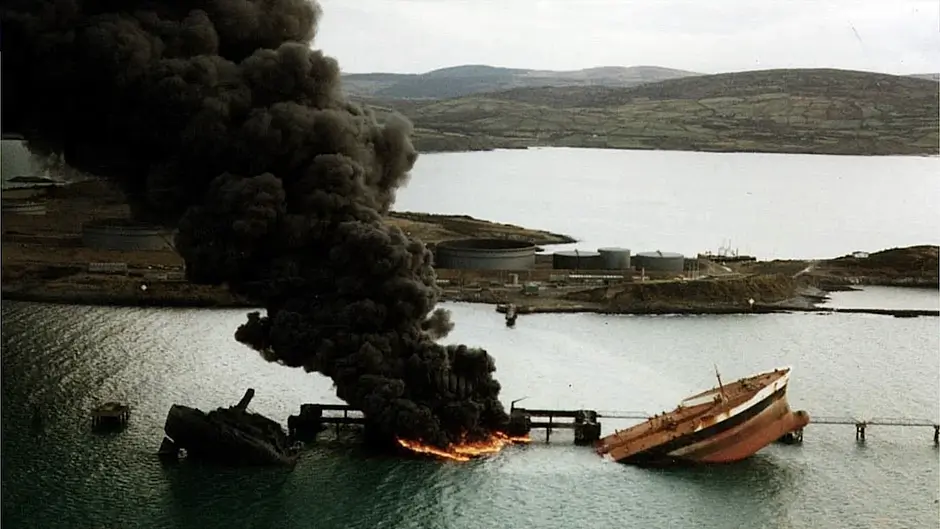
The French crew were asleep when, at 12:50 am, the wail of sirens suddenly pierced the silence: a rumbling from within the ship, a series of small explosions, then, at 1.06 am a massive blast.
The Betelgeuse broke in half, leaving the bow and stern up in the air.
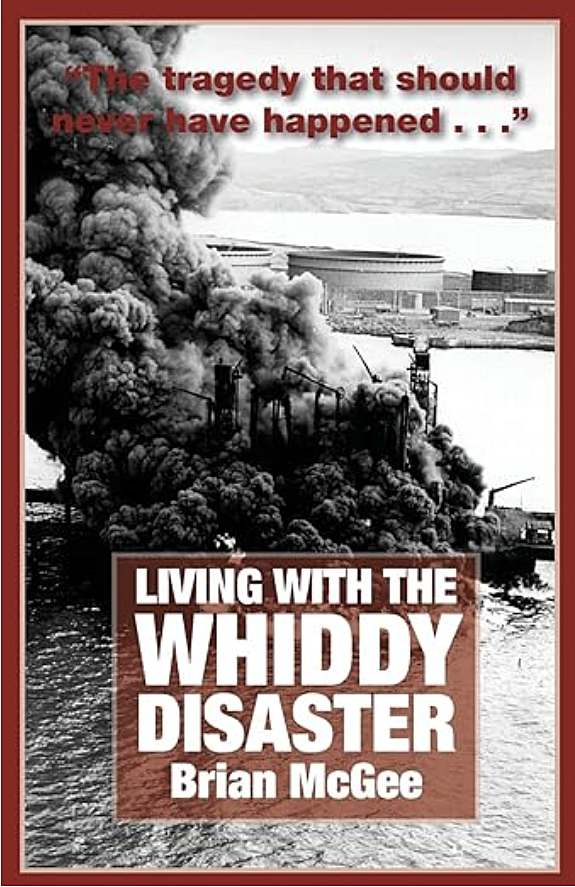
In his chilling account Living with the Whiddy Disaster (2014), assistant pump operator Brian McGee remembers being ‘filled with sheer dread, expecting at any moment that the tanks would overheat or be punctured and detonate, leaving Eleanor a widow and my little ones, orphans’.
Men were running for their lives ‘with flames swirling like a giant hand trying to engulf them’.
Casualties
The search for casualties began at first light. A grim procession of bodies, picked up around the bay, began to be ferried ashore and airlifted by helicopter to Cork City. Only 27 have ever been recovered.
When the Betelgeuse sank on January 9th it extinguished the inferno, but firefighters from Bantry, Skibbereen and Dunmanway were unable to get close to the wreck for a fortnight due to clouds of toxic, flammable gas.
Every member of the French crew, the wife of the ship’s baker, an English cargo inspector, the Irish crew and pilot on the jetty (50 in all) lost their lives. Subsequently, a Dutch diver involved in the salvage operation also died.
William Shanahan from Ballydehob was working that night because he’d been denied leave to stay with his wife who gave birth hours later.
Timothy Kingston from Goleen had stepped in for a colleague who wanted to take his wife shopping at Cash’s sale in Cork.
It meant leaving his four-year-old son Michael’s birthday party early.
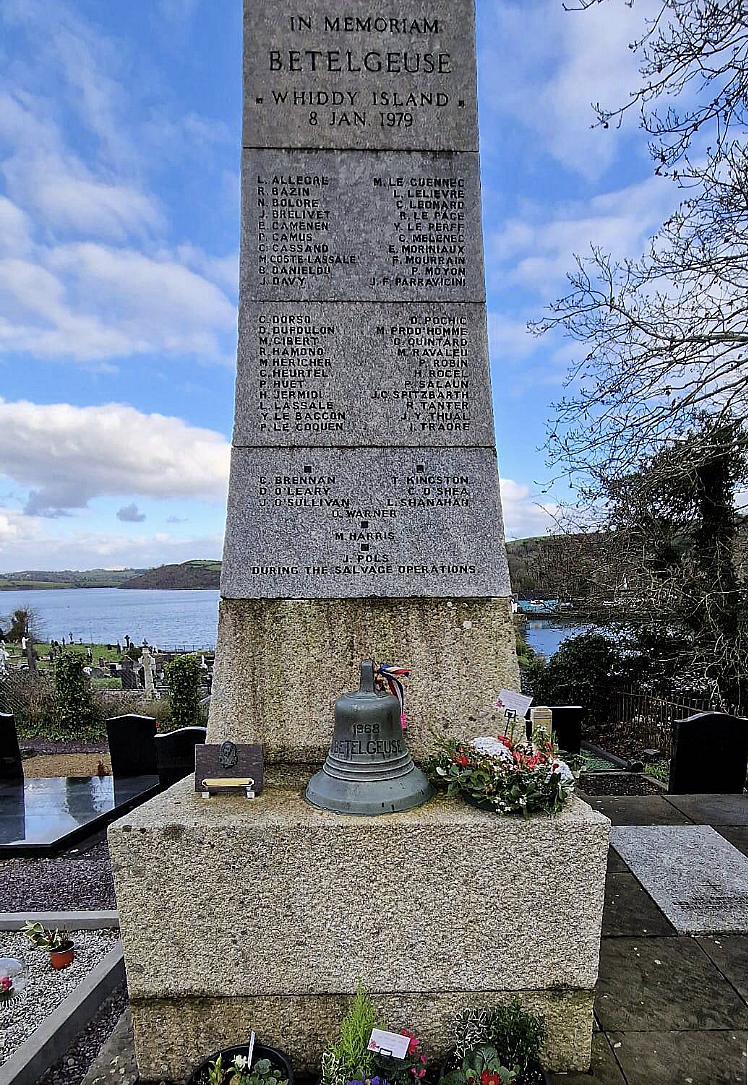
Inquiry
Taoiseach Jack Lynch promised a full-scale inquiry.
The tribunal opened in Bantry on April 26th, sat for 71 days and heard from 184 witnesses.
Its mammoth 488-page report, published in May 1980, described the tanker as ‘one of the shabbiest ever to visit Bantry’.
Apparatus had been ‘downgraded’ to save money, and needed replacing. In particular, it lacked a ‘loadicator’ to calculate stresses, and the terminal lacked an inert gas system to introduce non-inflammable nitrogen while fuel was being pumped out.
It criticised the lack of an evacuation plan, and the positioning of the two rescue tugs, which arrived ‘too late at the scene of the disaster to save the life of anyone’.
The Bantry Harbour Authority had failed to enact the regulations required under the 1972 Dangerous Substances Act; the fire brigade’s authority did not extend to the offshore jetty; and Gulf Oil’s fire-fighting systems were ‘wholly inadequate’.
The report singled out one despatcher for leaving his post in the control tower and not sounding the alarm in time.
It played down ‘the Irish State’s failure to ensure Gulf’s safety practices’, maintains Brian McGee. The ship, he says, was ‘dodgy’, ‘a rust bucket’. The jetty crew had ‘no proper fire training’ and were just told to ‘get to the windy side of the fire, act fast and ask questions later’.
The terminal Land Rover was ‘fairly clapped-out’, the fire engine ‘failed to start’, the diesel fire pump was ‘out of service’, hydrants lacked levers, hoses were not ready, no breathing masks or oxygen available.
‘There were just so many things wrong on Whiddy you could fill a book with them,’ Brian McGee concludes.
Michael Kingston, Timothy’s son, draws attention to the fabrication of evidence and incorrect logbook entries made by Gulf employees to cover their backs, and claims the incident showed up ‘some of the worst derelictions of duty in relation to safety in world maritime history, by the tanker’s owners, the terminal operators, the Irish Government’.
The victims’ families are still searching for the truth, and demand a new inquest, to have the death certificates changed from ‘drowning’ or ‘asphyxiation’, to ‘unlawfully killed’.
With short cuts to save money, and a lack of inspection and checks, Whiddy was an accident waiting to happen.
The seven Irish victims
• Charles Brennan, Jetty Utilityman, Reenmeen East, Glengarriff.
• Timothy Kingston, Pollution Control Officer, Shanavally, Goleen.
• Denis O’Leary, Plant Protection Operator, Currakoal, Borlin, Bantry.
• Cornelius O’Shea, Jetty Utilityman, Rossnosonogue, Glengarriff.
• James O’Sullivan, Jetty Foreman, Chapel Street, Bantry.
• William Shanahan, Jetty Utilityman, Church Road, Ballydehob.
• Captain David Warner, Pilot, ‘Carraig Donn’, Caher, Bantry.