Is a ‘little bit of madness’, as Graham Canty calls it, the X-factor behind West Cork’s extraordinary sporting rise? KIERAN McCARTHY explores the theory
GRAHAM Canty is many things to many people: hero, leader, warrior. But should we add theorist to the ever-expanding list that describes the Bantry man?
Possibly, if his explanation for West Cork’s remarkable sporting surge holds up.
ADVERTISEMENT
Accepting his Hall of Fame honour at the recent West Cork Sports Star Awards in the Celtic Ross Hotel, the former All-Ireland-winning Cork football captain offered a theory for the region’s golden age: ‘this little bit of madness.’
It’s a West Cork streak, he suggested, that fuels the drive, edge and belief pushing local athletes to places they once only dreamed of. It’s hard to argue with the evidence.
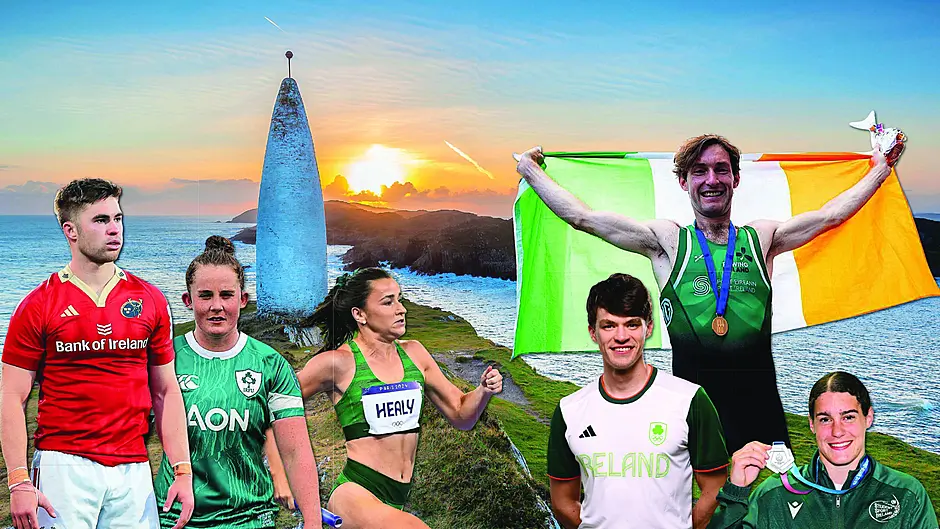
Olympic gods walk among us. Skibbereen Rowing Club, the medal factory, is now Ireland’s most successful rowing club, with gold, silver and bronze medals all housed on its shelves. At the Paris Olympics in 2024, seven Irish athletes hailed from West Cork – four rowers, two athletes and a hockey legend – a staggering return for a rural corner of the country. Only Dublin, Down, Antrim and the rest of Cork sent more.
And that’s only part of the story. There’s the inspiring rugby surge led by Jack Crowley, Gavin Coombes, Enya Breen, John Hodnett, and Fineen and Josh Wycherley, backed up by local clubs’ and schools’ breakthrough successes. Local athletes Phil Healy, Nicola Tuthill, Fiona Everard and Darragh McElhinney have all hit new heights on the world stage in recent times.
The list keeps growing. All-Ireland champions in GAA and road bowling, World and European champs in kickboxing, national winners in motorsport. And so on. It’s never been better for sport in this corner of the world.
‘In West Cork, I think we have something very unique here,’ Canty said. ‘We have ferocious talent. We have drive. We have commitment. We have volunteers that you won’t get anywhere else. We have this work ethic that drives everything, but underneath it all we have this little bit of madness.
‘I wouldn’t suppress it, I would drive it on. That little bit of madness would push you to go to places you thought you never could. It should be nurtured, harnessed, enjoyed and celebrated.’
So, is Canty right? Is there something in the water, in the wind, in the culture of this place that gives West Cork athletes an edge?
***
So what does this ‘little bit of madness’ look like in real life?
Perhaps it starts with the remarkable West Cork spirit, a fierce pride of place. That sense of belonging often feels stronger here, more deeply rooted. There’s a quirkiness here, a different rhythm.
‘It’s like its own county within a county,’ Kilbrittain hurling captain Philip Wall explained ahead of their All-Ireland club junior hurling final triumph, yet more history as the first West Cork club to wear an All-Ireland hurling crown.
Wall also recalled what former Carbery football manager Colm Aherne told his squad last season: ‘I love being from Cork, but the best thing about being from Cork is being from West Cork.’
Wearing your home region as a badge of honour matters, especially when you represent your own people on the bigger stages. Look at what Kilbrittain’s success means to locals: over 520 packed the Crowne Plaza Hotel in Dublin Airport for their All-Ireland final banquet on the night of their greatest day. The Black and Amber descended on the capital. No-one stayed at home.
But this ‘madness’ or passion or drive isn’t chaos. It’s a blend of stubbornness and an appetite for hard work that borders on obsession. It has to be.
The geography of West Cork presents a challenge to its own people in terms of distance to the main cities where, often, training centres are based. The Sport Ireland Institute in Abbotstown, Dublin, where high-performance athletes like Olympians train, is 300km from Kilbrittain, home of Olympic hammer thrower Nicola Tuthill.
Munster Rugby’s Limerick training base is a five-hour round trip from Coomhola, ten minutes outside Bantry – it’s a cross-country trek that Catherine Wycherley made weekly when her sons, Fineen and Josh Wycherley, were on their journey to become Munster rugby players. The brothers have already made over 200 appearances for Munster combined.
(Just 250 metres down the road from the Wycherleys live their cousins, the Bradys, and three of this clan – Sean, Oisín and Oran – have won world kickboxing titles. Strong genes. Just across the Coomhola River lives three-time Camogie All-Star Libby Coppinger. Headline-makers, neighbours)
Three times every week, Cork footballer Áine Terry O’Sullivan makes the almost 300km round-trip from Allihies, on the western end of the Beara peninsula, to county training at MTU Cork in the city. She thinks nothing of it – this is what she needs to do to play for Cork.
West Cork athletes have to go that extra mile to access the facilities and training needed to first reach and then perform at the highest level – this highlights the drive, commitment and work ethic Canty references. The need to push harder to be noticed. The need to work harder to earn that breakthrough. That’s a mindset; that dash of madness that Canty encourages, and it can be linked to the land, too, as locals embrace hard work. It’s part of their DNA.
Nicola Tuthill grew up on her family farm in Kilbrittain. Ditto for Phil Healy who rolled up her sleeves on their farm in Ballineen. Munster rugby star Gavin Coombes grew up on a dairy farm. It’s a similar story for Olympic rowing bronze medallist Emily Hegarty on her parent's dairy farm. Teddy O’Donovan, father of Gary and Paul, had a farming background too, and relished hard work, a trait his sons used to row into the record books. All of this is not a coincidence: it’s a direct result of the land shaping mindsets and the attitude to work.
Let’s flip the geographical challenges though; perhaps West Cork’s ruralness is, in fact, a blessing?
Dr Kate Kirby is the Head of Performance Psychology at the Sport Ireland Institute, and has worked as a psychologist with Team Ireland at the London, Rio, Tokyo and Paris Olympics. While Dublin is home now, Dr Kirby hails from Clonakilty, so understands West Cork and its uniqueness better than most.
‘Because I live in Dublin now, I can see the alternatives for kids who live in more urban settings – there are more distractions, more things to draw them away from the grind of training hard and being disciplined,’ Dr Kirby explained.
‘I wonder does the remoteness of West Cork, and especially if you go “west West Cork”, as I call it – down past Bantry – mean that the lack of things to do or places to go is conducive to real discipline and a strong work ethic, because there aren’t the same temptations and distractions that there might be in a more populated area.
‘The geographical factor lends itself to being committed and not being pulled in other directions.’
The greatest example sits on the banks of the River Ilen, a short drive outside Skibbereen.
***
To all those rowers who have picked up an oar for Skibbereen Rowing Club and who have proved there’s no harm in being a little bit crazy – this is the dedication at the start of Something in the Water, the story of how a rural rowing club rose from the muddy banks of the River Ilen to become an internationally-celebrated juggernaut. There’s a qualified madness to all rowers, a specific madness that pushes them to incredible lengths to go backwards on water faster than anyone else.
Over the past decade, especially, because of local people doing extraordinary things on the global stage, this club has put its hometown on the world map. Skibbereen: the town of rowers.
Skibbereen Rowing Club currently has approximately 150 members, but amongst its ranks are a selection of the greatest Irish rowers ever. Household names. The first Irish athlete to win three medals at three different Olympics, and Ireland’s greatest-ever rower, Paul O’Donovan. Double Olympic gold medal winner Fintan McCarthy. 2016 Olympic silver medalist and trailblazer Gary O’Donovan. West Cork’s first female Olympic medallist Emily Hegarty. World-renowned coach Dominic Casey.
We think we know why this club punches above its weight: the birthplace effect is a theory that suggests someone born in a small town (Skibbereen had less than 3000 people in the 2022 Census) has a better chance of becoming an elite sportsperson compared to those born in a big city. Why? There are less competing distractions, as outlined earlier, and also because sportspeople have a direct link to local role models – those who have been there, done that, and who are accessible.
When Gary and Paul O’Donovan were two young brothers with big dreams, they raced regularly against Skibb’s first batch of Olympic rowers – Eugene Coakley, Timmy Harnedy and Richard Coakley – on the same stretch of water that the club’s current young rowers race on.
‘There are definitely environmental factors when you look at it,’ Dr Kate Kirby says.
‘The opportunities that people have, and even the facilities that people have – they don’t have to be luxurious facilities, even just a place to go where they can hone their craft.
‘Look at the community school in Schull that has sailing as an offering – Schull has produced some really good sailors from that.
‘Having that place to go where people feel they belong, and where they can see what success looks like because they have role models there – there is a history of success which creates a belief for them. They all see that it's attainable.
‘Rowing has that – I know we have a golden generation now, but Skibbereen produced multiple world-class rowers before this generation of Olympic rowers. So the environment has a role to play.’
Dr Kirby adds: ‘Success breeds success, and rowing is a really good example of it – you are training alongside Olympic medallists in your local club, you see what they do, and it normalises success.’
Now, we know that geography and mindset matter, but talent doesn’t thrive in isolation.
***
If it’s ‘madness’ that creates the spark, it’s communities, coaches and families that give it oxygen, keep it lit and stop it burning out.
‘We have volunteers that you won’t get anywhere else,’ Graham Canty said, and two-time Olympic sprinter Phil Healy agrees. The Ballineen woman had to leave West Cork to pursue her athletic career because the facilities weren’t here to help her hone her craft: there was no local athletics track when Healy was on her rise to become the queen of Irish sprinting (first Irish woman to break the 23-second barrier in the 200m, held both national records for 100m and 200m).
Change, for the better, is here. Her home club, Bandon AC, will soon open its game-changing 400-metre all-weather track.
Without having its own home, this club has produced Olympians like Breeda Dennehy-Willis (Sydney 2000), Phil Healy (Tokyo 2021 and Paris 2024) and Nicola Tuthill (Paris 2024), and also two-time national senior cross-country champion Fiona Everard, and current Irish 1500m queen Laura Nicholson. Imagine the possibilities for its athletes as this new facility will transform the sport in West Cork.
In 2025, Bandon AC had 715 members, its biggest number ever, making it the largest athletics club in Cork and Munster. It’s another local success story that ticks so many boxes – athletes had to travel to the city to train on a track, access to role models (at the recent West Cork Sports Star Awards, Paudie Palmer Youth award winner Adaora Nnaemeka, a rising Bandon AC sprint sensation, received a special video message from the club’s sprinting trailblazer, Phil Healy), and also talented coaches such as Liz Coomey.
‘Facilities are one thing, but coaches are another – they are the foundation,’ Healy insists.
‘You can have all the facilities but not have the coaches and you don’t have the success.
‘Athletics is a volunteer sport, from grassroots to Olympic level for the coaches. It makes it even more impressive what Bandon has produced in recent years, developing this talent as pure volunteers.’
It’s the people that are driving West Cork’s emergence as a sporting force, their work ethic and dedication to their sports is creating the platform for local sportspeople to fulfil their talent, and drive sports locally to unprecedented heights.
***
We need to establish now that this is a golden era for West Cork sport, or are we guilty of confirmation bias, a tendency to interpret information to suit our own narrative?
Look at the top-line facts: the performance levels of local athletes on the grandest stages. Skibbereen rowers have led Ireland’s emergence as a global force, including the country’s first Olympic rowing medals (silver) in 2016, first Olympic rowing gold in 2021, and the first Irish women’s rowing crew (four in 2021) to win Olympic medals. That’s history.
In rugby, Darren Sweetnam became the first West Cork man to earn a senior cap for Ireland in 2017. Since then, Jack Crowley (Bandon RFC) has 30 appearances for Ireland, and Gavin Coombes (Skibbereen RFC) and Fineen Wycherley (Bantry Bay RFC) have also made senior debuts. At schools’ rugby level, West Cork won three of the four Munster Schools senior and junior cup titles last season – Sacred Heart Clonakilty (senior and junior girls) and Bandon Grammar School (junior boys). The rugby boom in West Cork is real.
Turning to athletics, Phil Healy was the first Irish woman to compete in three different track and field events (400m, 200m and 4x400m mixed relay) at the same Olympics in Tokyo 2021, has raced in two Olympic finals, and racked up 17 national sprinting titles. Rising hammer throw star Nicola Tuthill is an Olympian, and World Championship finalist at the age of 22. Two local women putting West Cork on the world stage.
Conor Hourihane has blazed a trail for soccer – the Bandon man is the first from West Cork to play and score in all top four leagues in English football, including the Premier League, as well as play and score for the Republic of Ireland senior men’s team too. A history-maker.
Ballylickey’s Keith Cronin is motorsport magic – he has won four British Rally Championship titles, and two Irish Tarmac Rally crowns.
And the list goes on, with success across many sports at all levels: county, national and international. So, this is, without question, West Cork’s greatest-ever era of sporting achievement. But what’s driving it? The answer: a cocktail of different elements.
As Graham Canty outlined, it’s talent and drive, shaped by volunteers who help sustain our sports heroes, inspired by role models who have shown what’s possible, with improving structures (like Bandon AC’s new track and Drinagh Rangers’ new astro pitch) giving locals access to top-class facilities within the region, and topped off with that sprinkling of ‘madness’ highlighting the West Cork mindset that embraces work ethic and the need to go that extra mile to get what you want.
Think about it in Canty’s story too, these factors also inspired the Bantry man to become a Cork football legend, the last Cork man to captain the county to All-Ireland senior football glory. He is an example of his own theory.
So, while the ‘madness’ is not the only factor, perhaps it’s the difference-maker as West Cork sportspeople continue to make headlines in all sports and at all levels.