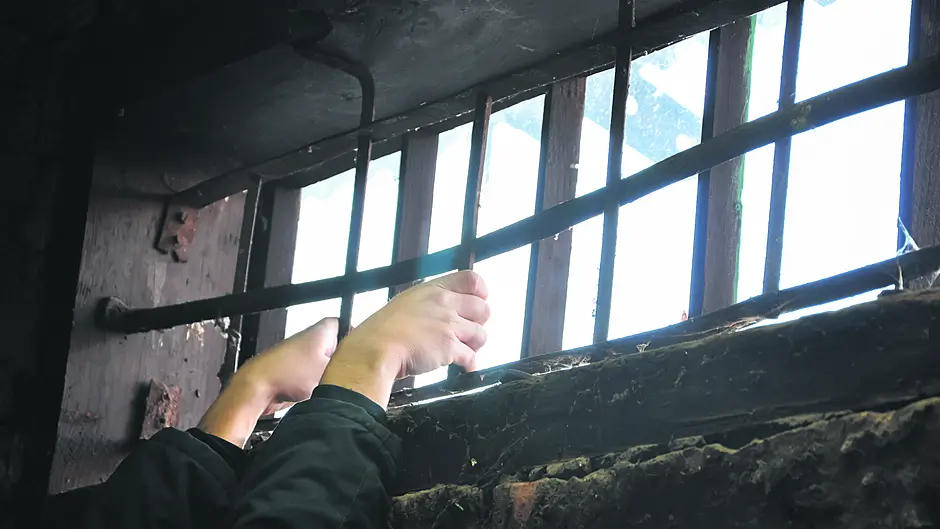
Here’s a story from the late psychotherapist and author Sheldon Kopp, about a man who imagines himself to be a prisoner in a cell. He stands at one end of a small, dark room, on his toes, with arms stretched upward, hands grasping for support onto a small, barred window, the room’s only apparent source of light. If he holds on tight, straining toward the window, he can see a bit of sunlight barely visible between the uppermost bars. This light is his only hope. He won’t risk losing it, so he continues staring toward it, holding tightly to the bars.
So committed to retaining sight of that glimmer of life-giving light, it never occurs to him to let go and explore the darkness of the rest of the cell. Thus, he never discovers the door at the other end of the cell is open, that he is free.
‘He has always been free to walk out into the brightness of the day’, writes Kopp, ‘if only he would let go.’ The power of Kopp’s parable lies in its familiarity.
ADVERTISEMENT
Many people live, at least for periods of their lives, as if they were that man at the window. We hold on desperately to what we know, even when it no longer serves us. It might be a belief, a role, a relationship, or a long-standing story about who we are. Often, people cling to the idea that if they work harder, behave ‘better’, or stay more vigilant, that they will eventually be validated. Their focus narrows to that one imagined source of light. In doing so, they overlook other possibilities for change or wellbeing.
In therapy, versions of this pattern appear in many forms. Someone who remains caught in grief may be unable to stop seeking signs of the person they’ve lost. Another may hold on to a belief formed in childhood that they are inadequate or unworthy. Others stay in relationships or jobs that have become harmful because those roles have fused with their sense of identity. In each case, the person is like Kopp’s prisoner, fixated on the narrow opening they believe will save them, and unable to see that the way out lies elsewhere.
The tragedy, as Kopp points out, is not that the cell is locked. The tragedy is the door is open, but the prisoner doesn’t know it.
Fear
Why do we hold on and cling? Fear is one reason. Uncertainty can feel more terrifying than pain we’ve grown used to. Familiar suffering is, paradoxically, comforting. It gives us a sense of control. As long as we stay fixated on that one sliver of light, we don’t risk the darkness of the unknown. Another reason: the belief that letting go means giving up. Surrender is often confused with defeat. But often, what we’re surrendering isn’t our hope or our goals. Rather, it’s our narrow, rigid idea of how those things must look. One of the key messages of cognitive behavioural therapy (CBT) is this: it’s not the situation that traps us, but our interpretation of it. We may assume we’re imprisoned because we’ve never questioned the layout of the room. We’ve never tested the door.
For many people, change does not come through sudden revelation, but gradually. At some point, someone may stop focusing on the narrow view they have always relied on and begin to question it. They start to consider the possibility that their understanding may be incomplete, that it may be time to turn around rather than to continue staring at the window. In practice, this turning point can take many forms. It might involve reconsidering long-held assumptions about oneself. It might mean acknowledging that a particular goal, relationship, or role has outlived its usefulness. It may also involve accepting loss rather than remaining trapped in the hope of reversing it.
Freedom is difficult. If you’ve lived for a long time as a prisoner of certain thoughts, assumptions, and beliefs, stepping out into the world as someone with choices, agency, and responsibility can be overwhelming. However, it’s also the beginning of something true.
There’s a line in Kopp’s parable that cuts to the heart of it: ‘He has always been free.’ The challenge is not escaping the prison, it’s recognising it was never locked. All too often, the only thing keeping us inside is our refusal to let go of the thing we’re convinced we need. Thus, the question becomes: what are you clinging to? What are you staring at so intently that you’ve never turned to see what else might be possible? What might happen if, finally, you let go?
Linda Hamilton is a Kinsale-based cognitive behavioural therapist. If you would like to get in touch with her, call 086-3300807 For more information, go to www.kinsalecbt.com