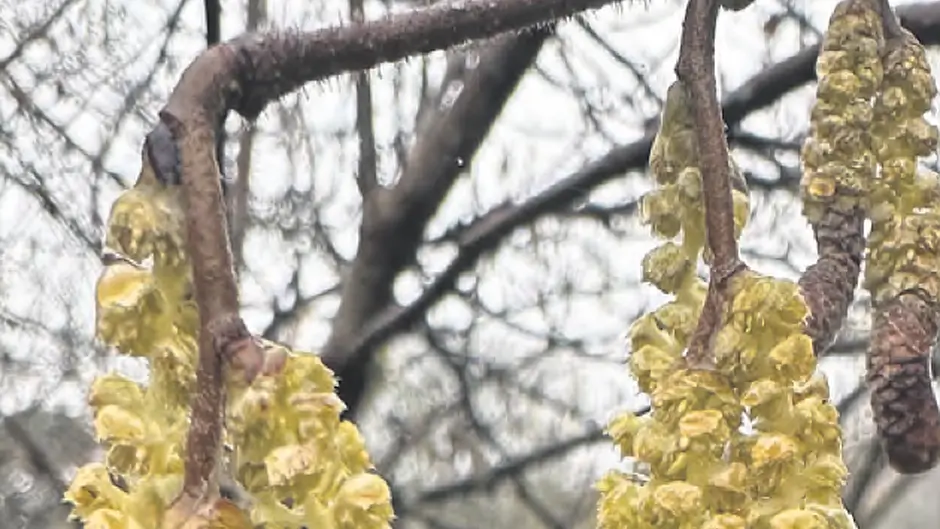

When it comes to reproduction, we often talk about learning about the birds and the bees. Yet many plants, including trees, also rely on sexual reproduction to ensure the continuation of their species. Part of the wonder and hope at this time of year is spotting those glorious yellow-green catkins that dangle and sway from hazel trees. These jaunty tassels are the hazel’s male flowers, producing pollen to fertilise the smaller, delicate red female flowers. Once fertilised, these female flowers develop into hazel nuts, the tree’s seed, later in the year. For many, hazel catkins are one of the first signs that spring is on the way. Appearing from January to March, they signal longer, brighter days ahead. Once you start looking for them, you can’t help but notice them in the hedgerows as you drive along.
Male, female, or both
ADVERTISEMENT
It is fascinating that trees can be male, female, or both. Some species are dioecious, meaning each tree bears either male or female flowers. For reproduction to succeed, both a male and a female tree are needed. With familiar holly, only female trees produce berries, and they require a nearby male holly tree to provide pollen for fertilisation. Monoecious trees, by contrast, carry both male and female individual flowers on the same tree. These species can self-fertilise or exchange pollen with neighbouring trees. Examples include oak, Scots pine, and birch. In general, self-pollination is less favourable, as cross-pollination, with other trees, promotes stronger genetic diversity and long-term resilience. Trees have evolved clever ways to avoid fertilising themselves. Pollen may be released before or after the female flowers on the same tree are receptive. This timing reduces the chance of self-pollination and helps explain why not all trees flower at the same moment, even when growing side by side in the same conditions. Some trees take a further different approach and bear flowers that contain both male and female parts on the one bloom. Hawthorn and apple are good examples. Their attractive blossoms entice insects, which transfer pollen between flowers as they feed on nectar.
Pollination
Indeed, insects play a vital role in moving pollen between flowers and between certain species of tree. Bees are well known pollinators, but moths, beetles, and butterflies also provide this valuable service. These trees will use flower colour, scent, and shape to attract pollinators, rewarding them with sugary nectar. It is a delicate balance. If too much nectar is available, an insect may not need to visit another flower, reducing pollen transfer. Not all trees use insect pollinators however, and wind is the most common pollination method. Many species are adapted for this. Hazel, birch, and willow catkins dangle and sway, allowing the breeze to shake loose vast quantities of fine pollen into the air. Nature has refined this system further for efficiency. Catkins on trees such as hazel often appear before the leaves emerge in spring. Without foliage blocking the air flow, pollen can travel more freely. Much to the frustration of allergy sufferers, it is not just love in the air and trees will produce pollen in huge quantities to maximise the chances that some grains will reach their destination.
The mighty oak
Our two native oaks, pedunculate oak and sessile oak, both bear male and female flowers on the same tree. While we readily recognise their acorns, the male catkins are less noticed. They appear just before the leaves each year, alongside the tiny female flowers that later develop into acorns. Oaks do not produce heavy acorn crops annually. Instead, every few years they have a mast year, producing vast quantities. This strategy overwhelms seed eaters such as jays and squirrels. Even after heavy feeding, enough acorns remain to germinate and grow. Oaks are deeply entwined with our history, mythology, and identity. In 1990, the sessile oak was designated Ireland’s national tree. It is a fitting choice; a mature oak can live for up to 1,000 years and support as many as 300 species of native insects and animals.
Going it alone
Not all trees require a partner every time they reproduce. Some can propagate asexually by layering or suckering. Layering occurs when a low branch touches the ground, takes root, and eventually separates from the parent tree. Suckers are new shoots that arise from the root system. Elms and blackthorn often spread in this way, producing clusters of genetically identical trees. Both layering and suckering create clones of the original tree. These strategies are particularly common in invasive non-native species such as cherry laurel and rhododendron. They can reproduce both by seed and by vegetative spread, enabling rapid expansion. In ancient oak woodlands, for example, rhododendron can dominate the understorey before oak saplings from fallen acorns have a chance to establish. In doing so, this suppresses the natural regeneration of our cherished oak trees.
Avian assistance
Like most reproductive processes, the work does not end with fertilisation. Seeds must be dispersed, and birds are often central to this. The attractive berries of rowan, elder, and hawthorn are designed to attract hungry birds. After passing through the digestive system of a thrush or blackbird, the seeds often germinate more successfully. In this way, the trees’ reproductive strategy depends on avian partners. However ingenious all these adaptations are, they can only go so far when humans disrupt the system. Successful tree reproduction depends on proximity, pollen transfer, cross breeding, and genetic diversity. The removal of native woodland and hedgerows breaks vital ecological connections. Planting a few isolated trees has value, but it cannot replicate the strength and function of established woodlands linked by mature hedgerows. Rewilding at a landscape scale is needed. Strengthening hedgerow networks would support pollinators and allow the movement of pollen and seeds between trees, enabling the birds and the trees to continue their age-old partnership.
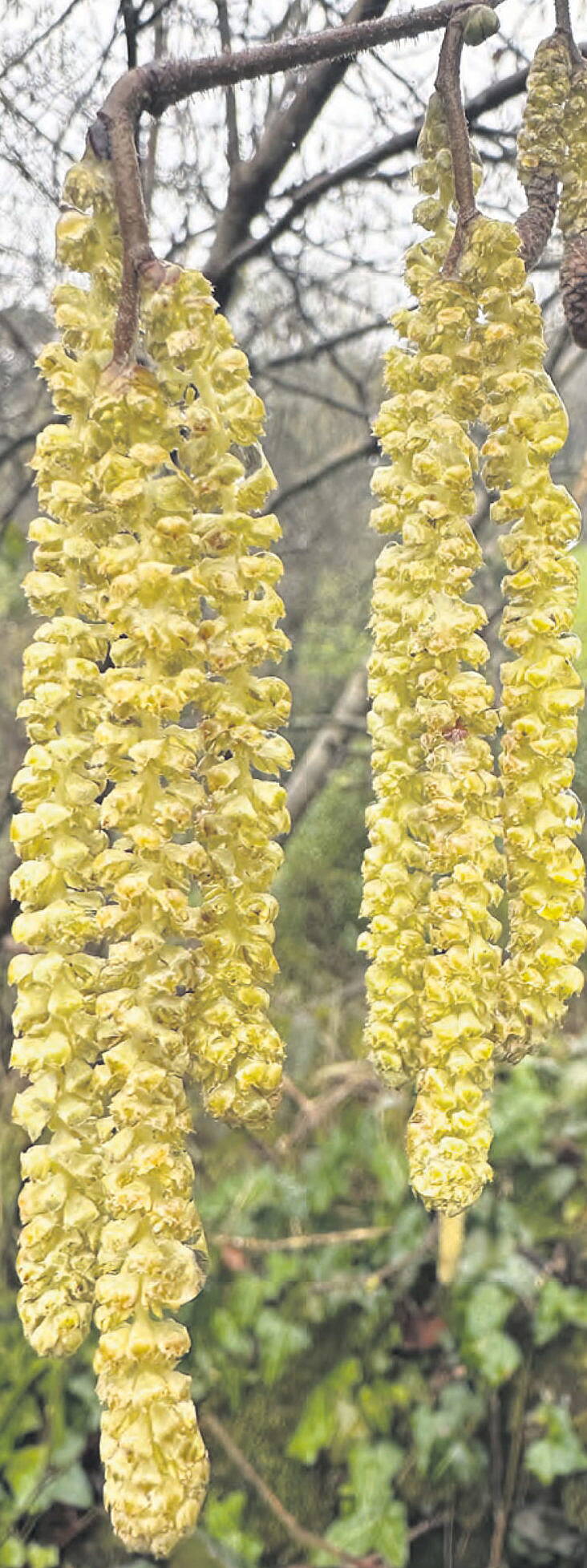 The wonderful dangling open male catkins of the hazel tree herald the onset of spring.
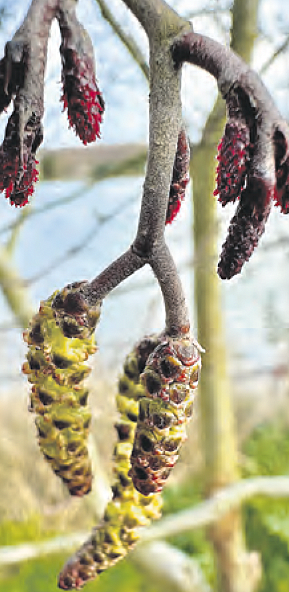 Alder also flowers in early spring, and both male and female flowers are borne on the same tree. Male catkins with the smaller female red flowers are seen here. (Photos: Ann Haigh)