IT may be celebrating 40 years in existence, but Bantry Museum celebrates a history that stretches far beyond that.
Bantry Historical and Archaeological Society, formed in March 1978, decided that the town needed something to reflect the town’s long and illustrious past. Cork County Council offered the use of the old Anco training building at the rear of Aras Bheanntraí in 1986.
One of the society and museum founders Hazel Vickery, who is now its curator, confirmed that with just two rooms and a small reception area they have come to the conclusion that they need a larger premises.
ADVERTISEMENT
Older members of the community, and indeed members of the voluntary organisation who are growing older, find the steps into the building difficult to navigate.
Some studies were done but it was found that a ramp would be almost impossible and way too expensive to install. The ramp was also considered to be a poor use of resources.
If Heritage Week highlighted anything, it is that a more central, and suitable building, is needed, especially as Bantry has an exceptionally rich history and has, with the news that the West Cork Music venue has been granted planning, there is loads of potential for Bantry to become a major cultural centre.
Hazel said she is aware that a new premises would involve major fundraising, but the society members have created a website that enables people to make donations online.
Amongst the photographs and displays is a West Cork cloak that was originally owned by a Bantry woman, a butter churn, pots and pans. There are photos of lace, some made in the lace school in Bantry Convent. Flood photographs also show the devastation caused in 1986 and on other occasions.
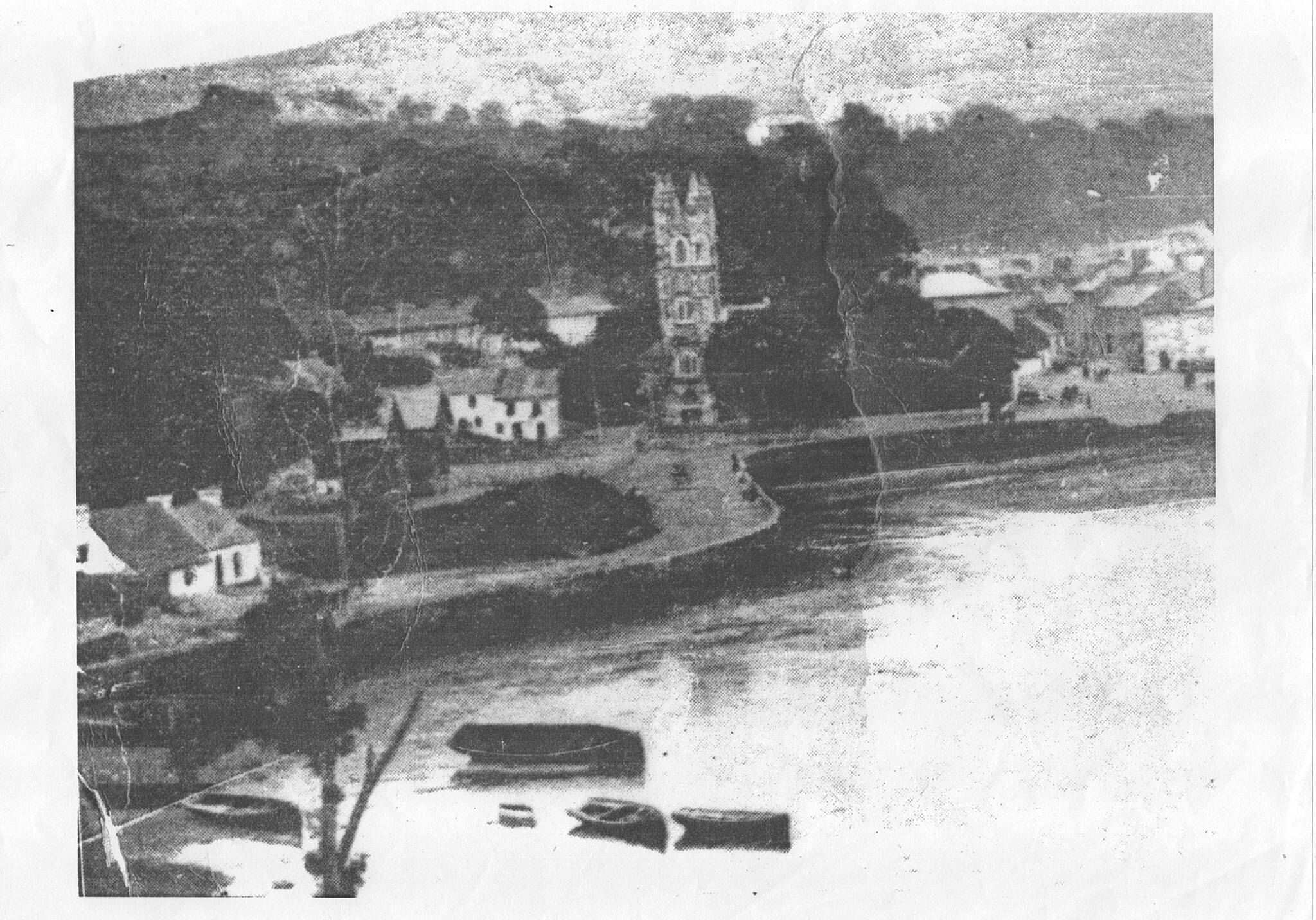 The old layout of the town which shows the tide close to St Brendan's Church.
Lots of people are drawn to the photographs of the original Corn Mill that was installed in the 1800s and was later transformed to a woollen mill. There’s even a blanket in the museum with the label ‘Made in Bantry’.
West Cork Training and Development assisted the society in their endeavours by arranging a CE worker to help out, meaning the museum is open five days a week from May to September.
‘What is on display is a collection of bits and pieces that we have been given over the years,’ said Hazel. ‘They keep tradition alive, and the photographs and newspaper cuttings are especially enjoyed by schoolchildren and overseas visitors.
‘We have a very large collection, but unfortunately it is a very small premises,’ she added. ‘Nevertheless, people are fascinated to see how far the tide came up in Bantry square and the fact that the train came to the quayside to facilitate the fishermen.’
Some of the interesting insights into Bantry’s history include the waterwheel that produced electricity for street lighting, thereby replacing the old oil lights.
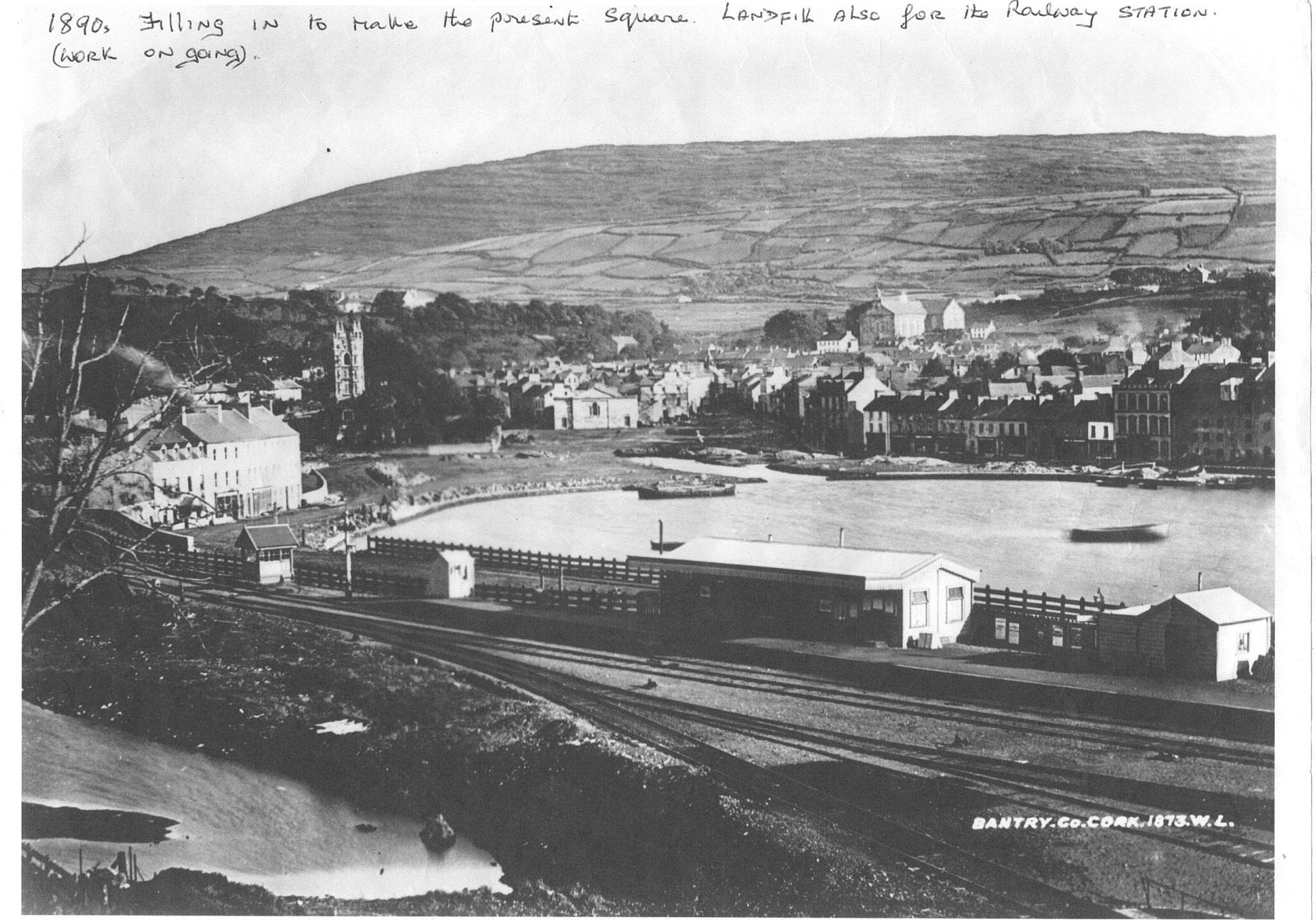 The area known as The Slob was filled in to create Bantry's town square.
It was a Mr Nugent, from Durrus, who had worked in the US in hydroelectrics, that first experimented on a waterwheel at Drombroe, before establishing the Bantry Electric Company.
Hazel, who initiated historical tours of the town, said that if people could afford it, they could have DC power in their home. In fact, in 1914, an advertisement in The Southern Star Vickery’s Hotel advertised the sale of their oil lamps because, as they proudly declare, ‘we now have the new electric lighting!’
When visitors come to the museum, the first things they see are photographs and part of an Ordinance Survey map.
Pre-1840, the area from St Brendan’s Church to what is now the tourist office, was once all water, but that was filled in and road was created.
In 1881 the Cork to Bandon rail line, which was operated by the West Cork Railway Company, was extended to Bantry.
The terminal was located above the town, near the hospital, but locals, especially fishermen, wanted the terminal to be easily accessible.
It was not an easy ask, said Hazel, but by the late 1880s filling in the slob, the mud pit in the inner harbour, began.
‘This was not an easy job because transport was by horse or donkey and cart. There were no JCBs or trucks,’ she added. ‘Stones were quarried from two quarries near the town. One was Hawk’s Quarry, near the present Circle K filling station, and the other was on the Quarry Well Road.
At the same time the stream from where the library is today had to be channelled and bridged over. In addition, the railway terminal had to be built where the present SuperValu carpark now is.
William Martin Murphy was awarded the contract to build the rail extension but that too wasn’t without logistical difficulties.
Due to the topography of the land, which included Convent Hill, the railway track had to take a roundabout route to the downtown terminal, which saw its first train arrive in 1882.
In 1888, the Bantry Steamship company was formed and passengers arriving on the train could disembark from the train and then board the steamship, one of which included Lady Elsie and go by sea to Glengarriff, Adrigole and Castletownbere.
Meanwhile, fishermen could tie up at the pier and load their fish boxes on the train for the market in Cork. Of course, the railway closed in 1961 and the rail tracks were removed.
Before that faithful day, Hazel recalled going to Rochelle Boarding School in Cork at the beginning of term, and the journey taking two hours.
It was as part of the West Cork Literary Festival that Hazel began giving guided walks of the town which proved hugely popular, and she has now trained volunteers who are still providing the tours and retired librarian Noel O’Mahony has also stepped in to help.