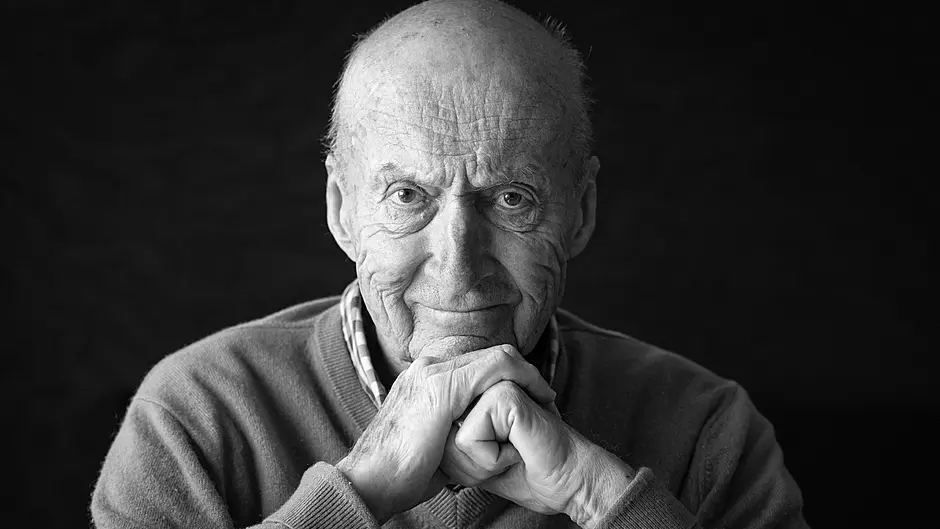
‘HE was living proof that you are young as you feel: if you don’t let old age in. And, for most of his life, Charles Daly did manage to keep it at bay.’
These are the words spoken by Charlie Daly, who helped his father, Charles Chuck Daly, write Make Peace or Die: A life of Service, Leadership and Nightmares, a title that pretty much encapsulates the 98-year-old veteran’s life.
Father and son spent about two-and-a-half years writing the book that was published in 2020 and resonated with veterans of all wars, especially the Korean War.
ADVERTISEMENT
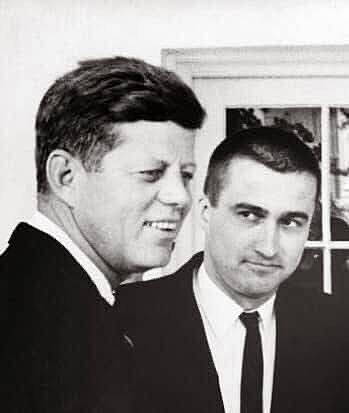
Even with a life as rich and diverse as his, including having served John F Kennedy in the West Wing, Charles Daly did not envisage becoming an author at the age of 93.
Nor could he have foreseen that the podcast in which he participated would have been listened to by more than a million people.
As a marine, Charles led a rifle platoon in Korea and received a Silver Star, which is the third highest decoration for valour in the US military. He was also presented with the Purple Heart after he was wounded in combat.
Most people who knew him, including his wide circle of friends in Bantry, where he purchased a coastal plot at Rooska in 1968 and built a home, knew that he had emigrated to the US as a young boy.
It was not a typical emigration experience because the family was well established, his mother, Violet, having once resided in what is now Bandon Grammar School, while his father, Ulick, had previously served as an officer in an Irish regiment in the British army.
Both his mother, as a former nurses’ aid, and his father were veterans of WW1, each having had a brother, Charles, who was killed in The Great War.
Named for his uncle, Charles joined the US navy at the end of WW2 before the outbreak of the Korean War.
‘The Korean War was about three months of his life from the time he deployed until he was wounded,’ said Charlie.
‘His unit had 200% casualties that means that everyone was either killed or wounded; and all of the replacements were killed or wounded, so it was an astonishingly violent experience.
‘Memories of that war had been continuous his whole life, but it became really overwhelming in his late 80s and 90s and his desire to write the book stemmed from that. He had a sense that if he didn’t finally talk about the war it was going to consume him.’
Charlie, like the rest of the extended family, especially his wife Christine and sons Michael, Douglas and Kevin, are all too aware of the extraordinary achievements of Charles Daly.
Today, the full and complete account of the life of Charles Daly is available at the Bantry Book Store.
It tells the full story from the year he spent in a naval hospital having his arm reconstructed after the war – something Charles never complained about because he was surrounded by people who had double or triple amputations.
Most will be drawn to his vivid recollections working for JFK, and working on Bobby Kennedy’s election campaign, having been with Bobby in LA when he was shot.
Their assassinations, and the assassination of Martin Luther King, whom he also knew, having been involved with passing the Civil Rights Act, had, according to Charlie, left him with the feeling ‘ENOUGH’ hence the purchase of property at Rooska.
In later years, Charles served as vice-president at the University of Chicago; vice-president of Harvard; and he ran the Kennedy Library in Boston.
‘One of these careers would have been amazing on their own,’ said Charlie, ‘but he was restless, and got bored easily, and would go from one from one very impressive career to another.
‘In fact, one of the things that attracted him to academic jobs is that he would have the summer off and he would spend it here, in Bantry.
‘Charles was someone who made really great friends wherever he went, including Bantry.
‘When his first wife, Mary, died he started the Mary Daly Fund, which generously supported many worthy causes for years.
When the fund was being wound down, later in his life, Charles donated the balance to what was then known as West Cork Women Against Violence and is today known as West Cork Beacon.
‘He was someone who abhorred violence and would not be silent on these matters,’ said Charlie.
‘He was someone who never did anything by half measures. He was just someone who was relentlessly true to himself.’
As a teenager, Charlies said he was ‘in awe’ of his dad, a man in his 80s, serving on the board of the Irish Independent in the early 2000s.
‘I remember my father in the townships in South Africa doing field work reporting on the Aids epidemic and how [it] was being handled atrociously by the South African government.
‘There, he worked directly with Doctors Without Borders, with patients, and with politicians, including meetings with Nelson Mandela.
‘All my life, I was in awe of the fact that he didn’t slow down. There are a lot of people who have a lot of energy but he really used his energy in ways that were focused on helping others, and leaving the communities in which he lived in, and the world, a better place.’