
The 1990s was an exciting time for the development of silage harvesting machinery, in particular self-propelled silage harvesters. Most manufactures had taken their harvester designs to their limits and the early 90’s brought new models from all of the big dominant players in the market- Claas, John Deere and New Holland. Deutz threw their hat momentarily in the ring while 90’s also saw the withdrawal of Hesston from the forage harvester market due to the Fiat New Holland merger. Horsepower, which had previously peaked at 300hp, soared towards and broke the 500hp mark which, along with many other advances, greatly increased output.
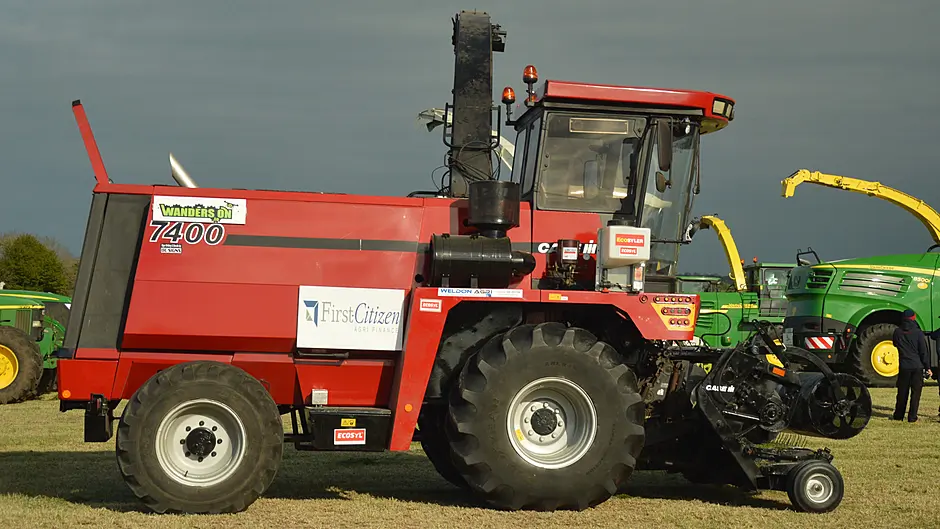
Eager to break into the market, Case acquired the Biddell group of which Mengele was a part of. Established in 1871, it was once a German industry leader for forage harvesting equipment. The Mengele 6900, 7400 and 7900 were already in production when Case IH purchased the company, the blue and white of Mengele rebranded under the red and black of Case IH, the line-up dubbed as the ‘Mammut’ range of silage harvesters.
ADVERTISEMENT
The engine of the Mammut 7400 is installed in a traverse position, across the rear axle. The engine of choice for all models for the range Volvo Penta VE310EDC with the 7400 pumping out 422hp, while the range topping 7900 pushed 480hp. By mounting the engine sideways, power could be sent directly from the flywheel to the front via a V-belt, eliminating the need for 90 degree gearboxes that conventionally mounted engines required.
The advantages were twofold- a simpler driveline system and reduced parasitic engine power losses resulting in more of the engines power being utilised. Drive is brought down the left hand side of the harvester, while the cooling fan can be reversed and is hydraulically driven.
At the front of the machine a 3m header a large mesh covered cylindrical crop roller pick up the grass, while a 68cm wide chopping cylinder had knives arranged in a multi knife format. Interestingly, the harvester featured full header control buttons on the right hand mudguard including an emergency stop button. The corn cracker for maize can also be lifted out of position by button.
The cab features a curved windscreen and passenger seat provided the operator with great amounts of visibility and space, and also boasts a comprehensive lighting package. The operators 4 fingers slot into the hydrostatic control lever, with fingertip button controls.
An all new design, the Case 8790 silage harvester was released in 1999, and was the world’s most powerful harvester before being discontinued in 2001. The Mengele portfolio was sold to Lely in 2010 which was subsequently acquired by AGCO. If you know of a Case harvester, please get in touch!
Contact Peter at [email protected] or see Instagram@flashphotoscork