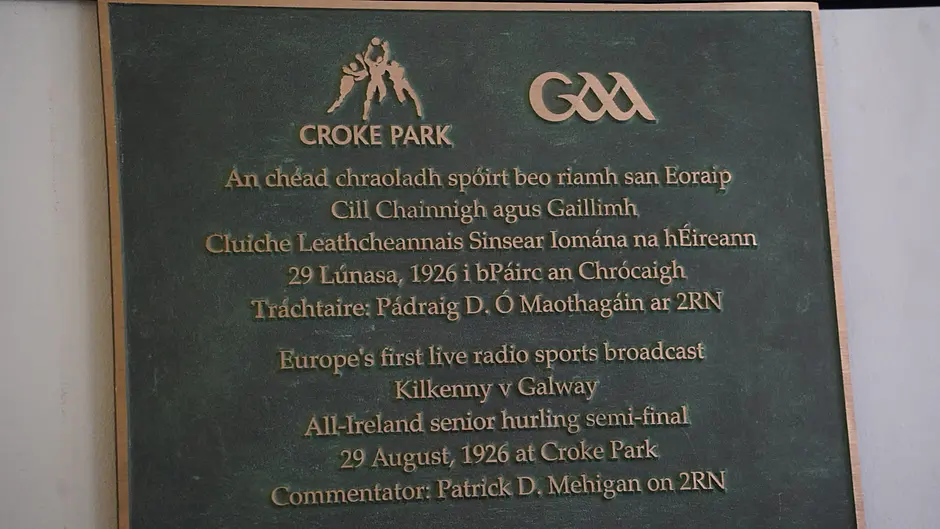
‘MEHIGAN was the original voice of the GAA,’ said GAA President Jarlath Burns, paying tribute to the West Cork man whose trailblazing role in sports broadcasting was recently honoured, writes TOM LYONS.
The GAA unveiled a plaque at Croke Park to mark the centenary of the first-ever radio broadcast of Gaelic games, a tribute to Ardfield native Paddy Mehigan.
On August 29th, 1926, the All-Ireland hurling semi-final between Kilkenny and Galway was broadcast live from Croke Park on the fledgling Irish Free State radio station 2RN.
ADVERTISEMENT
It’s believed that the full live commentary at Croke Park 100 years ago was the first of its kind for a field sport in Europe.
‘The baton he passed to Micheál O’Hehir, Micheál Ó Muircheartaigh, right through to the household national and local broadcasters of today, has been instrumental in helping to popularise Gaelic games and weave it into the fabric of Irish life,’ Burns added.
But who was Paddy Mehigan?
Patrick Denis Mehigan, known to all his friends as Paddy – son of Denis, a farmer, and Margaret – was born in Ardfield on St Patrick’s Day, 1884, pre-dating the GAA by eight months.
He attended the local Ardfield school and in 1899, at the age of 15, joined the Department of Customs and Excise in Dublin, as many young boys, like Sam Maguire, who also attended Ardfield NS, and Michael Collins, did.
He quickly became involved with the GAA and Gaelic League in the city.
In 1902, he was transferred to London and played hurling with the Robert Emmett’s club, being selected for the London team that lost the 1902 All-Ireland final against his native Cork.
Mehigan returned to Cork, joined Blackrock and played for Cork in the 1905 All-Ireland final against Kilkenny, which was eventually played in 1907. Cork won the original game but lost the replay following an objection from Kilkenny.
He was also a talented athlete, competing successfully at high jump, sprinting, road bowling and step-dancing. Specialising in the hop, step and jump, he became Irish champion in 1908.
Despite holding down a busy job, he got involved in sports journalism, including reporting matches, and began a long association with Cork Examiner in 1912, a weekly column under the pen name ‘Carbery’. Mostly concerned with Gaelic games, he wrote about all sports, including coursing, athletics, boxing, and also penned many articles on nature, as well as writing short stories and poetry.
Returning to Dublin in 1922, he continued to write for the Cork Examiner and was to become one of the foremost GAA journalists in Ireland.
Because of his national standing as a GAA journalist and historian, in 1926 he was approached by the new Irish Free State 2RN radio, better known as Radio Éireann, and asked to do a live commentary on a Gaelic match, never before attempted.
The game chosen was the Galway v Kilkenny All-Ireland hurling semi-final on August 29th, 1926, a brave venture because even though live broadcasts of sports events had been done in the USA, Australia and New Zealand, it had not previously been done in Europe.
The BBC had covered a boxing match in 1925 but had never done field games.
Mehigan admitted when he was coaxed into doing it by PS O’Hegarty, Minister for Posts and Telegraphs, that he hadn’t a clue what he was facing. He just turned up half an hour before the game in Croke Park and strapped on the broadcasting apparatus with a slip of paper in his hand listing the two teams.
When the signal came that they were on the air, he was told ‘to fire away,’ which he did, ‘spouting freely.’
His love of hurling and his deep knowledge of the game and the players clearly came across and he later admitted he loved it. It proved such a tremendous success, Kilkenny winning by 6-2 to 5-1. The GAA had just entered a whole new era of coverage for its games and the Ardfield native was the proud first.
So successful was the broadcast that he was asked to do it on a regular basis and soon became a household name all over Ireland, people gathering in crowds around scarce radios to hear his broadcasts. He completed 100 games before retiring.
‘I got a great kick out of it and was glad to help spread the light about the loved game of my boyhood,’ said Mehigan previously.
GAA President Jarlath Burns said recently: ‘The work of Paddy Mehigan continues to this day in how we spread our message across so many varied communications platforms and ensuring that our great story is told.’
His broadcasting success helped his journalistic career blossom, and in 1932 he was able to retire from the civil service to concentrate totally on journalism.
Among his great successes was the production of a Christmas annual, ‘Carbery’s Annual,’ which he began in 1932 and continued up to his death in 1965. Copies are now collectors’ items.
In 1984, a selection of his work, edited by Seán Kilfeather, was published as ‘Vintage Carbery.’
In 1918 Paddy Mehigan married Joanna Scully, a farmer’s daughter from near Clonakilty. They had six children, the family living in Ranelagh in Dublin.
Mehigan was the brother of famed footballer, Mick Mehigan, who played with Ardfield, Clonakilty and Lees. As captain of county champions, Lees, Mick led Cork footballers to the All-Ireland title in 1911.
Patrick Denis Mehigan died on December 4th, 1965, his legacy to the GAA and to Irish broadcasting never to be forgotten.