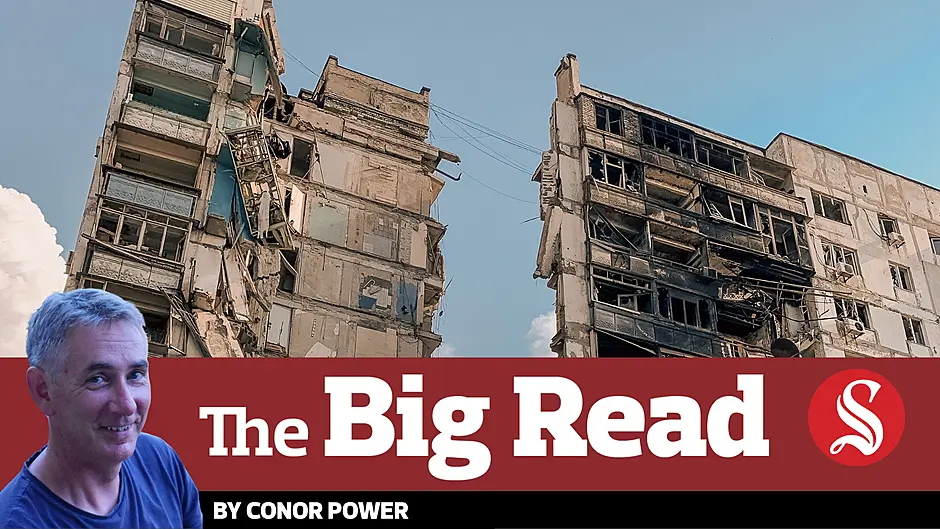
We watch a lot of war on the news these days.
Very often, I don’t bother switching it on because it’s just too depressing.
The scale of conflict is, quite simply, off the scale in this world and it feels like it’s only going to get worse.
ADVERTISEMENT
Old men scheme and plot and young men slaughter one another and you feel quite helpless to do anything about it.
Which is why when I was asked to participate in bringing vehicles packed with over a million euros worth of aid direct from Ireland to people in the Ukraine, I couldn’t say no.
Entering a war zone is no jaunt down to Barleycove but we did have safety in numbers.
In a cavalcade of eight jeeps, two ambulances, a minibus, two pickups and a mobile kitchen, we set off from the Holy Rosary Church in Greystones on a magnificent sunny day in September.
The sun glinted on the Irish Sea and the television news cameras followed our noisy departure to great cheers and soon we were crossing the sea to Cherbourg.
Our first port of call that evening was at the Menin Gate in Ypres (or IEPER, as the locals refer to it).
Every single evening at 8pm, the elaborate ceremony that accompanies the playing of The Last Post ensures that the unidentified British fallen at Ypres (including dozens and dozens of Irish names) are not forgotten.
After sampling the finest Belgian hospitality in their beautifully rebuilt town, we hit the road for the next day’s mammoth drive.
Here, we took in the Wings of Liberation Museum in Holland (telling the story of the disastrous Operation Market Garden) before arriving in the German town of Kassel for the night.
Colditz
The next morning, we drove deeper into Germany and deeper into its WWII past by visiting Colditz Castle. Located in what was East Germany, this remarkable prison was largely for the officer class and was the subject of many books and a BBC television series.
It was another reminder of the madness of war in a most entertaining way, with multiple stories of madcap escape attempts. Interestingly, of all the nationalities housed here, the British made the most attempts to escape (120) but had a less than 10% success rate (11 succeeded). The French, meanwhile, clearly concentrated on quality over quantity, with exactly half of their 24 attempts ending in success.
We overnighted in Leipzig - another large city that had risen remarkably from the ashes of the Second World War to become a vibrant metropolis with one of the most stunning opera houses you’ll see anywhere.
The next day’s drive was a true marathon involving eight to nine hours on paper, driving across a piece of Germany and virtually the entire width of Poland in one day. The minibus that we were driving had a device limiting it to 100kph. Speed limits on Polish motorways are 140kph and on Germany there’s no limit, so we were going to be surely longer than Google Maps’ estimate, sharing the driving between the four of us on board.
We finally arrived 12 hours after leaving Leipzig at Jarosław. Here, in a large timber-built venue on the edge of town, we were joined by the 30-plus contingent from Scotland and another 12 or so cyclists and two musicians - Nathan Johnston from Mullingar and Tetyana from Ukraine.
Convoy
The border with Ukraine was just a short drive away and we gathered in a long impressive convoy before running the highly unpredictable gauntlet that is the Poland/Ukraine frontier.
The plan was to get ahead and then have the cyclists do the last 20km or so into Kolomyia; our destination town near the border with Moldova.
Polish border guards were rigorous in checking paperwork, but we got through in less than an hour; an unexpected boost since waits of six to seven hours are not uncommon. We suddenly found ourselves stunned, staring at the unique stamp on our passports and taking selfies and group shots before a large blue-and-yellow sign bearing the name of Ukraine.
The colours of the national flag stand for the blue sky and the yellow of the harvest. When you pour blood on this flag, we were told, those colours turn to black and red respectively.
In Ukrainian graveyards, the fresh graves of those recently killed in the war are typically marked with two flags - one in each colour scheme. The first graveyard we passed on the road on the edge of a tiny village had just one such grave.
The first impressions of the country are that of a slightly poorer version of Poland. The main roads are good but the secondary roads can be horrendously potholed, requiring a special kind of high-speed driving to ‘hover’ over them so as to avoid puncture.
Manpower
Many of the famously fertile Ukrainian fields were being harvested but others bore all the signs of not having been touched in a couple of seasons. Manpower is a problem and the lack of young men in the villages you pass through is chillingly obvious.
We arrived in Kolomyia in driving cold rain, putting a damper on the planned joyous reception we were to receive. Along the busy road en route, lots of supportive hooting of horns, smiles and waves were evident in a country at war where everyone appreciates our very presence, not to mind all the things we were bringing.
In bigger towns such as Kolomyia (it’s about the size of Cork city), life feels very ordinary and the only reminders of war are the large colour posters of recently-fallen local soldiers and the curfew. Otherwise, you find yourself having a drink in a bar in a pretty European town, with cheerful locals.
We were bussed out to a large venue about 6km outside of Kolomyia. The next morning, we were up and out the door early. Our first port of call was a local secondary school. With so many teenagers singing and dancing on stage in the school hall, it was difficult not to visualise them having to get involved in an altogether more macabre dance in a few more years.
Down the hall, a corner of the walls normally dedicated to posting achievements and other sunny items, was instead plastered with photos and remembrance notes to the many students’ fathers who had already given their lives in defence of their country.
The city of Lviv boasts an incredibly pretty cobbled-stoned centre and on the main Market Square, a group of local dignitaries stood in the rain and sang the now-familiar national anthem as the cyclists arrived.
Bomb shelter
We adjourned to our old-world 18th-century hotel that featured real keys and a sign indicating the bomb shelter. Just a pleasant ten-minute walk away, our feasting venue was a large place with balcony seating and here we also had the farewell concert, with acts from Ireland (Nathan Johnston), Scotland (piper Eugene) and Ukraine (opera trained singer Tetyana Shyshnyak and a superb local men’ s choir – Dudaryk
Choir).
Outside, I got talking to a fresh-faced youth in combat fatigues who was hobbling around on a crutch. He turned out to be a 20-year-old from England named Harrisson. At the age of 18, without any combat experience or any family connection to the Ukraine, he ran away to join the Ukrainian army.
At first fighting in an infantry section in the Ukrainian Foreign Legion, he was moved a little farther behind the front line to ‘engineering’ - which nowadays means drone-flying. Harrisson’s unit was, he said, responsible for a huge number of Russian fatalities and destroying
many tanks.
The following day, we met another Englishman there to do his bit for Ukraine. Eddy Scott’s mission, however, was a purely humanitarian one. Last January, the white jeep he was driving marked ‘Emergency’ in red letters was deliberately targeted by a Russian drone pilot, as Eddy was evacuating residents from the battle zone near Pokrovsk in the Donetsk region.
He lost his left arm and his left leg and only survived thanks to his quick-thinking colleagues who applied two tourniquets and got him into an evacuation jeep - just like the ones we were delivering.
Cutting edge
His remarkably positive outlook is reflected multi-fold amongst the 300-plus patients at a centre on the outskirts of Lviv. With initial seed funding from the Warren Buffet Foundation, it’s an entirely privately-funded centre that’s at the very cutting edge of prosthetic limbs.
One of the positive sides of an ongoing conflict is that it acts as a catalyst for great technological leaps forward and the Superhumans Center now has a number of centres across the Ukraine, rebuilding shattered soldiers in mind and body.
Outside, we handed over the keys of our minibus that had ferried us across the great continent of Europe to a beaming, disbelieving Oksana Tovstiak. As Project Officer in the Fundraising Department of the cutting-edge rehabilitation centre, she had some idea that a bus was coming their way but was visibly overwhelmed by the contents.
Our mission didn’t feel like that much as we made our way to Ukraine - it was a highly enjoyable and adventurous trip in any case. But when you see the faces of the recipients and realise that we had delivered all these vehicles containing more than one million euros worth of medical supplies and equipment, you realise that, away from all the politicians and the depressing bulletins, you do have power and you can make a difference.
Crossing back into Poland felt like a relief and the EU looked like a shining calm promised land. Lviv and Western Ukraine are amongst the safest parts of the country, but the following night, the alarms were raised and more than 300 drones and missiles fell on the city and surrounding area. A sobering reminder, as if it were needed.
Durrus-based Conor Power is a freelance journalist and occasional broadcaster and author. Originally from County Waterford, he has been living with his wife and family in West Cork for 31 years, after a varied background that involves auctioneering, visitor centre management and funeral services.
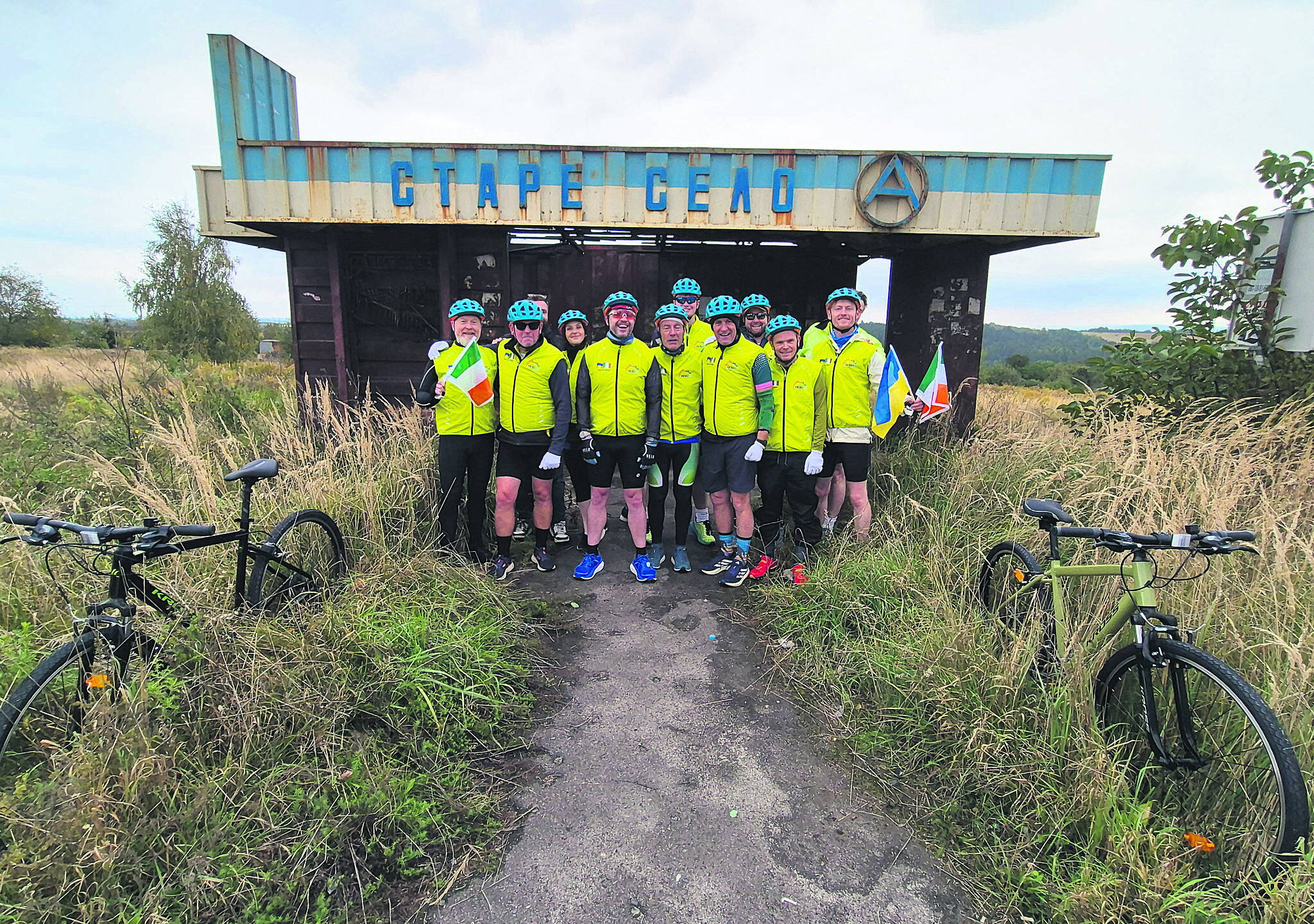 A group of cyclists stop and pose for a photograph en route to Lviv.
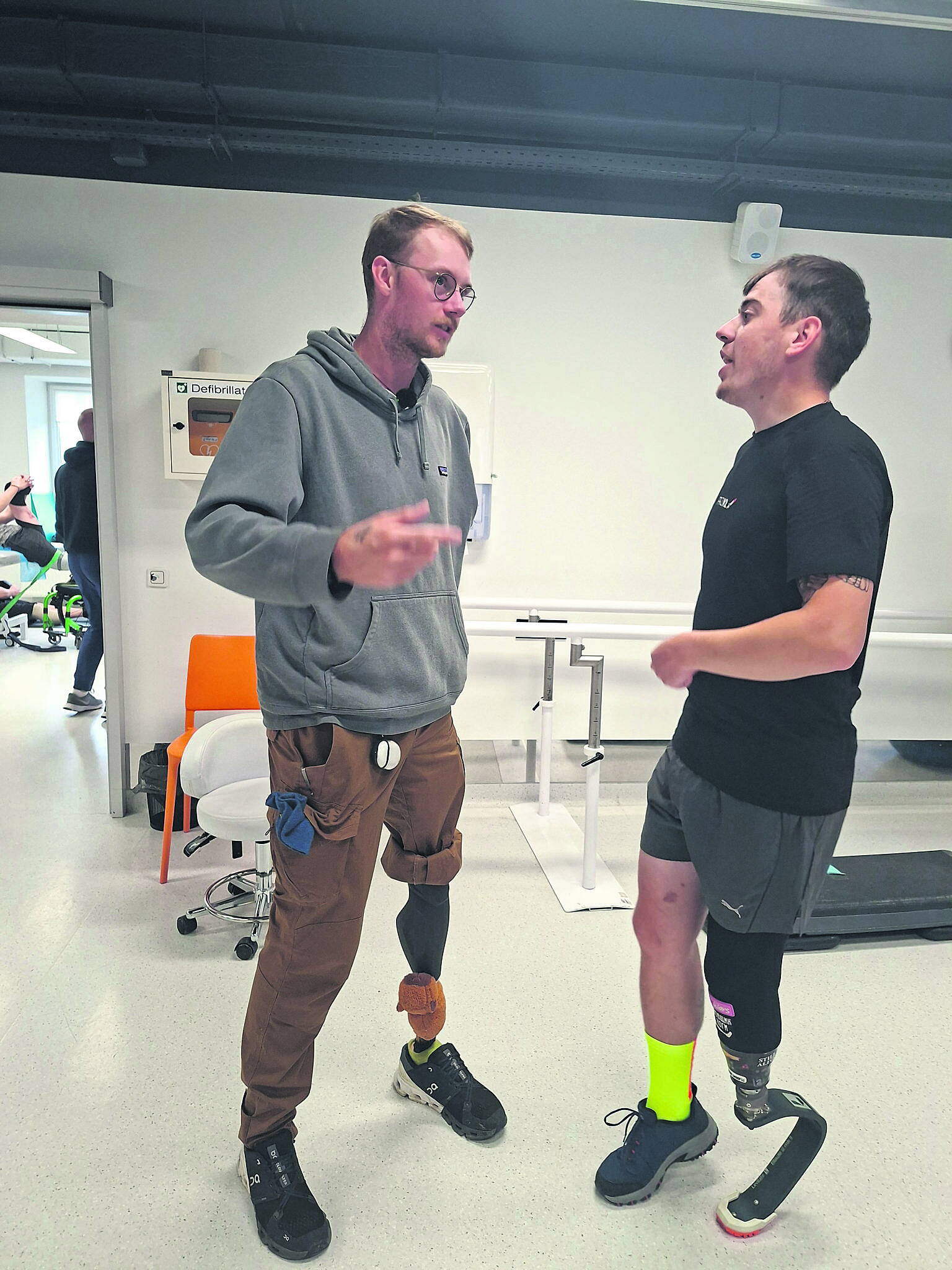 Eddy Scott and a friend at the Superhuman Center in Lviv, which specialises in prosthetics. (Photos courtesy of Conor Power)
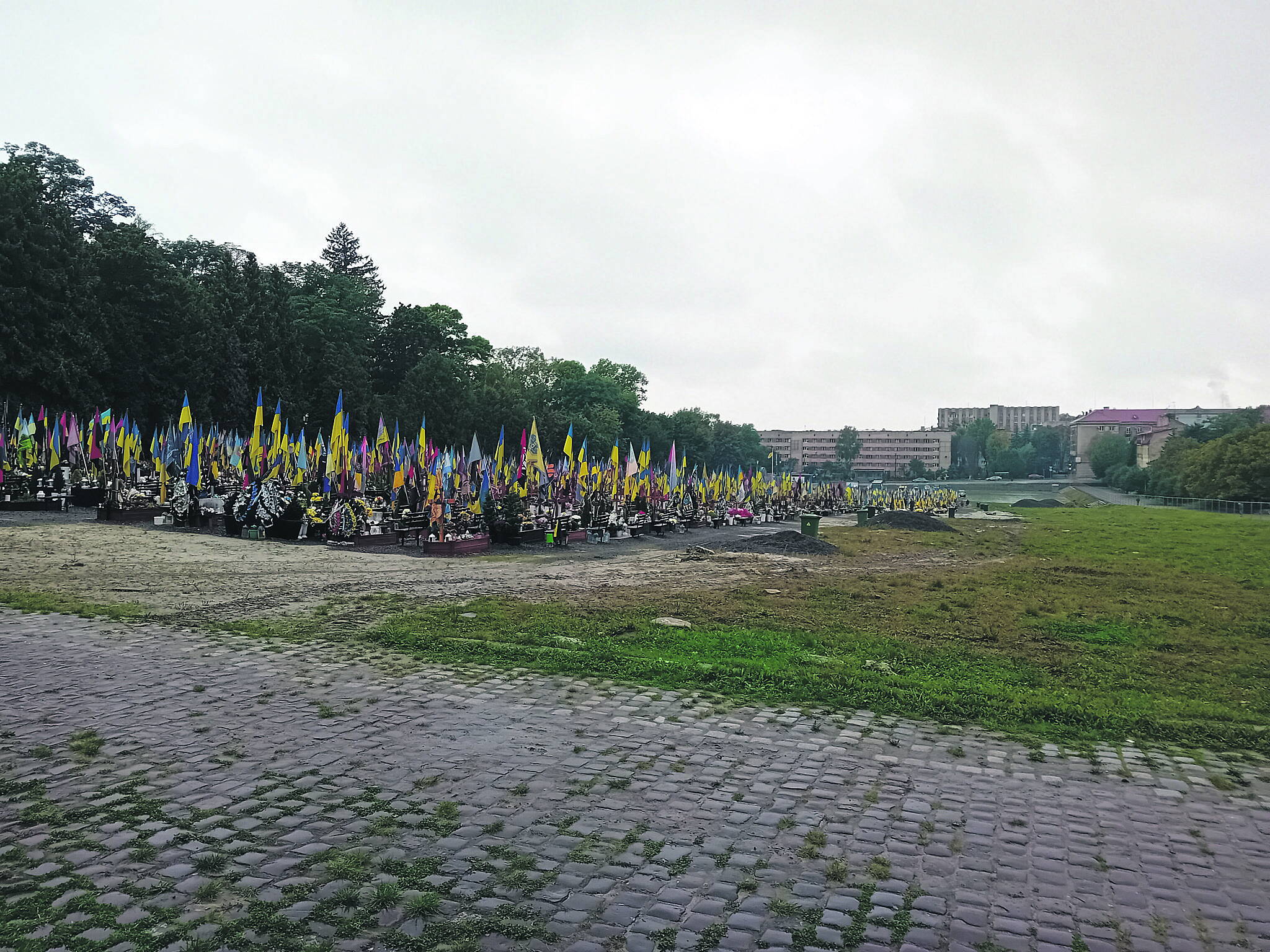 Graves of fallen defenders filling up year on year.