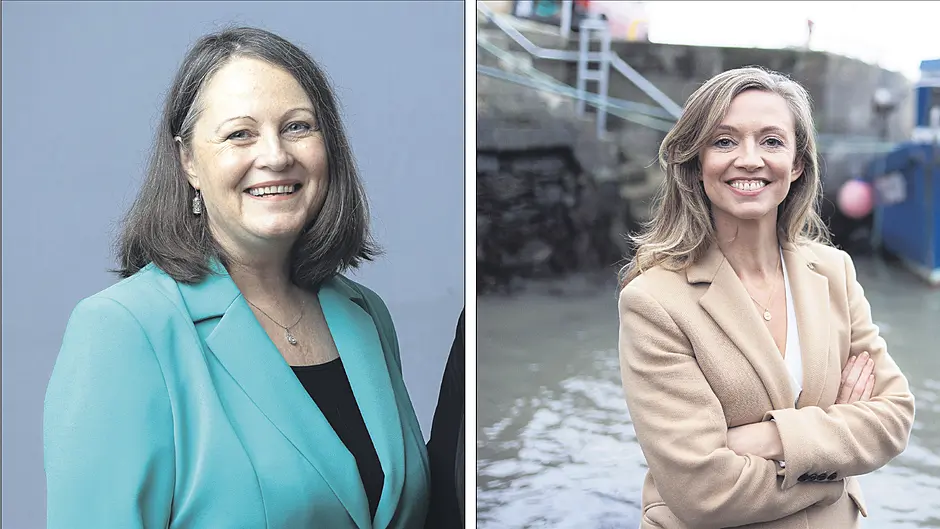
BY EMMA CONNOLLY
POLITICS, like so many sectors, is male dominated and women will encounter everything from subtle dismissal to outright sexism, and it can be exhausting and at times disheartening.
That’s according to Social Democrats leader Holly Cairns who admitted the challenges of being a female politician are real.
ADVERTISEMENT
‘But so is the impact you can make,’ said the West Cork TD. ‘Local politics shapes our communities and our everyday life. And when women aren’t at the table, our needs are pushed to the side.’
The party leader made the observation as a group called See Her Elected (SHE) urged Cork women to start thinking how they could change the statistic of just 18 of Cork County Council’s 55 members being female.
SHE is an award-winning programme supporting women in rural Ireland to become politically active, and it has just launched a new guidebook, A Guide to Running in the 2029 Local Elections.
‘My political journey started with the Marriage Equality and Repeal campaigns,’ revealed Deputy Cairns. ‘Knocking on doors, speaking with people, and listening to their stories made it very clear to me that this was how change happens. In Cork South West, I could see a deep sense of frustration among people, who like me felt their views just weren’t represented.
‘Myself and two other women were inspired to set up a local branch of the Social Democrats, and soon after that the local elections came along. Running was not without its challenges. I was immediately written off as not having a hope. Election coverage barely ever even mentioned my name. Because I didn’t fit the image of what some people thought a councillor should be.’
But no one works alone, she said.
‘What made the difference for me was having a supportive team of women in the Social Democrats, who understood the pressures, shared invaluable advice, and could have a laugh when things got tough. To any woman considering running in the next local elections, do it. When you step forward, you might be surprised at how many people have been waiting to vote for someone exactly like you.’
Dr Michelle Maher, programme manager of SHE, said the guide is ‘designed to de-mystify the process of running for election and to make political participation accessible to women in every corner of rural Ireland.’
She added: ‘We want women to know that there is a pathway for them — one that is supported, inclusive, and informed by the experience of those who’ve gone before.’
SHE’s free online election workshops, which will begin this month, are a good starting point for anyone who’d like more information.
‘Our advice and workshops are designed to level the playing field between the mostly male councillors seeking (re-)election and the women running to bring their expertise, lived experience and community commitment right into the council chamber,’ said Dr Maher.
But what of the barriers facing women, who may want to enter local politics?
‘Women lead busy lives and often undertake the majority of unpaid care work in families. This, and the issues like lacking confidence, and being outside of political circles are often cited as barriers to women running for election,’ said Dr Maher. ‘Women tend to wait to be asked to run, and that ask can come late in the day meaning that women don’t have enough time to put together a winning campaign. In See Her Elected we are asking women right now to join us and find out what’s involved.’
• Running from January to June, SHE’s one-hour online workshop will be repeated four times each month at different times to suit all schedules. Sign up at www.seeherelected.ie.
What our female Cllrs say …
Cllr Ann Bambury (SD)
I decided to run for councillor because, after years of volunteering and community work I felt a strong responsibility to turn that knowledge into real change locally.
Putting my name forward wasn’t without obstacles. I had to consider the financial cost of campaigning, which I covered entirely from my own personal expenses, as well as the time involved away from my family. As a mother of four, this was a major factor.
There are also challenges to being a woman in politics. While progress has been made, the political sphere can still feel skewed towards male members, particularly in terms of membership of committees, visibility and established networks.
Women often carry more of the mental and logistical load at home, which can make political life harder to navigate. But my advice to women considering running is simple: go for it. Your lived experience is a valuable asset, and representation matters.
Women think differently, bring different perspectives and are deeply needed at decision-making tables. With support, organisation and belief in your ability, you absolutely can do it.
Cllr Caroline Cronin (FG)
When I was initially asked about running as councillor, one of the biggest challenges I faced was overcoming the self-doubt and the perception that politics is a male dominated space where women might not be taken as seriously. There can sometimes be an old-school frame of mind that makes it harder for female councillors to be fully included or heard, but persistence and building strong connections have helped me through this.
My advice to any woman thinking about running in the next local election is to go for it. Believe in your ability to make change. Find experienced mentors and people who will help and support you along the way and don’t be afraid to put your ideas forward. Local politics is a great platform to shape our communities, and more women stepping up will only make it stronger, after all, most households in Ireland are organised by women so why not the country?
Cllr Isobel Towse (SD)
One reason I decided to run was because I have a strong sense of social justice. I felt there was a real need for a different kind of representation – one that reflects qualities often associated with women as weaknesses rather than strengths. Emotional sensitivity, for example, is frequently dismissed in politics, yet it is exactly what makes us empathic and able to make fair, people-centred decisions. At a time when leadership around the world is crying out for compassion, and nuance, it’s striking that Ireland still has the lowest representation of women in parliament in Western Europe. That gap exists partly because our political culture doesn’t value these qualities, and it deters many women from stepping forward.
Putting myself forward wasn’t without challenges. Like many women, I balance work, parenting, and running a household. As a single co-parent, I don’t have the same level of flexibility others do with their time, or the same levels of practical and emotional support. Women in my position are at an economic disadvantage too.
There are moments when I am talked down to, as though what I have to say isn’t valid. I’ve heard male politicians make inappropriate comments about female colleagues’ appearances, which is unacceptable.
My advice is this: your perspective is not only valid but urgently needed. Don’t underestimate the strength in qualities you may have been taught to downplay. Kindness and passion and desperately needed in politics.
Cllr Marie O’Sullivan (FG)
Growing up in a home where public service was part of everyday life, it always felt natural that I would one day follow the same path. My father served as a politician so entering politics was not just a career decision, it was a continuation of the values instilled in me from childhood. But politics still carries challenges, particularly for women. There remains, in many corners, a sense of the old boys’ club—slowly fading but not yet gone. Balancing public life with raising a young family adds another layer of complexity, demanding a level of micromanagement that many women quietly shoulder. Yet these challenges have only strengthened my determination.
What keeps me going are the small wins: resolving a local issue, helping a family navigate a problem, or simply hearing a heartfelt ‘thank you.’ Those moments remind me why I chose this path. I love my job, and I remain committed to making a meaningful difference—step by step, person by person, day by day.