BY STEPHEN O’SULLIVAN
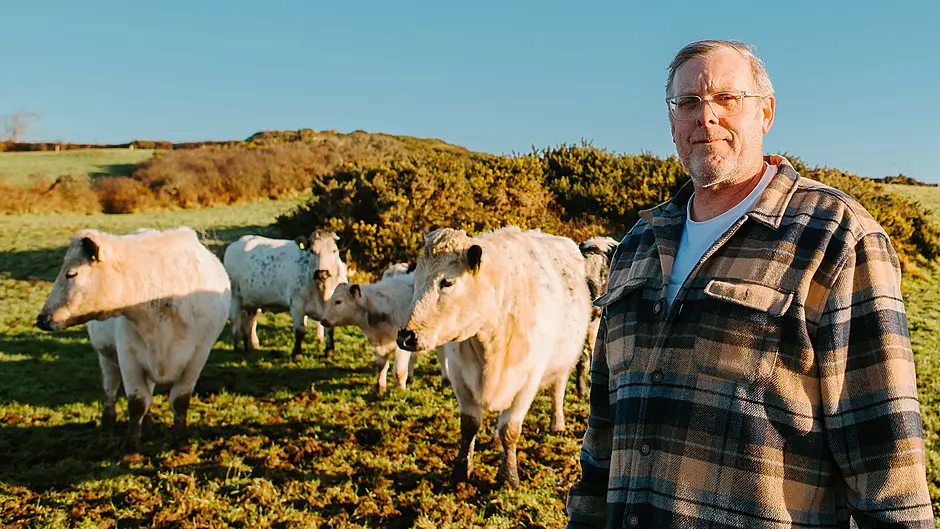
Liam O’Driscoll is suckler farming with his wife Ayna in the townland of Knockanoulty, Skibbereen along with their three children, twins Eamon and Ali (13) and Daithí (11). The twins attend secondary school in Skibbereen, while Daithí attends primary school in Skibbereen. Liam’s wife, a native of Turkmenistan, is a wedding photographer. Liam moved back to his native Skibbereen about fifteen years ago along with Ayna, where he took over the family farm. Prior to Liam returning, the main enterprise on the farm was finishing bullocks for beef production.
When Liam took over the farm, he had a few options in his mind to ensure the farm would be sustainable into the future: First, breeding his own herd and second, venturing into agroforestry and the participation in various Schemes.
ADVERTISEMENT
Liam was looking for the perfect breed of cow to fit his farming system, and took a liking to the Droimeann breed. He first got into Droimeann in 2018; Liam’s aim at the time was to one day produce 100% Droimeann purity. This aim came to fruition in 2025 when he had his first calf at 100% purebred Droimeann breed, with the trademark desirable traits: a hardy breed, easy calving, with good milk and beef quality. This suits Liam’s farming system, and he currently has 20 Droimeann cows and their followers on the farm along with a purebred Droimeann bull.
Most of the heifer calves are kept as replacements but any surplus animals are sold on as in-calf heifers at 15 to 20 months of age and approximately 480kg, to other farmers who are looking to maintain the Droimeann breed.
Liam slaughters the males for his own use and supplies them to friends and family. These animals are slaughtered at 500kg liveweight.
In order to ensure the farm is economically sustainable, Liam is a participant in farm schemes such as ACRES, the Organic Farming Scheme and the Agroforestry scheme. The Droimeann breed is classified as a rare breed as part of the ACRES scheme.
The Skibb man is also a great believer in hedgerows on the farm for shelter for animals and has a habitat corridor for wildlife. In fact, in the last five years, Liam has planted over 4,000 metres of various native species of hedgerow on the farm.
As there is no chemical fertiliser or pesticides being used on the farm, Liam considered the option to join the Organic Farming Scheme. This was a big financial benefit, and he could also tie in organic farming with the agroforestry on his farm. Liam plans to set aside 15 acres of his farm for agroforestry and has received approval; planting will commence this month. One of the major benefits of the Agroforestry Scheme is that he can claim this payment along with other farm scheme payments he receives.
Soil fertility on the farm is low, and Liam spreads lime regularly on the farm to increase soil pH, and imports cattle slurry from a neighbour and milk sludge from Carbery to maintain NPK levels on his farm. This is vitally important, due to the restriction of chemical fertiliser as part of the Organic Farming scheme.
About 15 acres is cut annually for hay and silage, and Liam sows and rolls mixed late-heading grass varieties. The one cut of silage allows him to graze his cattle longer through the winter, says Liam. His future plan is to continue to breed his Droimeann herd to 100% purity, and to maintain his participation in environmental schemes. He also intends to set aside a space for nature to ensure his farm is economically and environmentally sustainable when handing it over to the next generation.
Stephen O’Sullivan is a Business and Technology Drystock Advisor with Teagasc Skibbereen & Bantry.