THE PROTECTION of property in Bantry has been listed as the primary concern in a flood relief plan proposed by the OPW, consulting engineers, and Cork County Council.
An estimated 145 people attended a four-hour public consultation forum at The Maritime Hotel last Wednesday December 10th.
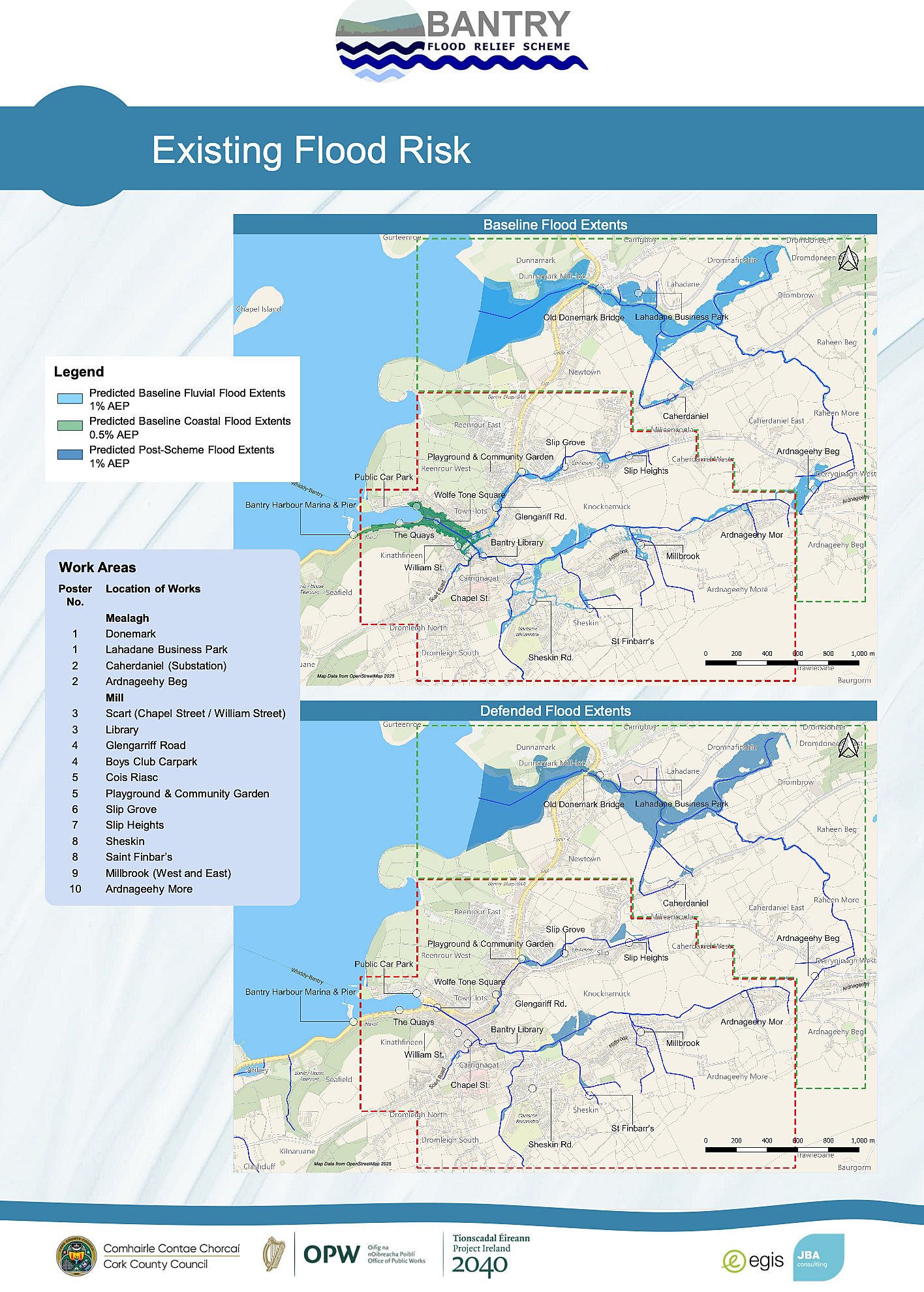
Details of the plan – now estimated to cost €40million - were broken down and displayed on 20 large billboards that covered each element of the plan, from how best to harness the overflow from the Mealagh River and the Mill River during severe weather conditions, to what parts of town need new drains to slow down or carry rain and surface water, as well as the size and scope of impermeable coastal flood defence walls around the inner harbour.
ADVERTISEMENT
One of the key comments on the night – although the OPW representatives, the consulting engineers, and the council’s own engineers declined to speak on the record to the media – is that people can forget the figure of €6.7 million.
The sum of €40 million is now the projected cost of the plan that could take until 2030 or 2031 before ground is broken, and two years of construction to complete.
That preferred option will have to be designed to a very high level of specificity before it is submitted for planning in about 18 months time. It will then take up to a year to secure a contractor.
Some in attendance expressed an underlying fear that a judicial review of any part of the plan could add three or more years to the timeline.
The overall view from members of the public is that the plan was very clearly set out, is practical, and very easy to understand, and covers all of Bantry from the Mealagh Valley to the quay walls in Bantry town centre.
One woman whose property repeatedly floods, who declined to be named, was given ample opportunity to discuss her situation with a senior engineer. She is of the opinion that the cleaning of rivers needs to be prioritised.
Helen O’Sullivan, a suckler farmer in the Mealagh Valley, said: ‘If we were allowed maintain the rivers like we were doing before the EU Birds Directive was introduced into Ireland over 20 years ago, we wouldn’t have half of this flooding.’
She explained that the Mealagh Valley river runs through her land which means her fields are prone to flooding, so, from an agricultural point of view, she expressed concern about the proposed catchment areas designed to slow down the water entering Bantry town.
She asked if some of the proposed environmental solutions – such as deep trenches to contain rain water instead of ‘hard’ infrastructure – will have an effect on landowners upstream.
It is understood that the proposed flood relief plan has the protection of houses and businesses from being repeatedly damaged by floods at its core because that is what secures funding.
The plan shows how the new impermeable coastal wall will be raised two metres and will have a stone wall finish, and suggests that the surface water that causes flooding at the Biggs car park and then down New Street, could be corralled by reinforced storm glass at the library instead of the railings that are there at present.
The plan gives consideration to the ecological protection of the rivers, and it is understood that the local authority will install substantial grills ‘upstream’ to prevent debris from being carried on the fast-flowing water entering the town.
Locally, there is some confusion about the difference between the €40m flood relief plan and a plan to replace the stone masonry arch culvert that runs beneath Wolfe Tone Square, New Street and Bridge Street in Bantry.
One thing is clear: the replacement of the old culvert with a new one will improve the flow of water through the town because the new culvert will have some increased capacity after ‘services’ contained within the system are streamlined.

It is expected that the replacement of the culvert will be done ahead of the flood relief project, so the timeframe for completion could be within the next two or three years.
The timeframe for the project is of concern. ‘How many businesses are there going to be in six years time?’ asked one business person, who noted there have been a lot of shop closures in Bantry due to increased costs.
The owners of one business, Organico, which is a major employer in the town, have concerns about the flood relief plan because it slates an operational portion of their business, at the rear of Glengarriff Road, for demolition in order to replace a culvert.
Hannah Dare, a co-owner of the business, told The Southern Star: ‘We’re still coming to terms with the news about the partial demolition and rebuild of our building. We don’t yet have all the details, but it’s clear that this will be a highly disruptive process for Organico.
‘At the same time, we recognise how important this project is. It will make a real difference for Bantry businesses affected by the floods and for residents who have been dealing with this issue for generations.
‘Knowing that this work will help ease the pressure on them, we’ll do our best to support and cooperate as the plans become clearer, even as we navigate the challenges it may bring for our own operations,’ she said.
Local businessman, Aiden McCarthy said the public consultation event offered ‘a very detailed assessment’ of the current situation taking the topography into consideration, since the town’s ‘roads, footpaths and most of the properties are just two metres above sea level’.
‘The challenges are great, but the project they are proposing is the most practical and achievable,’ Aiden added.
‘The design and planning will take its own course but the key factor for the town will be to minimise the construction phase. Ultimately, this project represents a substantial amount of investment... [which] will filter down for the benefit of a lot of traders and residents in the town.’