Taken from The Southern Star published Saturday, October 10th 1992.
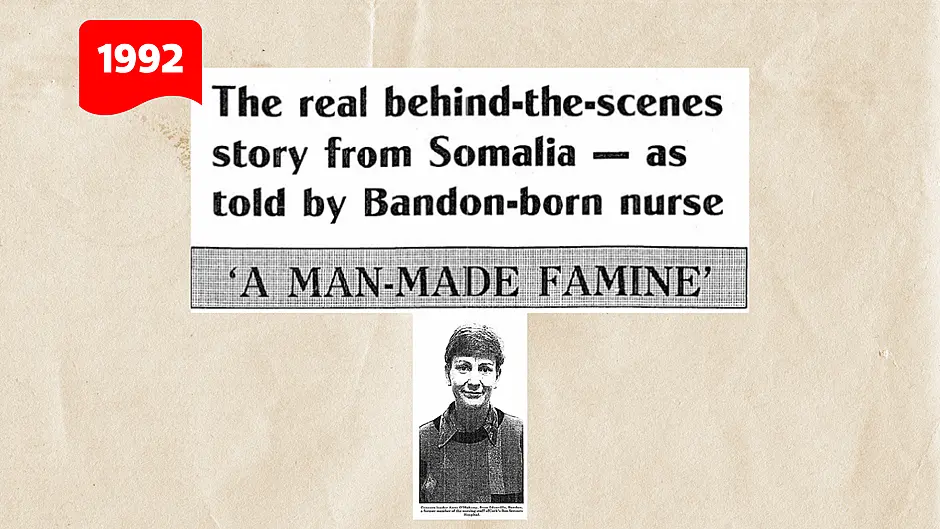
'A MAN-MADE FAMINE'
BY ANNE RYAN
ADVERTISEMENT
Behind the harrowing scenes of famine in Somalia — children with faces so gaunt they look as if they are old men who have lived lives of sorrow — there is the real story of what caused this man-made tragedy.
Bandon nurse and former Concern leader, Anne O'Mahony, just returned from the strife-torn country, told "The Southern Star" some of the political realities behind the disaster, not least of which was how Somalia had been used as a type of board-game by America and Russia to fight their former cold war.
Anne said that following her "nightmare" ordeal, during which she spent what should have been her University summer holidays in the country, her most profound hope and joy was the visit of Irish President Mary Robinson to the region.
Anne, who was once in charge of Concern's Sudan programme and who is now studying a Masters Degree in Development Studies (global trends) in Swansea, Wales, said that, even though she had been present in the highly dramatic Ethiopian disaster, Somalia was in every sense "worse."
One of the chief reasons for this was that Somalia was a man-made famine, which was somehow harder to take that Ethiopia, which had been largely caused by drought and crop-failure.
Somalia, once a prosperous African region with throbbing cities and "fruitful agricultural hinterland" had been devastated, firstly by national warfare, but second by a bitter civil war, during which soldiers fled, burning crops behind them, so the 'other side' could not themselves feed; the result of which has been a devastating laying bare of a whole landscape.
SIMPLY DESTROYED
Cities and a sophisticated infrastructure have been simply destroyed, as electricity, water, roads and buildings have all been bombed or shot down.
And, the worst legacy of all this, are the bands of lawless gunmen who roam about shooting at will, their main targets often being the tormented, weakened group of mothers and children.
Anne was stationed at the Baidoa food centre, where every morning she saw lines of what one could only call "walking skeletons" who had lived beyond their terrible despair to transcend to some state of unreality.
Mothers had watched children cry for something they could not give them, until they could cry no more and wasted in front of them, until the mothers became either lunatic or just dazed.
"Baggy trousers" syndrome was the term Concern nurses used to describe the little ones whose flesh had become so baggy, one could almost fit another child inside them.
But, Somalia did not occur overnight. The cause of its present turmoil stretched back to colonisation as a minor contributory cause and being used as a pawn in super-power games, as a more direct influencing factor.
In the '60s, the big Colonial powers withdrew leaving British Somaliland and Italian Somalia as one new, perhaps in some respects, uneasy whole.
WENT TO WAR
Then, in the '70s, the new country went to war with its neighbour, Ethiopia. Somalia was backed by Russia and Ethiopia by America.
Both countries were flooded with arms and they gained air-strips and other war-orientated infrastructure, as fronts to fight a cold war on other territory.
By the '70s war-hungry Somalia decided to get more ambitious and try to claw in Ethiopian Ogadeni into its own region. But, as the war was in full flight, the international cold war began to thaw and finally melted, leaving Somalia alone, without support, with a semi-equipped army.
A host of new soldiers, many who have never risen fully above this ancient clan-system, had become used to their new power roles. A dictator-form of Government saw that their old tricks of playing one side off against another, became turned back on themselves. A major civil war ensued.
As Somalia turned on itself to fight a civil war, the toll was taken on the women, children, the old, and the infirm who bore the brunt of the wanton destruction.
Anne, called by Concern to come over at the end of May, got a fright when she re-visited Mogadishu. "It was a revelation to walk through parts of this once crowded city, now simply deserted," Anne said, now back in her home of Edenville in Bandon, before her return to complete her master's course in Swansea.
With the advent of the rainy season, those that have been buried in shallow graves will have to be unearthed and buried properly, or the rain will wash up a sea of dead bodies.
"It is good to take the undernourished children and feed them to a point where the colour comes back into their cheeks," says Concern's Anne O'Mahony in this interview about the famine in Somalia.
Baidoa, which had been called the "sorghum basket of Somalia," sorghum being a basic food, the equivalent of our potato, had been wasted, simply ruined.
It was in Baidoa the Concern food centre was set up. It had once been home to a population of about 60,000 people. But, in an internal migration, the people of Baidoa had moved to Mogadishu and the people of the rural hinterland had roved to Baidoa, all seeking food and shelter for the warring bands of gunmen.
"They were just starving to death. They were just walking skeletons. Every morning, there were just lines and lines of them. It was a terrible sight," said Anne, who has been a nurse and chief administrator with Concern for some twelve years.
But the biggest present problem may come, not from even lack of food, but from the dead, unburied and shallowly-buried bodies.
A system has grown whereby most of the bodies are being buried by the last of the able-bodied, who charge about a dollar for the service.
But, with the advent of the rainy season, these bodies will pose the greatest health threat of all, and could cause plague, to kill off the last of the people, before starvation gets to them.
However, the Red Cross have now decided to dedicate their not inconsiderable resources to tackling this problem alone.
Those that have been buried in shallow graves will have to be unearthed and buried properly, or the rain will wash up a sea of dead bodies, and those that have just died will have to be buried straight away.
Getting food into Somalia is a huge problem, because of the crowds of lawless bandits. Relief agencies are forced to fall back on air-lifted food because of the difficulty of getting food in through the ports.
MORE EXPENSIVE
But air-lifted food drops are a lot more expensive and a mere 15 tonnes can be carried in the hold of a plane, compared to 10,000 in the hold of a ship. A full day's air-lifting schedule of nine lifts will bring in only 135,000 tonnes, which is "peanuts" compared to what is needed, Anne said.
One of the greatest methods of distributing food is to sell the relief supplies to Somalian dealers who charge market prices. The people have some money and can afford this. The food gets around quicker and this system has the advantage of defeating gunmen, who will steal off food-centres, whom they know won't defend themselves, but would not steal off the Somalians.
How does Anne cope? "You have to be tough," she says, "You become hardened. But it is never easy."
She witnessed some terrible atrocities. One woman had her baby shot on her back as she fled the bullets of the gunmen. She saw mothers crazed, because they could take no more. She saw starved children too weak to cry.
But it is "good" to take the undernourished children and feed them to a point where the colour comes back into their cheeks, Anne said.
Anne worked in Ethiopia when Bob Geldof visited it in 1985 and even before that. She ran the major Concern programme in Sudan and, as such, met diplomats, heads of State and did a lot of political and administrative work.
She was the recent chief guest of honour at a coffee morning in the Bandon Credit Union premises, attended by about 800 people, at which £3,000 was raised.
Anne's only regret was that she was not present in Somalia this week to see the President of Ireland tour this devastated land.
From the Archives is a look back through the top stories reported by The Southern Star in its 137 year history.
If you'd like to receive our weekly historical newsletter, you can sign up here.
Did you know it's possible to read past editions of The Southern Star dating all the way back to 1892? Enjoy 137 years of local and national history at your fingertips with a subscription to the Irish News Archives.