There has to be a consolation prize for the disappearance of summer’s long, warm days, and for me, it is the emergence of autumn and winter mushrooms.
As the weather gets colder and the air and ground become damp, a diverse array of magical fungi emerge from earth and wood.
As it is that time of year again, here are a few fascinating species to look out for on your wanderings around wonderful West Cork.
ADVERTISEMENT
Fruiting bodies
Firstly, the terminology of fungi can be confusing.
There is no biological difference between mushrooms and toadstools, and the terms are used interchangeably.
In the past, toadstool was more often used for poisonous or inedible species, but this distinction has largely disappeared.
Fungi belong to a kingdom of their own, separate from plants and animals.
Unlike plants, which make their own energy from sunlight, water, and carbon dioxide, fungi release enzymes to digest food in their surroundings before absorbing the nutrients.
Although autumn is the classic season for spotting mushrooms, the hidden fungal network, known as mycelium, lives underground or within wood year-round.
When conditions are right, the fruiting bodies we see above ground are produced.
Their purpose is reproduction, releasing spores that spread and grow into new fungi.
Fungi are vital to environmental and soil health, breaking down dead material, recycling nutrients, and supporting the growth of trees and other plants.
Super Mario power-up
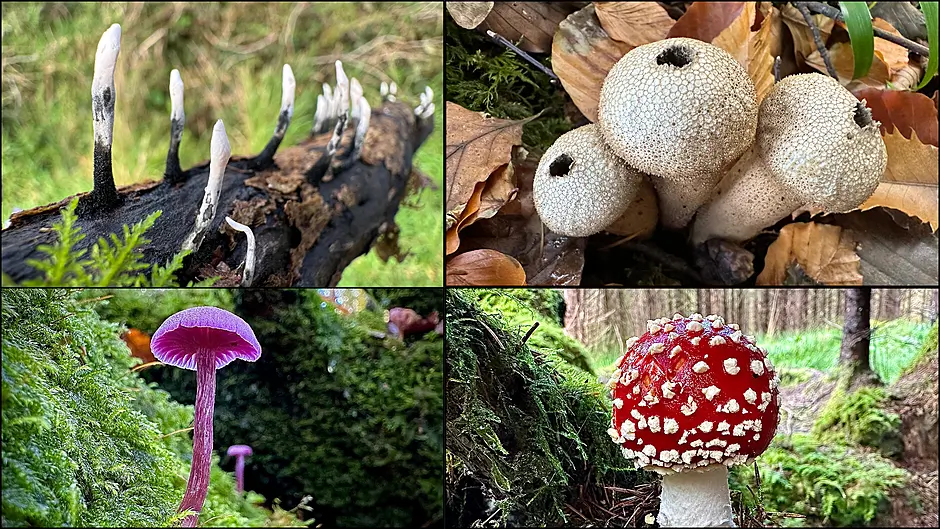
Fly agaric (Amanita muscaria) tops many fungi enthusiasts’ favourite species list.
This bright red mushroom with white spots inspired the power-up mushroom in Super Mario and features in countless fairy tale illustrations.
Its name comes from its traditional use as a fly control agent. Because it contains psychoactive compounds, the caps were once broken up into milk to attract and stupefy flies, which were then either poisoned or drowned.
This striking mushroom can be found in woodland, particularly where birch trees grow.
Lawyer’s wig
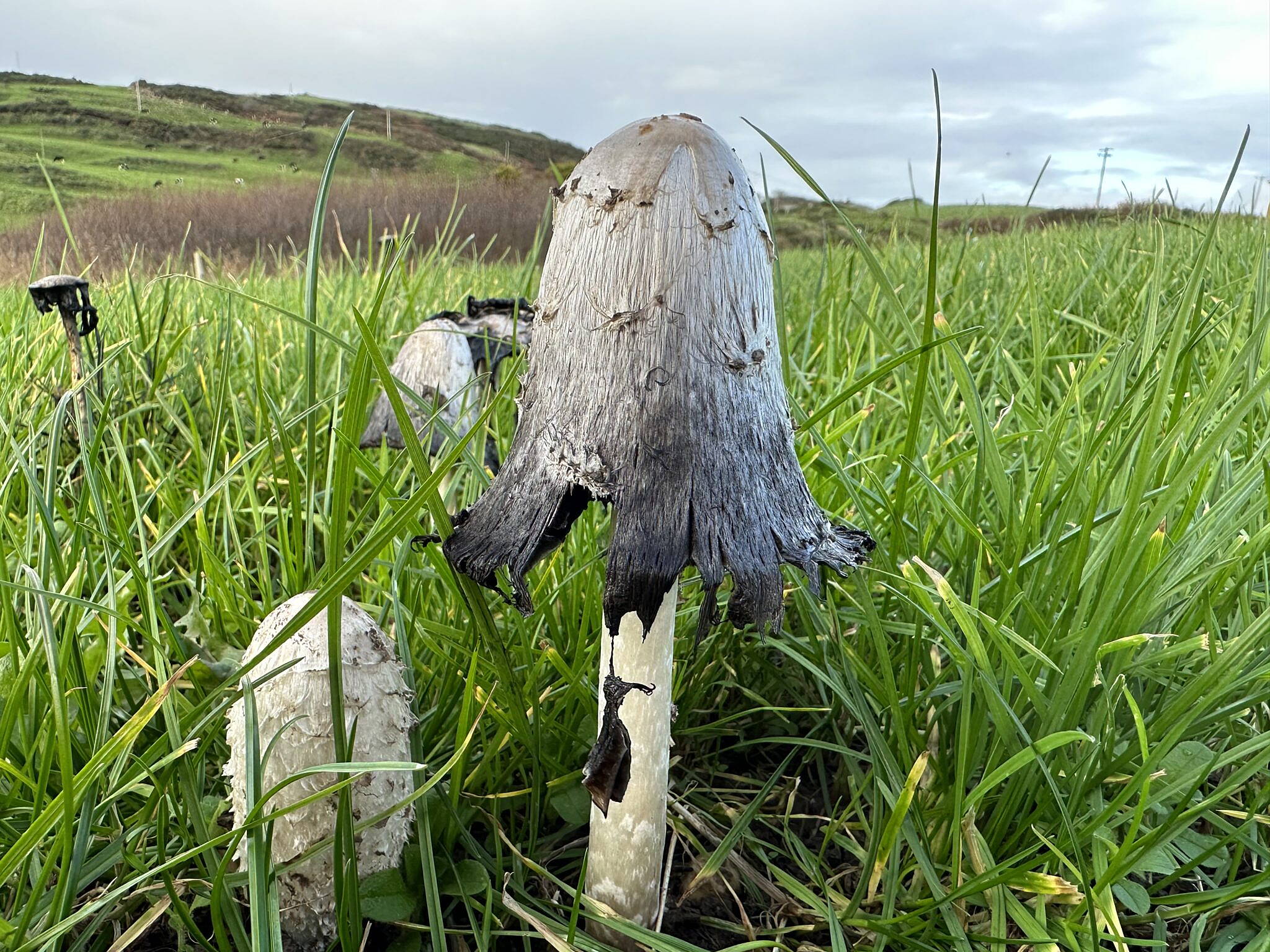
Most fungi rely on the wind to disperse their spores, but the lawyer’s wig, or shaggy inkcap (Coprinus comatus), takes a different approach.
As it matures, its cap and gills dissolve into a black, inky liquid, exposing more spore bearing surface and releasing spores in the process.
This self-digestion, known as deliquescence, can reduce the mushroom to a blackened mess within hours.
Before this happens, the mushroom has a shaggy appearance, which gives it its common name.
It can also kill tiny soil worms using toxins delivered in structures described as “spiny balls”, before releasing enzymes to digest them.
Fungi that do this are known as nematophagous, literally meaning worm-eating.
You might find a solitary lawyer’s wig, but they more often appear in groups on soil or grass, particularly in areas disturbed by people.
Amethyst deceiver
The amethyst deceiver is an unexpected pinkish-purple beauty found in woodland.
It can be found by looking carefully in leaf litter, mainly under beech trees. Look for it after rain, when its colour becomes more vibrant.
Fortunately, damp conditions are rarely hard to find in West Cork at this time of year!
The word ‘deceiver’ relates partly to its relative, the common deceiver, which comes in a range of colours and can resemble other mushrooms, making identification more difficult.
Puffballs
West Cork is home to a range of puffball species, including common puffballs, stump puffballs, and giant puffballs.
In these fungi, spores develop inside a rounded sac.
As they mature, the interior becomes powdery and the spores escape in visible puffs through an opening at the top.
It can be fun to squeeze them and release their clouds of spores, but avoid inhaling them.
The spores can irritate lung tissue and, in rare cases, cause a condition called lycoperdonosis.
This has mainly been reported in dogs that have played with puffballs and inhaled significant amounts of spores, but it is still sensible not to breathe in the spores directly.
There is no need to help them along, anyway.
Falling raindrops can naturally trigger the release of spores by creating pressure on the fungus.
Giant puffballs are particularly impressive, weighing up to five kilograms.
Their spores are released when the entire structure breaks down. Puffballs can be found in a variety of habitats, including woodland, grassland, farmland, and hedgerows.
Candlesnuff fungus
Candlesnuff fungus (Xylaria hypoxylon) is a common species that grows year-round on dead wood.
Once you learn to recognise it, you will keep spotting it.
It’s a thin, upright fungus, up to two to six centimetres tall, and is usually black with white tips.
Young specimens resemble burnt candlewicks, giving the fungus its name.
When mature, flicking one can release a puff of white spores that trails away like smoke from a snuffed candle.
Candlesnuff fungus is also described as bioluminescent, meaning it can produce light in the dark.
Although this sounds exciting, the glow is extremely weak and not typically visible to the naked eye.
Growing on dead wood in an advanced stage of decay, candlesnuff fungus helps break it down and return nutrients to the soil.
It is always worth remembering the old saying that all fungi are edible, but some only once, as they can be fatal.
I err on the side of caution and prefer to admire mushrooms for their shapes, colours and fascinating biological strategies rather than forage for them.
Whatever your approach to mushroom hunting, make the most of this time of year and head out to discover some of West Cork’s fascinating fungi.