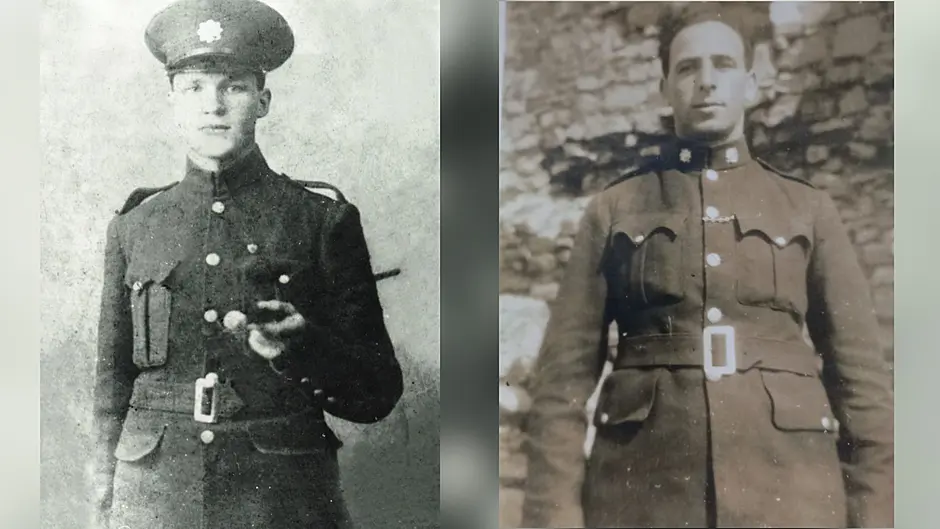
AMONG the ten deceased, retired and serving members of An Garda Síochána who were honoured with Scott Medals for bravery, one previously served in Bantry, while another gave long and distinguished service to the people of Skibbereen.
The year 2023 marked the 100th anniversary of the killing of the first garda sergeant in the execution of his duty - Sgt James Woods who had been stationed in Bantry before taking up a post at Scartaglen in County Kerry.
Sgt Woods was killed in a raid after armed and masked men, believed to be local anti-treaty volunteers, entered the station at 8.30pm on December 3rd 1923.
ADVERTISEMENT
It was Gda Patrick Spillane’s first post and he was badly beaten in the same incident, but lived to tell the tale.
In fact, he went on to serve with distinction in Skibbereen from April 9th 1935 until his death in 1981.
The garda commissioner Justin Kelly awarded a total of 12 medals to 10 recipients at a ceremony at Walter Scott House in Dublin recently, 102 years after the Kerry raid.
One posthumous Gold Medal was presented to the family of Sgt Woods; there were two posthumous Silver Medals, including the one that was presented to Gda Spillane’s family, and nine Bronze for members of An Garda Síochána, three of whom are deceased.
Patrick Spillane’s son, Pat, was born in Skibbereen in 1947 and lived in the town until he himself joined the gardaí in 1967.
He spoke to The Southern Star about this historic and tragic event. He outlined how his father, a native of Blarney, was born in 1901 and was a member of the Irish Volunteers from 1918 to 1922.
He said Colm Wallace, the author of ‘The Fallen – Gardaí killed in service 1922-49’, explained how three of the armed men entered a crowded kitchen where Gda Patrick Spillane, Jeremiah Lyons, his wife and six children, as well as two brothers, James and Michael Kearney, were present.
Pat takes up the story saying his father, a station orderly, was set upon and ordered to put his hands up, which he did.
Gda Spillane was struck on the side with the butt of a rifle and his nose was broken.
Next, they dragged him towards the stairs and ordered him to climb up as the armed men followed closely behind.
When they reached the second floor he was ordered to strip.
He refused saying he was ‘prepared to die in defence of his Garda uniform.’
One of the men threatened to shoot him if he did not strip.
Again, he refused and the raider told him that if he didn’t strip it would go worse for him.
‘He bravely stood his ground,’ said Pat.
‘He was badly beaten and forced onto a bed and they ripped his uniform from him.
‘He was only wearing his shirt, which he was told to remove. He refused but they eventually succeeded in taking the shirt from him.
‘The raiders then took his watch and chain, and the 30 shillings from his tunic pocket. They burst open his wooden chest and removed more money and clothing that was also stolen.’
The raiders forced open other chests belonging to gardaí and took the contents. Then, they ordered Gda Spillane to call Sgt Woods who was in another room. He refused and they threatened to shoot him.
Pat said one of the raiders went downstairs calling loudly for Sgt Woods and on hearing the commotion the sergeant came into the kitchen.
‘The sergeant was forced at gunpoint towards the stairs. As he reached the stairs, he was prodded with a rifle near his neck and a shot went off. He was killed instantly and in the commotion that followed the raiders fled.’
Pat is proud of the fact that his father showed bravery and heroism as a 22-year-old garda in an era of widespread civil unrest.
Patrick Spillane went on to serve at garda stations in Tralee, Ballybunion and Listowel.
It was on May 20th 1934 that he was transferred to his first West Cork station in Drimoleague.
He was assigned to his final station in Skibbereen on April 9th 1935 and remained there until his retirement on May 15th 1952.
In the four decades that Gda Spillane lived and worked in Skibbereen he was held in the highest esteem, and his passing at St Anne’s Hospital in Skibbereen in 1981, was a sad occasion in the community.
‘As a family we are all very proud of him,’ said Pat, who recalled how during The Emergency, from 1939 to 1945, his father was seconded from the gardaí and became the district administrative officer of the Local Defence Force for the Skibbereen area.
Pat Spillane said he was glad to report that for 29 years his father had a long and happy retirement from An Garda Síochána.
And he’d be proud of the medal bestowed upon him.