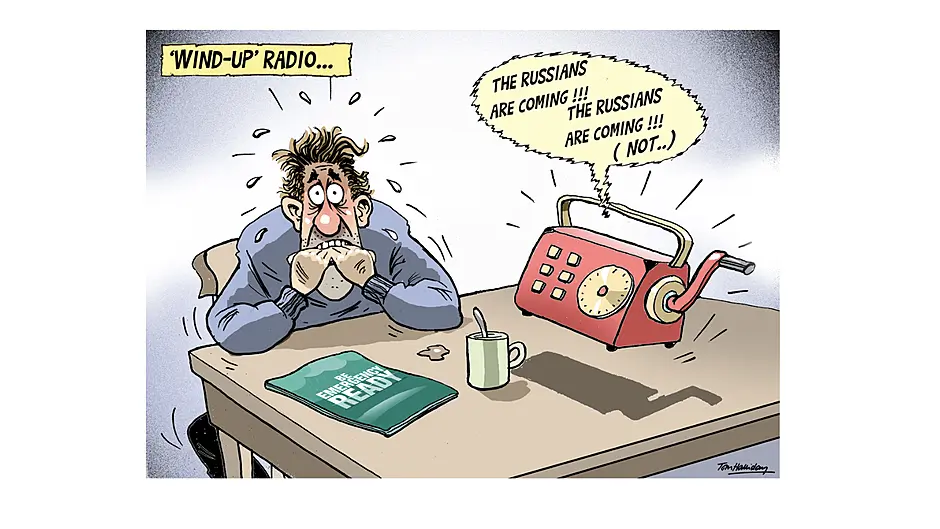
Listen, I like to keep on top of global events, as you all well know, but you’d be only getting yourself down if you were taking it all seriously all of the time. But like the rest of you, I freak out from time to time.
Like recently, when I opened the Be Emergency Ready booklet, which An Post dropped through roughly 2.2 million letterboxes and which most of us read with a sinking feeling that the Russians are coming.
As you all know, there’s a strong tradition here in the storied halls of The Southern Star, that we like to keep a keen eye on Moscow. So my hackles were up immediately.
ADVERTISEMENT
It’s a sensible document, in fairness. It wants you to have a battery or wind-up radio, a paper map (remember them?) and a waterproof bag for your passport and birth cert, presumably so that when society collapses you can still prove to the lads guarding Centra who you are.
But it turns out we got the soft-focus edition. Records released to The Journal under Freedom of Information show officials dropped the EU’s advice that households should have supplies to survive for at least 72 hours, because they worried it would make people anxious about why they were being told. One draft graphic was a concern because it might read like a countdown, as if something was due to happen by Thursday.
They needn’t have worried because, well, we were already worried when we read the Be Emergency Ready title page. Part of my brain never fully left March 2020. Say “essential supplies” and I’m back in the hall with a basin of hot water and a bottle of Fairy Liquid, scrubbing a net of mandarins as if Dr Tony Holohan was standing over me.
So that’s why I immediately filed the leaflet away between the takeaway menus and the carefully stored box of Joe Jacob’s iodine tablets, and don’t intend to read it again.
Saunas and death metal
Still, there’s a way to be organised without going full COVID, and the Finns seem to have it cracked. They’ve been nudging citizens to plan for 72 hours for years, they have shelter space for most of the population, and nobody up there appears to be getting hot and bothered.
They just get on with it, the way they get on with saunas and death metal. That’s what sharing a border with the Vladamir Putin does to you, I suppose.
We could do with a bit of that, because our own arrangements are more delicate than you’d think. EirGrid says Britain now supplies about 16 per cent of the electricity used on this island, through three cables under the Irish Sea, while demand could hit a record this winter. The backstop is a fleet of temporary emergency generators that will have cost us €1.4 billion by the time they’re switched off, plus the old Tarbert station, converted from coal to heavy fuel oil and kept on standby.
Then you read that one blown-out oil well in eastern Niger has been leaking over 40 tonnes of methane an hour since late September, enough to cancel out about 40 per cent of Ireland’s emissions and you want to fire the compost bin into the River Bandon.
It doesn’t mean we shouldn’t be getting our own house in order of course, and we’re lucky to have the links to old mother Britain for the time being while we slowly, slowly get our wind energy system into action. You can’t heat the house with Sally Rooney books, lads.
Pint of plain – or pain?
Over in the parallel universe where the tech billionaires live, it was a rough week for splitting the G. Mark Zuckerberg turned up on The Cheeky Pint, the podcast Limerick’s John Collison hosts in a pretend pub, and brought a keg of Dublin Guinness for the occasion.
He took a sip of what looked like pure head, made a face like a man handed cold dishwater at a removal, and put it down. Pint Baby he is not. The clip got over 13 million views, and in Dublin, Guinness marketing execs could be heard weeping for joy across the Liffey.
His defence was “That’s just my face”, which is ironic given the name of the social media platform that made him billions. The Irish Times reckons he got through about 1.4 pints over the full episode, so he did persist in all fairness.
AI giants stoke flames
And finally, a Sligo man is at the centre of a row between the AI giants, 120-odd years after his death. George Gabriel Stokes was born in Skreen in 1819, the son of the local Protestant minister, and ended up Lucasian Professor of Mathematics at Cambridge, a job Isaac Newton once had and Stephen Hawking later held. Nice gig if you can get it.
His Navier-Stokes equations, published in 1845, describe how fluids move, and whether they always hold is one of the Millennium Prize problems with a million dollars attached.
OpenAI says 10,000 of its AI agents cracked it in 88 hours with a 166-page proof, the mathematicians are still squinting at it through tears. Among other things, his equations help explain why the bubbles in a pint of Guinness sink. Whether he’s be able to calculate exactly what happened on Mark Zuckerberg’s face when he drank it, is a different question. There are some things AI will never know.