My parents talk to strangers. All the time. Everywhere. They’re incorrigible.
BY JOE KEOHANE
They’ll go on vacation, meet someone, and then I’ll get a call from that individual a week later because my mother thought we’d get along.
ADVERTISEMENT
They’ll reach across two tables in a crowded restaurant to offer a comment or ask a question, and people actually enjoy it.
And then I’ll get a call from these people, too.
They just have a certain energy. When I was a kid, we’d have random people show up at holidays.
One time my father brought home two bagpipers he’d encountered at a coffee shop. He liked them, so there they were, in the kitchen, at Christmas, with the bagpipes.
My parents are in their 80s now, and they are still talking to everyone, still making new friends. For them, talking to strangers isn’t just recreation. It’s fundamental. It’s indistinguishable from being alive.
In many ways, I followed their lead. I found work as a journalist, musician, and screenwriter, which are all very social businesses. Now, pushing 50, I remain an incurable collector of friends, acquaintances, conversations, and experiences, that come from making a practice of talking to strangers.
There was a moment, however, when that wasn’t the case. After our daughter was born ten years ago, I found myself withdrawing. I suddenly stopped talking to people in bars or coffee shops. I started using the self-checkout lanes at the supermarket. I relied on my iPhone to perform all the tasks that used to require human interaction. I didn’t choose to pull away like this. I just defaulted out.
But it was clear that I was losing something profound. My life was suddenly less rich—in serendipity, and story, and weirdness. I felt adrift in my city. What happened?
Two things. One, I had a baby. Babies are black holes of need, as we all know. I was tired, and spending less time out in the world, which reduced my opportunity to, say, learn from a bartender all about the mating habits of the leopard slug. And, two, I had a phone. And if you have a smartphone, and you’re of a certain privileged class, you can basically go the rest of your life without ever talking to anyone again.
What exactly what was I losing? That question changed my life. It sent me down a hundred different rabbit holes, and I discovered a rich body of research on the benefits of talking to strangers.
Over the last 20 years, psychologists have discovered that talking with strangers can make us happier, healthier, more connected to our communities, mentally sharper, less lonely, and more trustful and optimistic.
I’m a Bostonian living in New York City. You’re Irish. We probably don’t need to be told about this. Some of the greatest talkers in earth live in Ireland, Boston, and New York. But my country is having a full-blown mental breakdown driven in part by crises of loneliness, alienation, and estrangement. And according to a 2025 study by psychologist Joanna McHugh Power at Maynooth University, and sociologist Christopher Swader of Lund University in Sweden, Ireland is currently the loneliest nation in Europe.
Power and Lund suggest the fact that Ireland has been experiencing more immigration and emigration of late is a factor. Inward and outward migration is associated with higher levels of loneliness, because friends are leaving, strangers are taking their place, and people aren’t talking to one another.
Meeting new people is the cure for loneliness. And you can’t meet new people unless you talk to strangers.
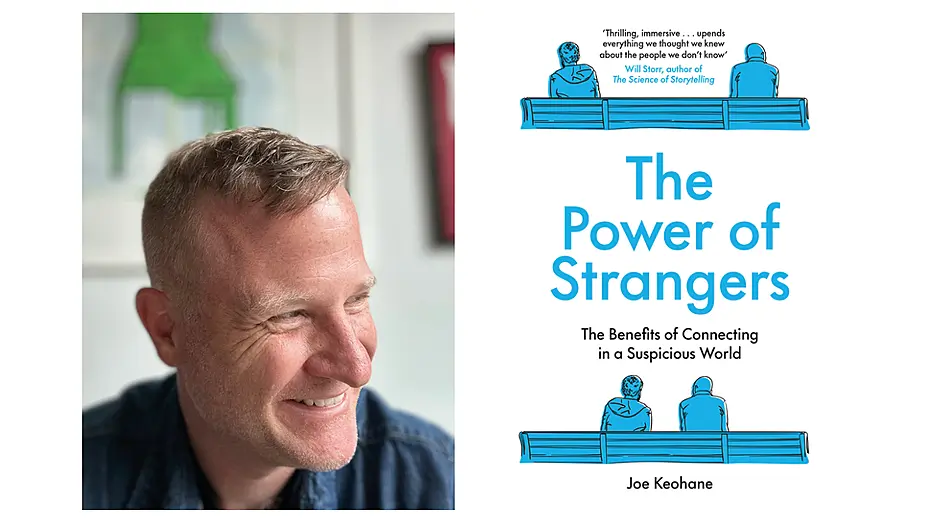
Joe Keohane is the author of The Power of Strangers: The Benefits of Connecting in a Suspicious World. He will be appearing at Bantry Books on August 28th, at 6.30pm, and would very much like to hear your stories, and then make you call his parents.