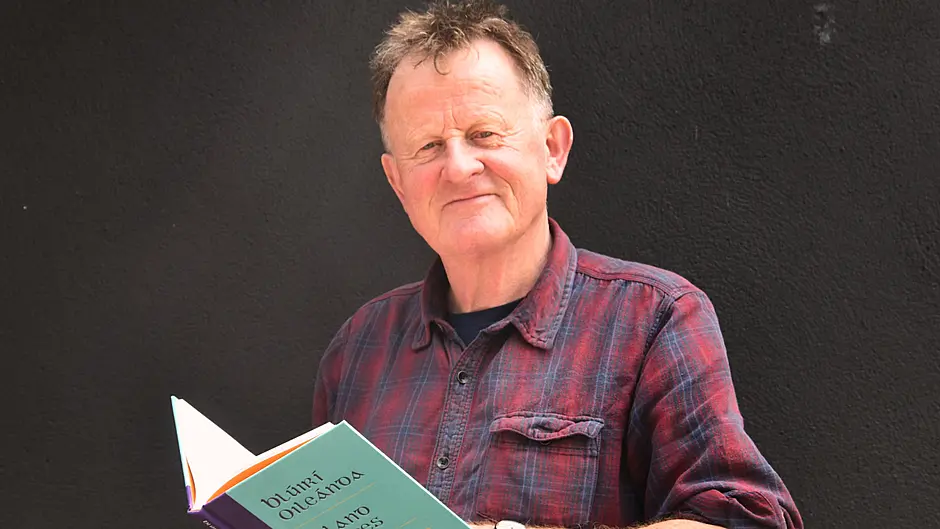
Historian Dairmuid Ó Drisceoil’s beautiful book is a tribute to the affection he holds for the land of his forefathers.
BY AISLING MEATH
AS a tribute to the affection which he holds for the land of his forefathers, writer and historian Diarmuid Ó Drisceoil has published Blúirí Oileánda - Island Pieces.
ADVERTISEMENT
The unique book encapsulating life on the West Cork island of Cape Clear will be officially launched on Saturday August 22nd at City Library, Cork as part of National Heritage Week.
In all 29 different topics, all drawn from the fabric and history of island life, are examined in the book. Pieces ranging from ditches to dressers, prayer books to spades, shipwrecks to emigration and the world-famous Cape Clear storytelling festival.
Each chapter is written in both Irish and English and wonderfully illustrated with vibrant photographs throughout. The physical book is in itself beautifully presented and bound with a simple yet elegant blue cover using the old Irish script echoing another Cape Clear book ‘Seanchas Chléire’ by islander Conchúr Ó Siocháin, first published in 1941, and later translated into English in 1975 by Ríobárd P. Breathnach as ‘The Man from Cape Clear’
‘The simplicity of the design created during the war, in a time of austerity appealed and myself and designer Stuart Coughlan also wanted to pay homage to Ó Siocháin’s book, one of the topics covered,’ explained Diarmuid.
Diarmuid’s own father, Jerry Sheámus, left the island in his teens for secondary school and went on to train as a teacher. Growing up in Cork city, Diarmuid was a frequent visitor to the island spending summers with his grandmother Mary who was born in 1884, widowed in 1919, and wore black for the rest of her life.
‘It’s incredible to think that my grandmother knew people who had survived the famine and of course as a young fella I never thought of asking her about that,’ he reflected.
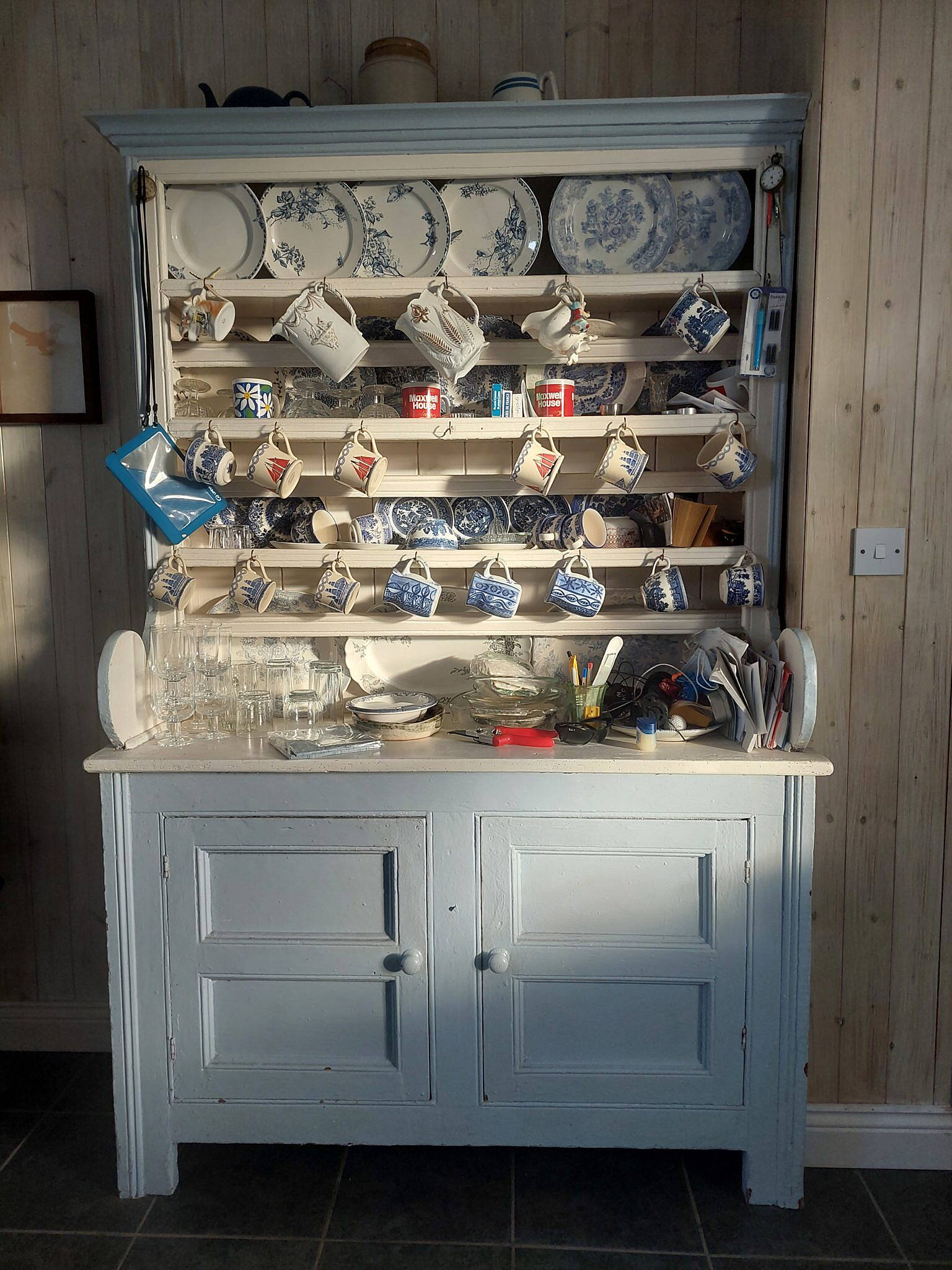 A traditional dresser.
Three of her sons, his uncles, Jamie, Dinny Shémuis, and Paddy also lived on the island. They worked their land and tended their animals with no running water or electricity, which did not arrive on Cape Clear until 1971, another topic examined in the book.
The family home still remains and although Diarmuid is based in Cork he spends a lot of time there, and indeed it was where he wrote ‘Island Pieces’ over the course of last winter.
Many island homes such as Diarmuid’s had a traditional dresser and at first glance their pretty collection of plates would not seem to be anything out of the ordinary, but when examined through the lens of history these simple objects divulge fascinating events of island life.
Some of the plates taking pride of place on the dressers of several island homes, to this day, came from the 1884 shipwreck of the ‘Illyrian’ which had departed from Liverpool bound for Boston but had lost its way in the fog floundering on the south side of Cape Clear.
Some 68 men were rescued in lifeboats with thankfully no loss of life, and the plates which survived the sea were also brought to safety and sheltered on island dressers including the one in Diarmuid’s family home.
‘It was usual after a storm that people went in search of ‘raic’ or wreckage which would be washed ashore after a vessel had sunk or from the decks of ships blown off course in a storm,’ he explained.
‘Timber was an especially valued item of ‘raic’ but there could be barrels of whiskey, oil or other treasures which were welcomed into households that were often not materially well off.
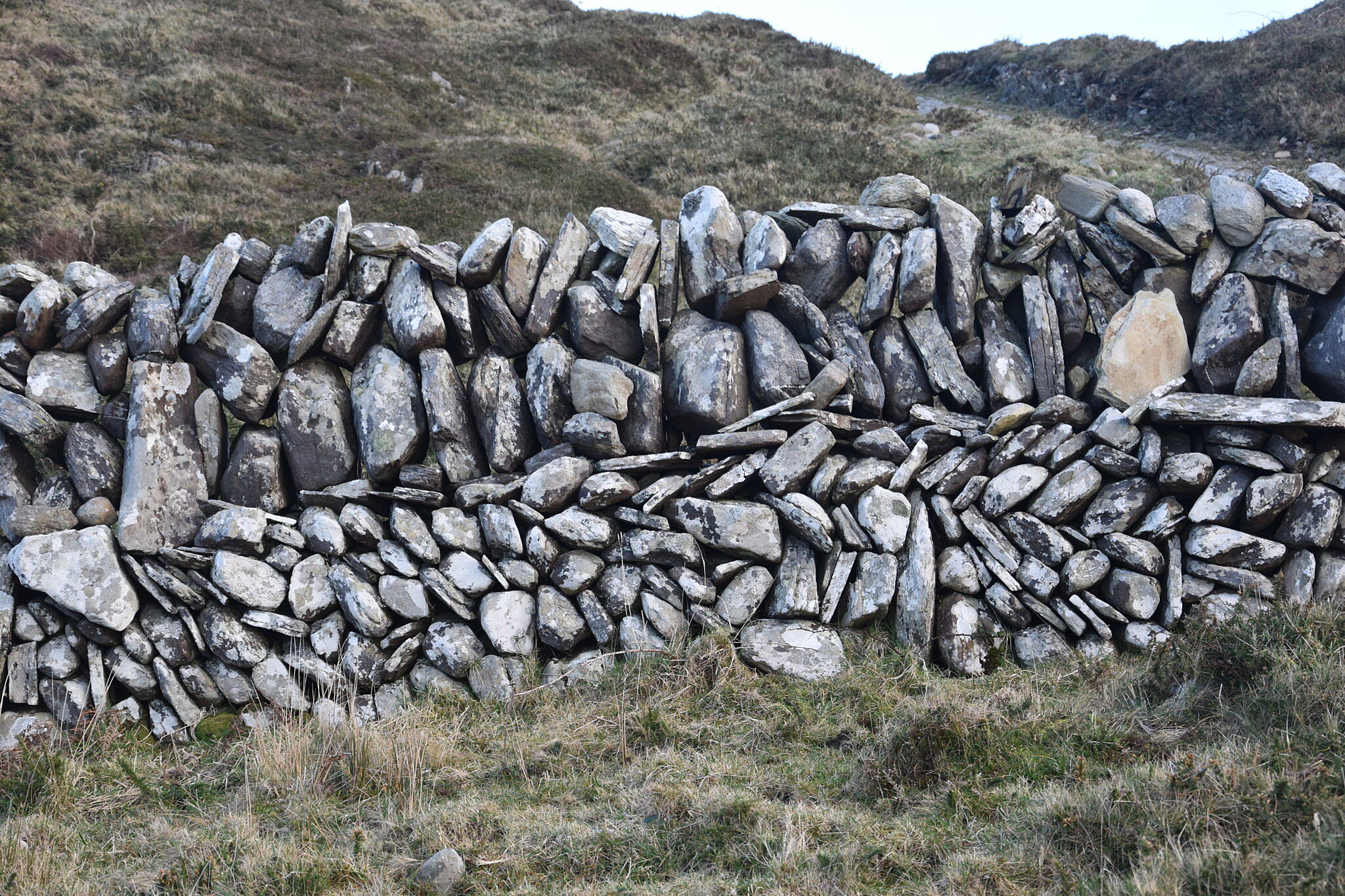 One of the stone walls crafted by generations of islanders.
‘My family spoke about another Limerick ship the ‘Maigue’ which went ashore in South Harbour in the 1940s, and islanders managed to offload a good bit of bacon from its cargo.’
In Island Pieces you will find an account of the unique Cape Clear gansey, knitted for his uncle Tade in 1920 by Catherine Con Cadogan, and marvel at the beauty of the dry stone walls, usually referred to as ditches.
These were crafted by the hands of generations of islanders over hundreds of years, each stone having been carefully carried and placed into position in order to divide up the 1,500 acres making up the boundaries of approximately 1,600 fields, enclosures and gardens.
‘The seed for the book was planted in 2012 during the Cape Clear storytelling festival when I was preparing a talk on island history. I went around the house picking up different things,’ recalls Diarmuid, who discovered that each object then propelled him into researching an aspect of social history.
Prayer books, spades, stiles and quern stones are recalled, each one a component of a way of life on the island which is now passing into the mists of time.
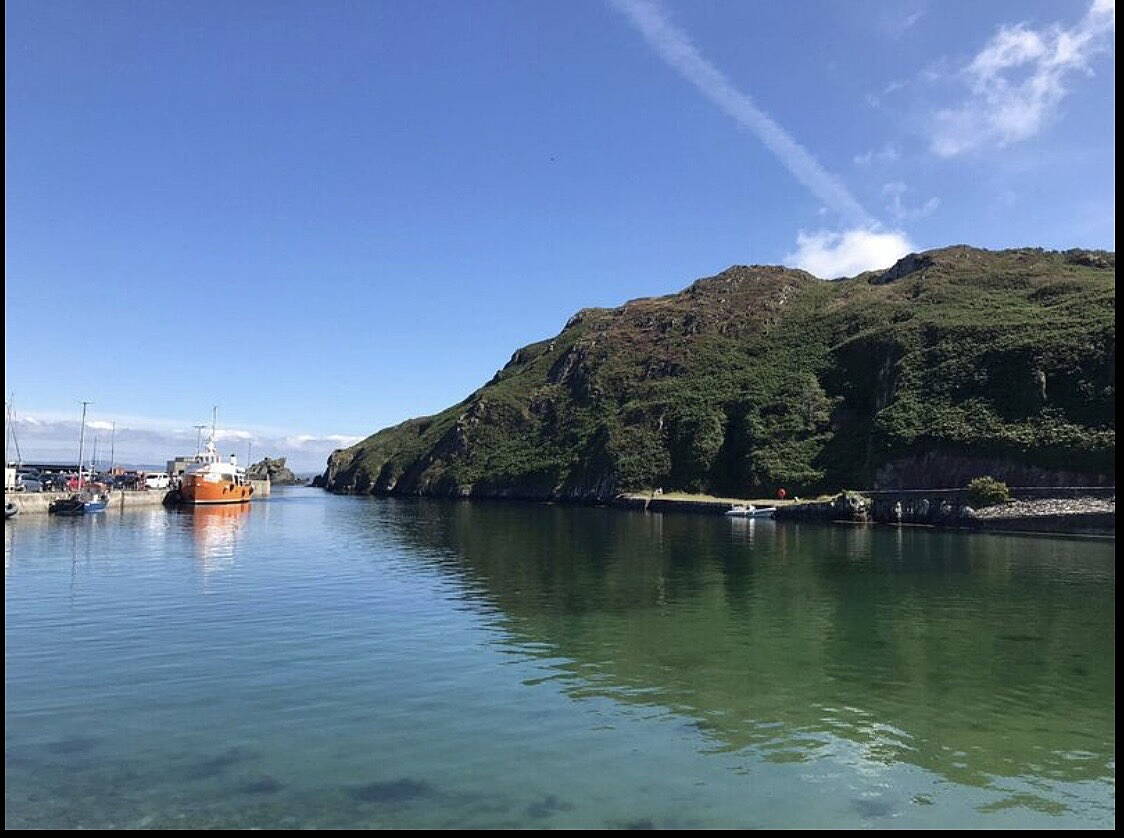
‘I wanted to include a detailed piece about the harbour. People often wonder why it’s so big considering the population is only 110 people now. This harks back to the 1880’s when the fishing industry was strong.
‘Now there is only one lobster boat and only fishing in the summer. It’s all that remains of the strong fishing tradition which was once part of island life. There was a time when there were over 40 boats fishing out of the island.
 Screenshot
‘The boom went from early 1880s to mid 1920s. There was so much employment - the bigger boats had crews of eight, there were smaller boats as well, and even the women and children were employed curing the fish and putting them into barrels for export.’
Diarmuid has witnessed many changes to Cape Clear over the years including loss, and recalls Steve Wing, wildlife officer at the birdwatcher’s observatory, a cherished resident.
‘Cape Clear is a real place where real people live and though the obvious attraction of Cape is the beauty of the landscape, but it’s a different place after the tourists leave when it goes very quiet in the winter.
‘Although I am a regular visitor to the island and have strong connections to the place, I am not a full- time resident. I think that the emphasis should be on improving resources for those who live there all year round.’
Blúirí Oileanda - Island Pieces can be purchased through capeclearbook.ie and all good bookshops.