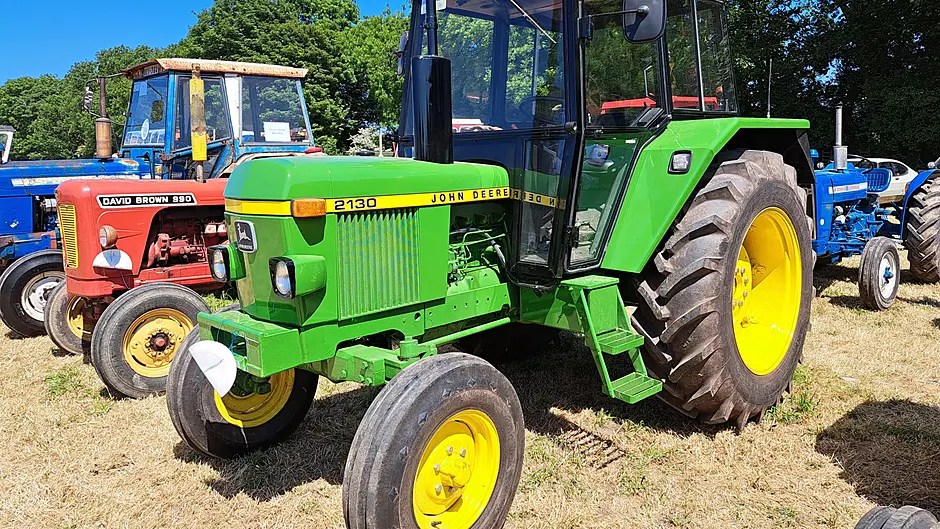

John Deere’s 30 series was launched on 1972, replacing the outgoing 20 series tractors.
The smaller models in the line-up were manufactured at the Mannheim factory in Germany, with their larger siblings manufactured in Waterloo, Iowa, USA, which is still the case today for most John Deere tractors.
ADVERTISEMENT
Initially, the tractors continued the ‘horse shoe’ type bonnet and nose styling of their predecessors, which was updated to a sleeker and rounded version in 1974.
The indicator mounted on the decal strip being an endearing characteristic of this new mid 70’s styling.
The 2130 was produced in Mannheim, and was the largest tractor in the four-cylinder lineup which also included the 2.9l 56hp 1630 and 3.6l 68hp 2030.
The 3.9l power unit of the 2130 produces 75hp. The tractor has hydraulic output of 47l/min with a lift capacity of 2.5tons.
The transmission provides 8F and 4R gears with the gear sticks located in the good old-fashioned between-the-legs position.
The gear box provides four gears, with the left stick selecting range one, two, and reverse as well as a park gear. Conveniently, range one is positioned below reverse allowing for a shuttle effect, more practical than the Ford equivalent.
This is then doubled thanks to an optional Hi-Lo on the move splitter which provides 16F/8R. Only a 540 speed PTO is available.
Tipping the scales at 3.2t, it is a nimble and lightweight tractor.
Initially, the 30 series were fitted with a Duncan cab, however the Sekkura built OPU cab was released in 1974.
A superior cab to the previous unit, the OPU-Operators Protection Unit-is a roomy and well laid out unit with great visibility. As well as the Hi-Lo splitter, the hand throttle and PTO lever are also located around the steering column.
Two hydraulic spool valves are positioned below the seat to the right which are a little bit of a stretch, but the slim console of the lift controls is mounted on the mudguard and is comfortably reachable.
The high roof is often fitted with a sun roof, while sliding side windows also provide ventilation.
Interestingly, the 2130 was also available in 4wd format, as John Deere took notice of growing trend of 4wd tractors.
However, the John Deere 30 series delivery of 4wd was different to its competitors.
Instead of taking a drive line from the gearbox to the front axle, John Deere employed a hydraulic four-wheel drive system, with a hydraulic motor in each hub of the front axle.
Contact Peter at psob1987@gmail.com or see Instagram @flashphotoscork