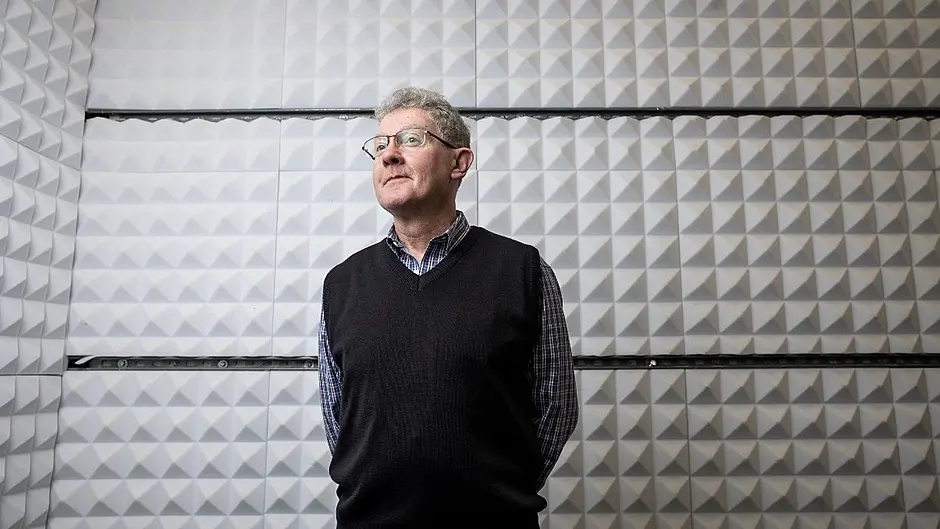
PROFESSOR Séamus Davis has been awarded the prestigious Michael Faraday Medal and Prize, which is one of the top awards in science.
Born in Skibbereen in 1961, he graduated from UCC with BSc in 1983 before completing his PhD at Berkeley in 1989.
He is Professor of Quantum Physics at UCC, and Professor of Physics at the University of Oxford in the UK, and was selected for the award by the Institute of Physics (IOP).
ADVERTISEMENT
The Michael Faraday Medal and Prize is awarded for exceptional achievements in experimental physics.
Throughout his career, Séamus has combined scientific insight with technological innovation, developing ground-breaking instruments and techniques that make it possible to visualise and interrogate quantum phenomena with unprecedented precision.
“We invented new instruments to visualise materials at a quantum level,” he explained to The Southern Star. “Before, we pictured in our minds what we believed quantum matter looked like, but we never knew for sure as we could never see it.
“Our instruments are like a superpower that have revolutionised how we see quantum matter and have discovered that a large number of our assumptions were not correct: that the quantum world is more complex than our models suggested.”
According to Séamus, a key component of Ireland’s quantum strategy for 2030 is that advances in artificial intelligence (AI) are assisting in new discoveries in quantum physics.
“We can use AI to explore our quantum imaging information. The amount of data we produce with our instruments is huge, going over all of it alone would be almost impossible.
“Imagine taking 10 million photographs of the night sky, and trying to identify all the stars you see in each image, that is the scale of the challenge we face,” he added.
“However, by uploading all this data for AI analysis we can confirm theories and make new discoveries. In the past three months alone, we have made two new discoveries, with AI speeding up the process and analysing in days the kind of large data sets that would take humans years to assess on their own.”
Séamus, who is a member of the National Advisory Forum for Quantum Technologies, said: “This work is a key piece in the larger jigsaw that is Ireland’s bid to be an international player in quantum physics. It is the new frontier in quantum physics.”
In 2023, he was awarded the prestigious American Physical Society’s Oliver E Buckley Prize in Condensed Matter Physics, an award won by 18 Nobel Prize winners.
Séamus has played a leading role in advancing our understanding of quantum matter, including superconductors, superfluids, supersolids and quantum spin liquids.
Séamus pioneered spectroscopic imaging scanning tunnelling microscopy, enabling researchers to map the electronic properties of quantum materials in remarkable detail. His innovations led to the discovery and visualisation of correlated electronic liquid crystal states, including exotic electronic phases found in both copper-based and iron-based superconductors.
Further landmark contributions include the development of quasiparticle interference imaging, now widely used internationally to study electronic quantum materials, and the invention of scanned Josephson tunnelling microscopy, which led to the discovery and visualisation of the first electronic supersolid, known as the pair density wave state.
More recently, Séamus developed scanned Andreev tunnelling microscopy, a powerful technique designed to investigate intrinsic topological superconductors.
The Michael Faraday prize will be presented at the IOP awards dinner in Glasgow on Tuesday November 3.